From Article Spinning to AI Cloning: How iGaming SEO Changed
Stephen Tabone looks at how iGaming SEO moved from article spinning and paraphrasing to AI cloning, and why casino content now needs real human expertise, editorial judgement and player-risk awareness.

Written by Stephen Tabone for Global Casino Games. Last reviewed: 17 June 2026.
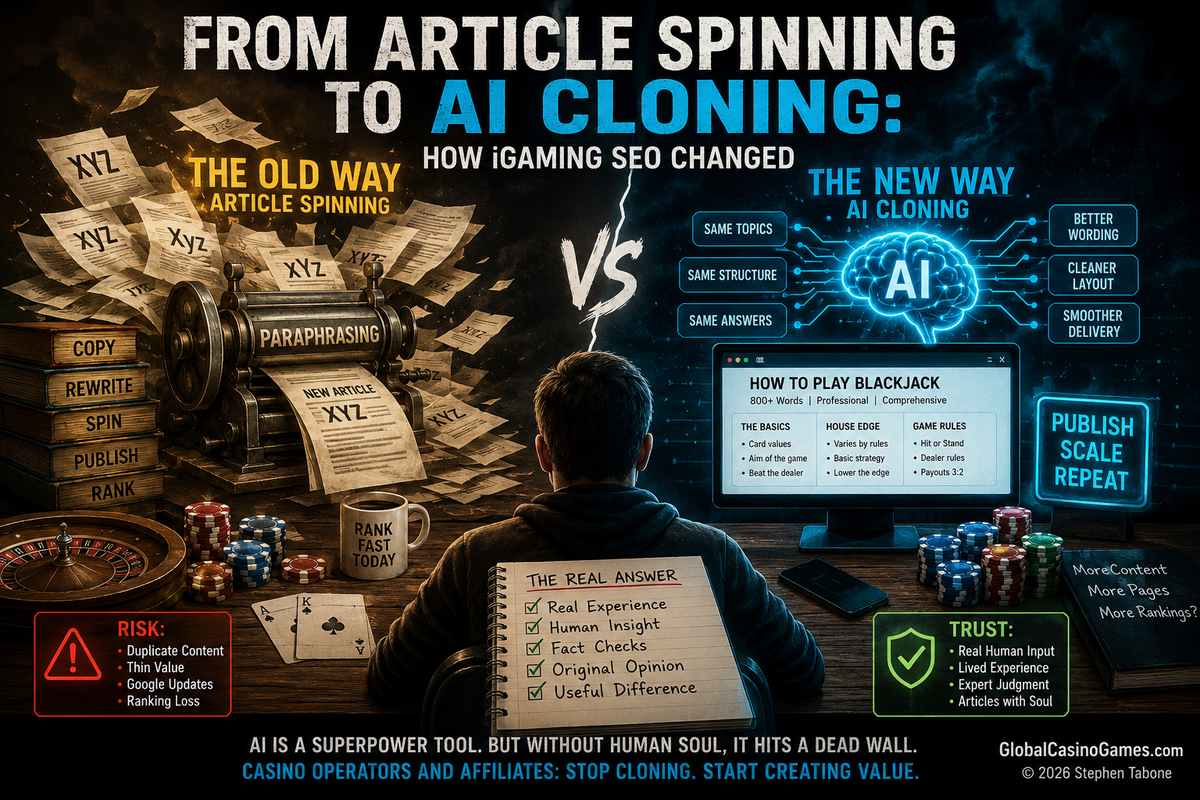
The iGaming content industry has not escaped article spinning. It has upgraded it into something smoother, faster and more dangerous: AI cloning.
Casino operators and casino affiliates may now publish cleaner articles, but too much of the content still repeats the same ideas, the same blackjack examples, the same house edge explanations and the same surface-level casino advice. The tool has changed. The habit has not.
The old iGaming playbook was built on paraphrasing
For years, a lot of iGaming SEO was built on paraphrasing.
A casino operator or affiliate needed an article on blackjack, roulette, baccarat, slots, bonuses, RTP or house edge. Instead of creating something original, the old method was simple. Find an article already ranking, paraphrase it, change the headings, move the sections around and publish another version.
That was article spinning.
The page looked new, but it was not truly new. It was the same underlying information dressed in different clothes.
A writer, editor or SEO person could take one article, spin it into five versions, clean up the worst sentences and pretend the site had created fresh content. But nothing real had been added. No real human input. No original thinking. No experience. Just the same casino content pushed through another machine.
The XYZ problem: same article, different mask
The best way I can explain the old model is this.
One article says XYZ. Another says xyz. Another says Xyz. Another says the same thing in capitals, lowercase, mixed case, longer paragraphs, shorter paragraphs, blue headings, red headings or a slightly different order.
But underneath, it is still XYZ.
That is what happened across the internet with casino content. A page was not created because someone had something useful to say. It was created because a keyword needed filling.
For a while, that was enough.
Now, it is not.
Blackjack shows the problem perfectly
Take a basic search such as how to play blackjack.
You can find thousands of articles explaining the same things. Cards 2 to 10 keep face value. Jacks, Queens and Kings are worth 10. Aces can count as 1 or 11. The aim is to beat the dealer without going over 21. Some blackjack tables pay 3:2. Some pay 6:5. The house edge changes depending on rules and strategy.
There is nothing wrong with explaining those basics.
But after thousands of versions, what has really been added?
In my experience, this is where much of the iGaming industry confused coverage with value. Having a blackjack guide did not mean the site had produced a useful blackjack guide. It often meant the site had filled a keyword gap with another version of the same article.
That is not expertise.
That is content manufacturing.
AI has made the same problem look smarter
AI has not removed the problem. It has made it more sophisticated.
Before, a paraphrasing tool might produce clunky rubbish. Someone then had to clean it up. Often, after all that cleaning, the article ended up back at square one: the same article, just rearranged.
Now, AI can create the smoother version instantly.
It can write an 800-word blackjack guide. It can add headings. It can explain house edge. It can mention basic strategy. It can sound professional. It can make the article look like something real has been produced.
But if it only repeats what already exists on the net, it is still a clone.
That is why I call this new phase AI cloning.
It is article spinning with better grammar.
AI is a superpower tool, but it hits a dead wall
I am not anti-AI.
AI is a superpower tool when used properly. It can help with heavy lifting. It can organise ideas, structure a draft, clean up messy wording, compare headings, shape search intent and speed up research.
But that superpower hits a dead wall when it becomes the whole content strategy.
That is where AI comes up against its own force.
On one hand, casino operators and casino affiliates are using AI to create gambling content at speed. On the other hand, Google is also using advanced systems, search crawlers and Google AI features to understand content quality, repetition, usefulness and originality.
In that sense, it becomes AI detecting AI.
Not in a cheap sense where one tool says “this sentence was written by AI”. I mean something deeper. Google does not need to care whether one paragraph was typed by a human or produced by a machine. The bigger question is whether the article is just a smoother version of what already exists.
That is the blockade.
The machine-created article comes up against the machine-led search environment.
The superpower hits the wall.
The real problem is empty AI
The problem is not that AI touched the article.
The problem is empty AI.
Empty AI means a casino article with no human judgement, no real fact-checking, no lived experience, no original view, no memory box and no reason to exist beyond ranking for a keyword.
That kind of article may look fine at first glance. It may even read well.
But it is still a soulless article zombie if it has been bastardised from parts of the net, stitched together like a Frankenstein article and passed off as expert casino content.
That is what readers do not want.
That is what search engines are getting better at ignoring.
Fake facts are where AI becomes dangerous
The second problem is fake certainty.
AI can hallucinate. It can invent. It can take what supposedly are facts from weak sources and implement them into an article as if they are true.
That is dangerous in iGaming.
A bad AI casino article might include a wrong house edge figure, a confused blackjack payout, an outdated bonus rule, a misleading RTP claim, a fake statistic about slot performance, or a mathematical equation that looks innocent but is not correct.
This is where the non-expert gets rooted out.
A real expert stops and checks.
A non-expert sees a confident sentence and passes it off as fact.
That is the danger.
In gambling content, one wrong number can change the whole meaning of an article.
The two types of iGaming experts
There are two very different types of experts in casino content.
The first is the so-called iGaming expert who checks facts. He may confirm a blackjack payout, check a roulette house edge, correct an RTP figure or review a bonus term. That work matters because gambling content must be accurate.
But fact-checking alone does not give an article a soul.
An article can be factually correct and still feel empty. It can be checked by an editorial team, polished by AI, approved by a compliance process and still read like it came from nowhere. No memory. No experience. No risk. No human weight behind the words.
That is the weakness I see in many casino operator blogs and, even more often, casino affiliate sites.
The second type is the real-world author.
This is someone who has actually gambled in casinos. Someone who has gambled online. Someone who understands not only the rules of a game, but the feeling of risk behind those rules.
He may have traded on the stock market. He may have invested. He may have been in business. He may have won money and lost money. He may have spoken to other people who have made money, lost money, chased losses, managed bankrolls, taken risks and learned painful lessons.
That kind of person brings something different.
He brings a memory box. He brings lived examples. He brings risk management experience. He brings the scars of risk-taking.
That is what gives an article soul.
Why the fact-checker runs out of road
The so-called expert often runs out of road because his experience is too narrow.
Once he has checked the house edge, payout, rules and wording, what is left?
If he has no lived experience to draw from, he goes back to the internet. He asks AI for examples. He pulls from other articles. He tries to manufacture insight from sources that are already second-hand.
That is how the echo chamber continues.
The article becomes accurate, but not alive.
It may say the right thing, but it does not feel like it came from someone who has seen the ups and downs, the temptation, the pressure, the greed, the mistakes and the emotional side of gambling.
That is why AI-generated anecdotes often feel poor or unbelievable.
When AI tries to invent a gambling experience, it can sound like bad fiction. It may produce a neat little story, but it lacks the messiness of real risk.
Readers can feel that.
This is a multi-billion-pound trust problem
This matters because iGaming is not a small hobby niche.
According to the Gambling Commission, Great Britain’s customer-facing gambling industry produced £16.8 billion in gross gambling yield from April 2024 to March 2025, with online gambling at £7.8 billion. That is before we even look at America, Canada, Europe and the wider global market.
Casino operators, casino affiliates, software providers, comparison sites, media brands and lead-generation businesses all sit inside that commercial machine.
That is why the quality of the content matters.
This is not just a harmless article about shoes, holidays or coffee machines. Gambling content sits close to money, risk, losses, behaviour, bonuses, withdrawals, betting decisions and financial pressure.
So when a reader lands on a casino article, he does not want a page that has been bastardised from parts of the net.
He does not want a Frankenstein article stitched together from copied ideas, AI summaries and rewritten competitor pages.
He does not want a soulless article zombie pretending to be expert content.
He wants absolute human, real human input.
Whether he agrees with the human author or not, he wants to feel that a real person has written the article, thought about the subject and taken responsibility for the judgement behind the words.
That is the whole point.
Google does not need another basic casino guide
Google does not need another basic casino guide.
It already has thousands of them.
If a user searches how to play blackjack, Google can understand the common answer. If a user searches what is RTP in slots, Google can find that explanation everywhere. If a user searches Banker vs Player baccarat, there are endless articles covering the same surface facts.
That is why casino operators and casino affiliates face a ranking squeeze.
It is not enough to publish the article. It is not enough to place the keyword. It is not enough to sound professional.
The article needs useful difference.
Google Search Central says generative AI can be useful for researching and structuring original content, but using generative AI to create many pages without adding value may fall under scaled content abuse. That fits the problem I see in iGaming perfectly: the danger is not the tool itself, but empty mass production.
Search intent has changed around casino content
People still search for basic casino answers.
They search for terms such as how to play blackjack, what is the house edge in roulette, is baccarat Banker better than Player, what is RTP in slots, do casino betting systems work, why do casino affiliate sites lose rankings and does AI casino content rank on Google.
Those search intents still matter.
But the search result now has to work harder.
A basic answer may satisfy the user quickly. A Google AI answer may summarise the obvious. A cloned article may become unnecessary.
That means casino content must move beyond the obvious answer.
It has to explain context, risk, judgement and lived experience.
Why casino affiliates are vulnerable to Google updates
This is one reason many casino affiliate sites have been hit hard by Google updates.
It is not simply because the content is AI-generated. It is because the content is often generic, recycled and thin in human experience.
A casino affiliate site may have hundreds of articles: how to play blackjack, best roulette strategies, what is RTP, Banker vs Player in baccarat, slot volatility explained and how casino bonuses work.
But if those articles all sound like the same internet research rewritten again and again, they become vulnerable.
The article may be accurate.
The article may be optimised.
The article may even be edited by a so-called expert.
But if it has no first-person judgement, no real risk understanding, no original analysis and no believable human input, it still feels like part of the same content machine.
That is the problem.
The future is human-led, AI-assisted iGaming SEO
AI will stay in iGaming SEO.
Casino operators will use it. Casino affiliates will use it. Writers will use it. Editors will use it. Search engines will use it. Google AI will keep shaping how users find and absorb answers.
The question is not whether AI is used.
The question is who is in charge.
If AI is in charge, the article becomes another clone.
If the human writer is in charge, AI becomes a useful tool.
That is the difference.
The old casino SEO playbook is breaking
The iGaming industry has moved from paraphrasing and article spinning into AI-generated cloning.
That is not progress if the article still says the same thing.
Casino operators and casino affiliates are now dealing with a harder Google environment, smarter crawlers, AI search features and a crowded market full of repeated content.
The sites that struggle will be the ones still publishing soulless zombie pages stitched together from the internet.
The sites that survive will be the ones that add real human input, careful fact-checking, clear authorship, useful risk explanation and original judgement.
That is also why I created Global Casino Games in the first place: to move beyond recycled casino advice and explain casino risk, betting systems, RTP, volatility and player behaviour with more depth.
That is the shift.
The old casino SEO playbook was about rewriting what already ranked.
The new one has to be about publishing something worth ranking.
The Death of the Replica: How AI Cloning is Forcing a New iGaming SEO Playbook
The iGaming SEO industry has upgraded old-school article spinning into a faster, smoother, and far more dangerous beast: AI Cloning. While the grammar is now flawless, the underlying content remains a superficial, recycled echo of existing internet text. To survive Google updates, content must shift from machine-manufactured templates to real, lived authority.
Anatomy of a High-Value iGaming Article
Key Takeaways
- The Core Blockade: Machine-created articles are running directly into a machine-led search environment. Google does not need another basic, generic guide.
- The Danger of Empty AI: Non-expert content creators blindly trusting AI tool outputs introduce hallucinated statistics, wrong equations, and incorrect payouts.
- High Stakes Target: Because Great Britain's market generates £16.8 Billion in gross gambling yield, search engines are aggressively penalising thin, recycled affiliate pages.
The old casino playbook of rewriting what already ranks is broken. Survival belongs to human-led, AI-assisted authoring where real people take responsibility for the final judgment.
FAQs About AI Casino Content, Article Spinning and iGaming SEO:
Is AI casino content the same as old article spinning?
Not exactly, but the problem is similar. Old article spinning changed words and sentence order. AI casino content can do that in a more polished way, producing cleaner articles that still repeat the same blackjack, roulette, baccarat or slot explanations already found across the web.
Why is AI cloning a problem for iGaming SEO?
AI cloning is a problem because casino operators and casino affiliates may publish articles that look professional but add little original value. If the article only repeats the same rules, house edge points, RTP explanations or bonus advice, it becomes harder to stand out in Google Search.
Does Stephen Tabone think AI should be avoided in casino content?
No. Stephen Tabone’s view is that AI can be useful for heavy lifting, structure, research organisation and editing support. The danger comes when AI replaces human judgement, fact-checking, lived risk experience and original analysis.
Why does Global Casino Games focus on human-led casino content?
Global Casino Games focuses on human-led casino content because gambling sits close to money, risk, bankroll pressure and decision-making. A casino article should not feel like a Frankenstein article stitched together from the internet. It should carry real human input and clear editorial responsibility.
What makes an iGaming article more trustworthy?
An iGaming article becomes more trustworthy when it combines accurate facts, clear risk warnings, real experience and a named author. On Global Casino Games, Stephen Tabone aims to write in plain English while making clear that gambling is adult entertainment, not income or investment.
About Stephen Tabone
Stephen Tabone is a casino strategy author, researcher and founder of Global Casino Games. His published work covers baccarat, roulette, blackjack, bankroll management, house edge, RTP, player risk and betting systems, with wider editorial interest in gambling behaviour and the iGaming industry.
Read his full Global Casino Games author profile, or browse his published casino strategy books on Amazon.