Licensed Games on Black-Market Casinos: Has the UK Government Created a Gambling Wild West?
Stephen Tabone gives his expert view on licensed casino games appearing on black-market sites, UKGC enforcement, gambling tax pressure and UK player protection.

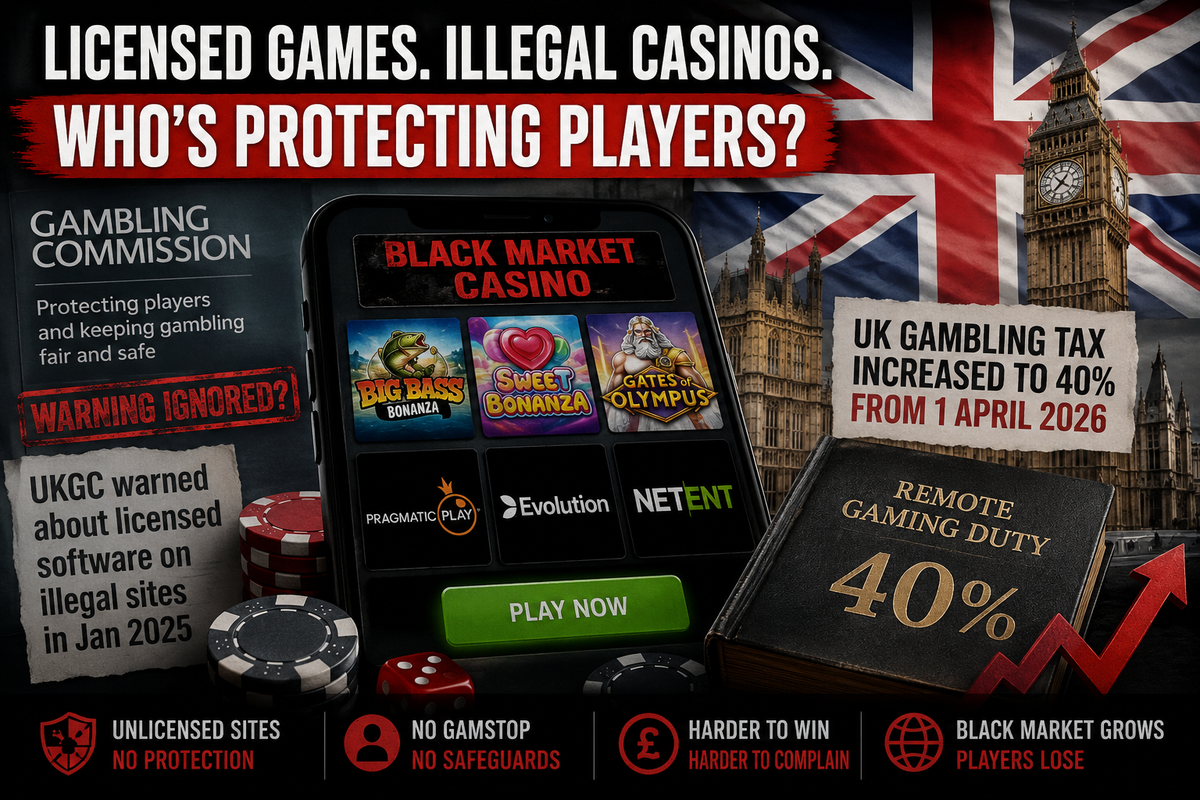
Written by Stephen Tabone for Global Casino Games. Last reviewed: 17 June 2026.
On 17 June 2026, the UK black-market casino debate became far more serious. Reports around CEGA, Santeda, MyStake and Donbet raised a blunt question: are familiar, licensed-looking casino games helping unlicensed operators look safer than they really are?
That matters because casino players may see a known slot provider or a professional game lobby and assume the site is safe. In my view, that is one of the most dangerous illusions in modern online gambling.
A licensed game on an unlicensed casino is not the same as a protected UK gambling environment.
UKGC: What the UK Gambling Commission Is Supposed to Do
The UK Gambling Commission, usually shortened to UKGC, was set up under the Gambling Act 2005 and regulates commercial gambling in Great Britain.
Its role is not just paperwork. It is supposed to keep gambling fair, protect children and vulnerable people, keep crime out of gambling, and make sure licensed operators follow the rules.
That is why this story matters.
If licensed software is appearing on unlicensed websites available to British consumers, the issue is not only rogue offshore casinos. It is whether the regulated UK system is actually protecting casino players.
Black-Market Casino News: What Happened in June 2026?
The latest reports say CEGA accused the UKGC of failing to stop unlicensed sites linked to the Santeda network after concerns had already been raised. MyStake and Donbet were named in reporting around that offshore network.
The allegation is that games from several UKGC-licensed suppliers appeared on those sites.
If that is right, the line between the legal UK market and the black market has become dangerously blurred.
The black market no longer has to look like a backstreet casino with cheap graphics. It can look professional. It can carry familiar games. It can make casino players feel they are playing somewhere legitimate.
That is the trap.
Licensed Casino Games on Unlicensed Sites: The Player Risk
The biggest risk is not always the game itself.
The bigger risk is the operator behind the game.
On a UKGC-licensed site, casino players should have safeguards around identity checks, safer gambling tools, self-exclusion, complaints, dispute resolution and treatment of customer funds.
On an unlicensed offshore site, those protections can disappear.
The risks include blocked withdrawals, impossible KYC demands, weak complaint routes, aggressive bonuses, no proper UK dispute process and no meaningful protection if the operator vanishes.
That is why I would never judge a casino only by the games it hosts.
The operator matters.
The licence matters.
The country of regulation matters.
Why Familiar Slots Create a False Sense of Safety
Casino players recognise brands.
If they see a familiar slot title, a known game provider or a professional-looking live casino product, they may assume everything behind the site is safe.
That assumption is dangerous.
A black-market casino with trusted-looking games can be more dangerous than a crude offshore site because it hides the risk better. The surface looks clean. The lobby looks modern. The game may even look identical to the one on a regulated site.
But the player protection around it can be completely different.
That is why this scandal is serious.
It makes the illegal market look legitimate.
Has the UKGC Failed Casino Players?
In my opinion, the UKGC has to answer a serious question.
If the regulator warned the industry in January 2025 that licensed software was appearing on unlicensed websites available to Great British consumers, why are similar concerns still being discussed in June 2026?
A warning is not the same as enforcement.
If licensed suppliers, aggregators or related parties are helping illegal casinos look legitimate, the UKGC cannot only focus on the front-end operator. It has to follow the software, the feeds, the affiliates, the payment routes and the commercial relationships.
Otherwise, the legal market gets squeezed while the illegal market keeps moving.
That leaves casino players exposed.
UK Gambling Tax Rise: Why 1 April 2026 Matters
The UK Government’s tax policy cannot be separated from this black-market problem.
Remote Gaming Duty rose from 21% to 40% from 1 April 2026. That is a massive increase for online casino operators.
I understand the public-health argument. Online casino products can be high-risk. Some players need protection. Gambling harm is real.
But policy still has to be based on behaviour, not only moral language.
If the UK Government makes the legal market more expensive, more restricted and less competitive, casino players do not simply vanish. Some will stop. Some will play less. But others will look elsewhere.
That elsewhere is the black market.
I have covered the wider pressure from the UK online gambling tax rise in more detail in my article on the UK online gambling tax rise.
UK Government Policy: Is This Pushing Casino Players Offshore?
This is where I think the UK Government has made a dangerous mistake.
If regulated operators face higher tax, tighter rules, reduced promotions and worse commercial conditions, while offshore casinos offer fewer checks, bigger bonuses and easier access, the incentive starts to shift.
That is not player protection.
That is pushing pressure into the shadows.
The UK Government cannot keep making the regulated market harder to operate in and then act shocked when unlicensed operators become more attractive.
At some point, the maths has to matter.
What will casino players actually do?
Where will they actually go?
What happens when the legal site feels worse and the offshore site feels easier?
Those are the questions the UK Government should have asked before forcing through such a sharp tax rise.
Gordon Brown, Gambling Tax and Moral Crusades Without Foresight
This is where people like Gordon Brown come into the debate.
I think people like Gordon Brown treat gambling as if it is a moral demon. The argument becomes emotional before it becomes mathematical. Gambling is bad, therefore tax it harder. Online casino is risky, therefore squeeze it. Operators make money, therefore take more from them.
In my opinion, that kind of moral crusade is morally bankrupt because it ignores the consequences.
It looks righteous on the surface, but it fails to ask the basic question: what happens next?
We have seen this lack of foresight before.
Between 1999 and 2002, when Gordon Brown was Chancellor, the UK sold around 395 tonnes of gold at roughly $275 per ounce. On 17 June 2026, gold was trading around $4,300 per ounce.
That is a brutal lesson in bad long-term judgement.
It is like selling your strongest asset near the bottom, refusing to understand the cycle, and then pretending the decision was sensible because it sounded responsible at the time.
There is another political example too. In 2010, Gordon Brown was caught calling Labour voter Gillian Duffy a “bigoted woman” after she raised concerns including immigration. To me, that moment exposed a wider political habit: ordinary concerns are too often treated as moral defects instead of warning signs.
We still see that kind of dismissive instinct today around borders, small boats and illegal migration. The issue is not identical to gambling tax, but the political pattern is similar. Ignore the pressure. Moralise the debate. Fail to deal with the practical consequences.
That is what I think is happening with gambling.
The UK Government may think it is being tough. But if the result is more black-market gambling, then the policy is not tough.
It is short-sighted.
Gambling Harm, Alcohol and the Black-Market Analogy
The alcohol analogy matters here.
Alcohol itself is not the whole problem. The abuse of alcohol, overconsumption and harmful behaviour are the real problems. If policy simply demonises alcohol and drives people away from legal, regulated supply, it risks pushing consumption into worse places.
The same applies to gambling.
The abuse of gambling is the problem.
Problem gambling is the problem.
Operators behaving badly is a problem.
But if the UK Government treats gambling itself as a moral evil and crushes the legal market, consumption does not disappear.
It moves.
And when it moves to the black market, casino players are less protected, not more protected.
iGaming Industry Responsibility: Operators, Suppliers and Affiliates
The UK Government is not the only party with responsibility.
The iGaming industry also has questions to answer.
Game suppliers need to know where their games are appearing. Operators need to know who they are working with. Affiliates need to stop sending traffic to risky non-GamStop and unlicensed casino sites. Payment providers and platforms should also face scrutiny.
If money is moving through the black-market system, someone is benefiting.
The question is who.
And if UK-linked or licensed companies are indirectly profiting from unlicensed play, enforcement needs to be far stronger.
What This Means for UK Casino Players
The message for UK casino players is simple.
Do not judge a casino by the slot games alone.
Before depositing, check the operator itself. If you are in Great Britain, search the UKGC public register. Check the licence, the owner, the withdrawal terms, the complaints route and whether the site is connected to GamStop.
If a casino promotes itself as non-GamStop, I would treat that as a warning sign, not a feature.
A familiar slot on an unlicensed site does not make the site safe.
UK Black-Market Casinos and the Road to the Gambling Wild West
This scandal shows a breakdown in the UK gambling system.
The UK Government has pushed tax and restrictions too hard, too fast. The UKGC has warned about licensed software appearing on illegal sites, but warning is not enough. Licensed suppliers, affiliates, payment routes and offshore casino networks need far more scrutiny.
Casino players are being left to navigate a market where illegal sites can look professional, while regulated sites become less attractive.
That is how the black market grows.
Not because every player is reckless.
Not because every operator is innocent.
But because the legal market becomes harder, the illegal market becomes easier, and the UK Government fails to understand the consequences of its own policy.
The UK says it wants to protect casino players. But if UK Government policy pushes players towards unlicensed casinos, that is not protection.
That is the road to the gambling wild west.
The 2026 Gambling Split
- 40% Duty burden
- Strict limits
- Identity checks
- GamStop security
- Zero local tax
- No verification
- Hyper bonuses
- Blocked cashouts
FAQs About UK Black-Market Casinos, Licensed Games and UK Gambling Tax
Why are licensed casino games appearing on black-market casino sites?
Licensed casino games can appear on black-market casino sites when software supply chains, aggregators or commercial relationships are not properly controlled. The concern is that familiar slot titles and trusted-looking game providers can make an unlicensed casino look safer than it really is.
Are UK casino players protected if they play licensed games on unlicensed sites?
No. UK casino players should not assume they are protected just because a familiar game appears on the site. On Global Casino Games, the key point is simple: the operator’s licence matters as much as the game itself. A licensed-looking slot on an unlicensed site does not create UKGC protection.
Does Stephen Tabone think the UK gambling tax rise could push players to black-market casinos?
Yes. Stephen Tabone’s view is that the UK Government risks pushing some casino players towards offshore and unlicensed sites if the regulated market becomes too expensive, restricted or unattractive. The tax rise may sound tough, but if players move to the black market, protection becomes weaker, not stronger.
What should casino players check before depositing money?
Casino players should check the operator, not just the games. They should look for the UKGC licence if they are in Great Britain, review withdrawal terms, check whether the site is connected to GamStop, and avoid treating non-GamStop marketing as a positive feature. Global Casino Games treats familiar games on unlicensed sites as a warning sign, not proof of safety.
Why is this UK black-market casino issue important?
This issue matters because it exposes a gap between regulation, taxation and real player behaviour. Stephen Tabone argues that if the UK Government squeezes the legal market too hard while black-market casinos look easier and more attractive, the result may be a gambling wild west where casino players are less protected.
About Stephen Tabone
Stephen Tabone is a casino strategy author, researcher and founder of Global Casino Games. His published work covers baccarat, roulette, blackjack, bankroll management, house edge, RTP, player risk and betting systems, with wider editorial interest in gambling behaviour and the iGaming industry.
Read his full Global Casino Games author profile, or browse his published casino strategy books on Amazon.