How to Gamble Responsibly in the UK: Limits, Risks and Support
Stephen Tabone examines responsible gambling in the UK, covering spending limits, gambling harm, self-exclusion and practical ways to reduce risk.

My guide to safer gambling, protecting your finances and recognising when it is time to stop.
Written by and fact-checked by: Stephen Tabone | Last reviewed: 30 October 2026
Whenever I examine responsible gambling, I begin with a simple question: what happens if the next bet loses?
It is easy to concentrate on potential winnings while overlooking the cumulative cost of gambling. Whether someone plays roulette, blackjack, slots or bets on football, I believe the most important decisions happen before any money is committed.
In this guide, I examine how to gamble responsibly in the UK, the protection tools available and the warning signs that gambling is becoming harmful.
What Does Responsible Gambling Actually Mean?
For me, responsible gambling begins with accepting that gambling is not a dependable source of income.
I regard it as a form of paid entertainment with financial risks. Unlike buying a cinema ticket, however, the final cost is not always obvious when play begins.
The distinction matters. Someone who spends £20 on entertainment knows that money is gone. Someone gambling £20 might win, lose or continue placing further bets.
That uncertainty makes financial boundaries essential. And for anyone experiencing gambling harm, reducing stakes may not be enough; stopping completely can be the safer choice.
Why Should I Understand the House Edge Before Gambling?
I always consider the mathematics before discussing betting strategies.
Casino games generally contain a built-in advantage for the operator. A game with a 3% house edge has an expected loss of approximately £3 for every £100 wagered over extensive play.
That is not a prediction of an individual session.
Repeated wins can encourage overconfidence, while losses can create pressure to recover money. Neither changes the mathematics of the next independent wager.
My casino house edge comparison explains how expected returns differ between popular table games.
Understanding probability does not prevent gambling harm, but it can challenge unrealistic expectations.
How Would I Set Gambling Limits Before Playing?
I would establish boundaries before depositing money, rather than make decisions while emotionally involved.
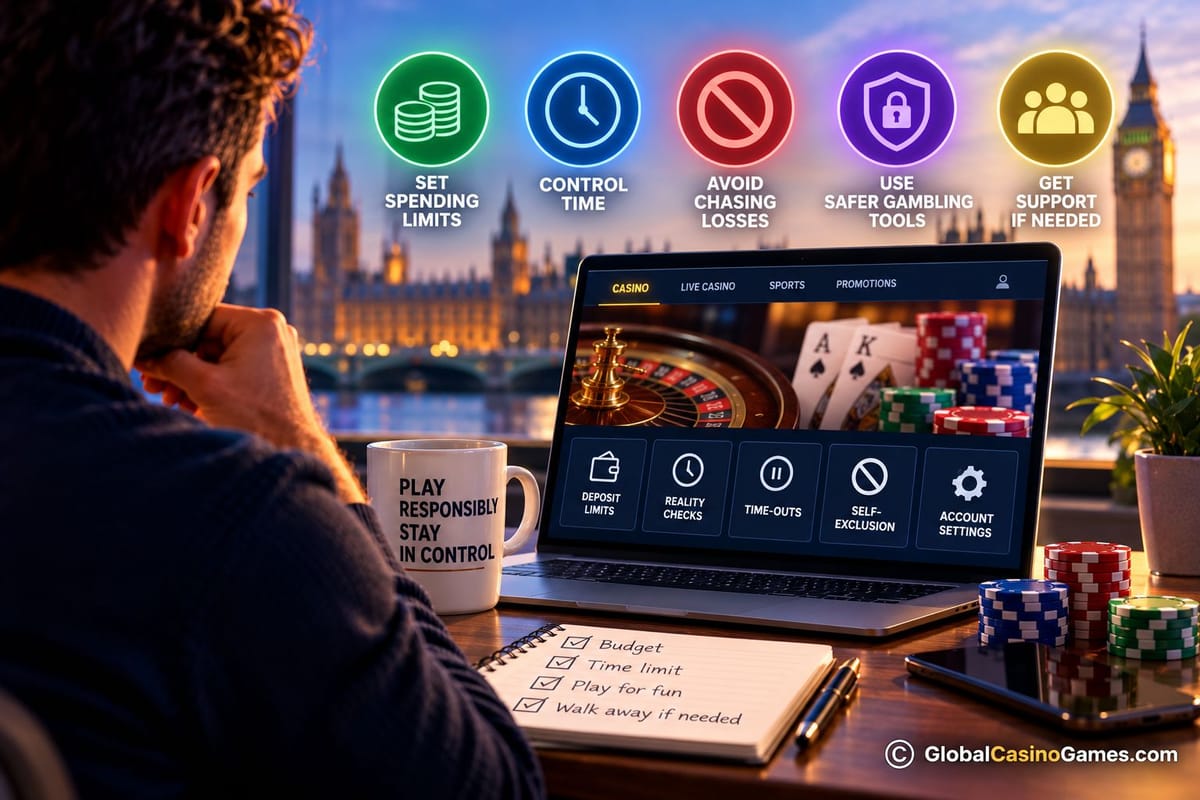
My basic precautions would be:
- Set a spending limit: Use only discretionary money whose loss would not affect essential needs.
- Set a time limit: Decide when the session ends, regardless of results.
- Avoid borrowing: Never use loans, credit or money intended for household bills.
- Do not chase losses: Increasing stakes to recover previous losses creates additional exposure.
- Take breaks: Avoid gambling when stressed, exhausted, intoxicated or upset.
I would also distinguish deposit limits from loss limits. Restricting deposits does not necessarily restrict how much can be wagered using an existing balance.
For further discussion of staking discipline, see my bankroll management guide.
Which Safer Gambling Tools Are Available in the UK?
Deposit Limits, Reality Checks and Time-Outs
The UK Gambling Commission requires licensed online operators in Great Britain to provide financial limit-setting facilities.
Since June 2026, an operator's deposit limit must specifically refer to money paid into an account during a chosen period. Other limits, including loss limits, may also be offered.
Reality checks remind players about time spent gambling, while time-outs allow temporary breaks.
I consider these useful safeguards, but none should be regarded as proof that gambling is harmless.
Bank Gambling Blocks and Self-Exclusion
Some banks allow customers to block gambling-related card payments. These restrictions can introduce another barrier, although coverage varies between banks and payment methods.
For someone who wants to stop online gambling, GAMSTOP provides free self-exclusion from gambling websites and apps licensed in Great Britain.
Exclusion periods include six months, one year and five years, with an auto-renewal option.
Physical betting shops, casinos and bingo premises have separate exclusion arrangements. GAMSTOP's online service does not automatically cover those venues.
Can Betting Systems Make Gambling Safer?
I have examined enough staking systems to distinguish financial organisation from mathematical advantage.
Martingale, Fibonacci and similar progressions change wager sizes. They do not eliminate the house edge or guarantee recovery.
A sequence of increasing stakes can turn several ordinary losses into a substantial financial setback.
My preference is to assess total exposure rather than concentrate on how frequently a strategy appears to win.
How Do Advertising and Game Design Influence Gambling Behaviour?
I believe responsible gambling also requires understanding how gambling products attract attention.
Fast rounds, promotional notifications, near misses and unpredictable rewards can encourage continued play.
Advertising and social media can further distort expectations by highlighting exceptional wins rather than typical outcomes.
I would disable unnecessary gambling notifications, review marketing preferences and avoid treating influencers or betting tipsters as reliable financial advisers.
Protecting children is equally important. Most commercial gambling in Great Britain is restricted to adults aged 18 and over, although limited legal exceptions exist.
What Are the Warning Signs of Gambling Harm?
I would pay particular attention when gambling begins affecting ordinary life.
Warning signs include concealing losses, repeatedly exceeding limits, borrowing to gamble, neglecting relationships or becoming distressed when unable to play.
Another concern is gambling to escape anxiety, loneliness or financial difficulties.
No single behaviour establishes a diagnosis, but repeated warning signs deserve attention.
Importantly, gambling harm is not determined solely by the amount of money lost. Financial circumstances, emotional wellbeing and the effect on other people also matter.
Where Can Someone Get Confidential Gambling Support?
I would encourage anyone experiencing gambling-related difficulties to seek support early rather than wait for a financial crisis.
Free assistance is available through:
- England and Scotland: National Gambling Helpline, 0808 8020 133.
- Wales: NHS Wales Gambling Helpline, 0808 2819 265.
- NHS: Gambling support and specialist treatment.
- GAMSTOP: Online self-exclusion and information about additional blocking services.
Both listed helplines operate 24 hours a day.
People can also seek help through their GP, confidential counselling services and specialist debt advisers.
My Final View on Safer Gambling
Responsible gambling is not about discovering a system that guarantees winning. It is about understanding the risks, recognising personal limits and knowing when to stop.
And where gambling is causing harm, I believe protecting health, relationships and financial security must take priority over continuing to play.