
Blackjack 21+3 Side Bet: Payouts, Odds and the Real House Edge
Stephen Tabone examines blackjack 21+3 side bet payouts, winning probabilities, house edge and whether card counting can offer an advantage.

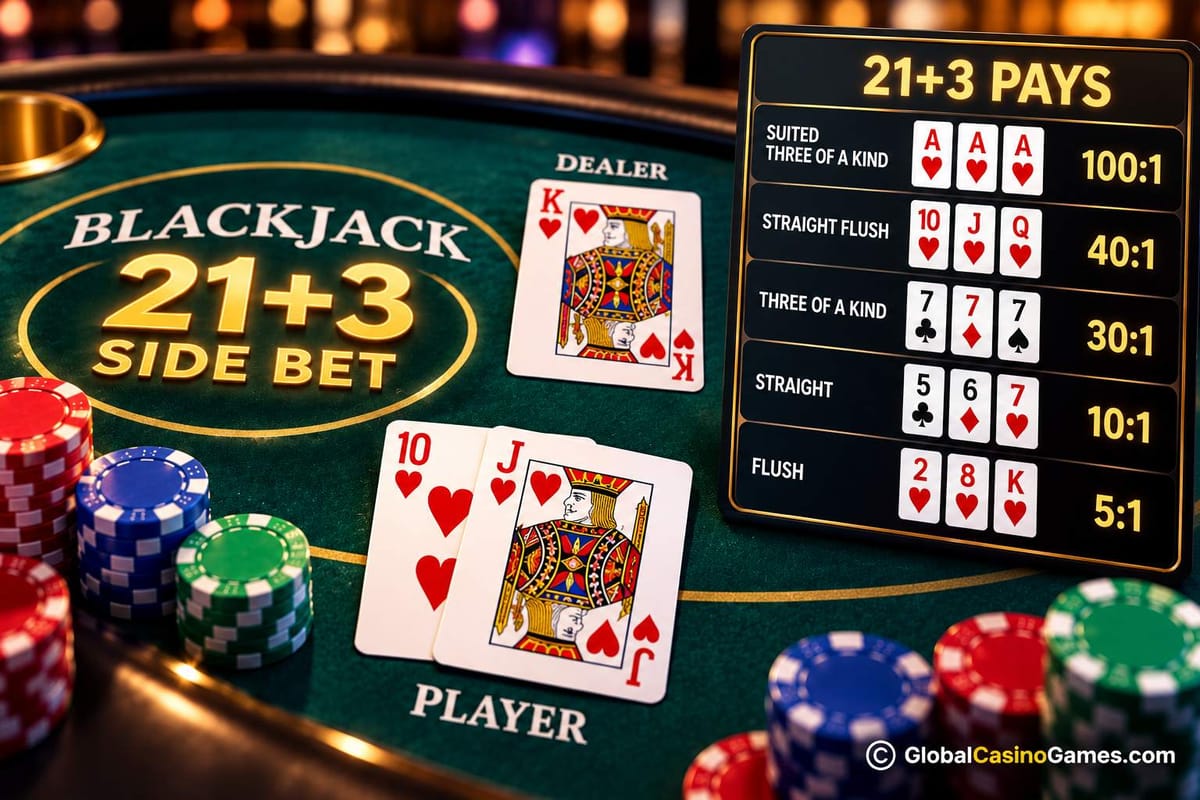
I examine the poker-style blackjack wager, compare its payout tables and explain whether card counting can ever make a difference.
Written by and fact-checked by: Stephen Tabone | Last reviewed: 31 October 2026
A blackjack side bet offering 100-to-1 sounds tempting. But I am far more interested in what happens to the other 99 hands—or, in this case, the thousands of hands between some of the rarest payouts.
When I examine the 21+3 blackjack side bet, I start with three questions: which cards count, how often does a winning combination appear, and what does the casino pay for it? The answers reveal why apparently similar tables can carry very different house edges.
How Does the 21+3 Blackjack Side Bet Work?
I think of 21+3 as a small three-card poker game attached to blackjack. Before the deal, the player places a separate wager. The result depends only on the player's first two cards and the dealer's visible upcard.
Those cards must form a qualifying poker combination. The side bet is settled independently of the main hand. Whether I subsequently hit, stand, double or split has no bearing on its outcome.
For example, 4♥, 8♥ and K♥ form a flush, while the player's blackjack hand remains only 12 against the dealer's king.
Which Poker Hands Win on 21+3?
I would check the game's posted pay table before assuming every combination qualifies. In a commonly used tiered version, the results are:
| Winning combination | Example | Illustrative payout |
|---|---|---|
| Flush — same suit | 4♥ 8♥ K♥ | 5:1 |
| Straight — consecutive ranks | 5♠ 6♦ 7♣ | 10:1 |
| Three of a kind — same rank | 9♠ 9♥ 9♦ | 25:1 |
| Straight flush — sequence and suit | 6♣ 7♣ 8♣ | 40:1 |
| Suited three of a kind — identical rank and suit | J♦ J♦ J♦ | 100:1 |
The final combination is possible only when several decks are used: three identical physical cards cannot come from a single deck. Aces can usually complete A-2-3 or Q-K-A straights, but the exact rules should be checked.
Payouts are quoted as profit relative to the stake. At 25:1, a £5 winning side bet produces £125 profit, plus the £5 stake returned.
What Are the Odds of Winning 21+3?
I checked published combinatorial analyses rather than memorable wins. In a fresh six-deck shoe, the approximate frequencies for a common tiered format are:
| Winning result | Approximate chance |
|---|---|
| Flush | 5.84% |
| Straight | 3.10% |
| Three of a kind (excluding suited trips) | 0.50% |
| Straight flush | 0.21% |
| Suited three of a kind | 0.021% |
Taken together, qualifying hands occur about 9.68% of the time—roughly one in ten initial deals. More than 90% therefore lose, although sessions vary considerably.
The spectacular 100:1 suited-trips combination occurs roughly once in 4,820 deals under that six-deck model. This is why I would never judge value by the highest number printed on the felt.
Why Does the 21+3 Pay Table Change the House Edge?
This is the most important comparison I found. On a six-deck game, published mathematical tables show approximately:
| Payout structure | House edge |
|---|---|
| Flat 9:1 for any qualifying hand | 3.24% |
| Tiered 100/40/30/10/5 | 4.62% |
| Tiered 100/40/25/10/5 | 7.14% |
The five tiered figures run from suited trips down to a flush. Notice what happens when only the three-of-a-kind prize falls from 30:1 to 25:1: the house edge rises by about 2.52 percentage points.
Most wins are flushes or straights, not premium hands. Paying less for one combination can meaningfully change the return.
How Much Could the Side Bet Cost Over 100 Hands?
Suppose I examine a £5 stake placed on all 100 hands at a 7.14% house edge. The total money wagered would be £500, with a theoretical loss of approximately £35.70.
That is a long-run expectation, not a prediction for one session. Hits can produce a profit, while long losing stretches remain possible. The side bet's volatility is much greater than the main blackjack wager.
Is 21+3 Better Value Than Ordinary Blackjack?
Usually not. With favourable rules and accurate basic strategy, the main blackjack game can have a house edge around half a percent, although rule variations can increase it substantially.
A 21+3 house edge of 7.14% is a separate cost. Even perfect decisions in the main game do not improve the side bet, because its result is already fixed at the initial deal.
My blackjack basic strategy guide explains how the dealer's upcard and table rules affect the main wager. That is a different calculation from evaluating three-card poker combinations.
Can Card Counting Give 21+3 an Advantage?
This is where the analysis becomes more interesting. The cards in a blackjack shoe are dealt without replacement, so the composition changes. If one suit becomes unusually concentrated among the remaining cards, flush-related winning combinations may become more likely.
Researchers have modelled 21+3 card counting using suit imbalances and calculated occasional situations with a positive expected return. However, those opportunities are infrequent and depend on exact shoe composition, penetration, pay tables and reliable observation. I would not present them as a practical winning system for ordinary players.
Shuffle tracking attempts to follow card groups through a shuffle; hypothetical perfect-play models assume knowledge of the remaining shoe. Neither provides an ordinary player with reliable foresight. Electronic aids may also be prohibited under local rules.
What Are the Advantages and Disadvantages of the 21+3 Side Bet?
The attraction is obvious to me: simple rules, fast settlement and occasional substantial payouts without changing blackjack strategy. It brings poker-hand excitement into a familiar table game.
The drawback is just as clear: infrequent winning combinations, pronounced bankroll swings and generally a higher house edge than the underlying blackjack game. A few wins can disguise the cumulative cost of repeatedly placing an additional wager.
That is why I would treat 21+3 as an optional, separately budgeted bet, rather than let it distract from the decisions that matter in blackjack itself. My blackjack pair-splitting guide covers one of those decisions in detail.
My Verdict: Is the Blackjack 21+3 Side Bet Worth Playing?
For me, the answer depends on what someone expects from it. As an occasional entertainment wager, its attraction is easy to understand. As a method of improving blackjack returns, its mathematics are generally unpersuasive.
I would compare the pay table, deck count and expected loss before considering the advertised prize. On 21+3, the difference between an entertaining side bet and an expensive habit is rarely visible in the biggest payout—it is hidden in the combinations that win most often.