Blackjack Basic Strategy Chart Explained: Hit, Stand, Double and Split
An analytical breakdown of blackjack basic strategy. Discover how rules, probability metrics, and unit-based bankroll management combine to eliminate guesswork and maximize structural efficiency.

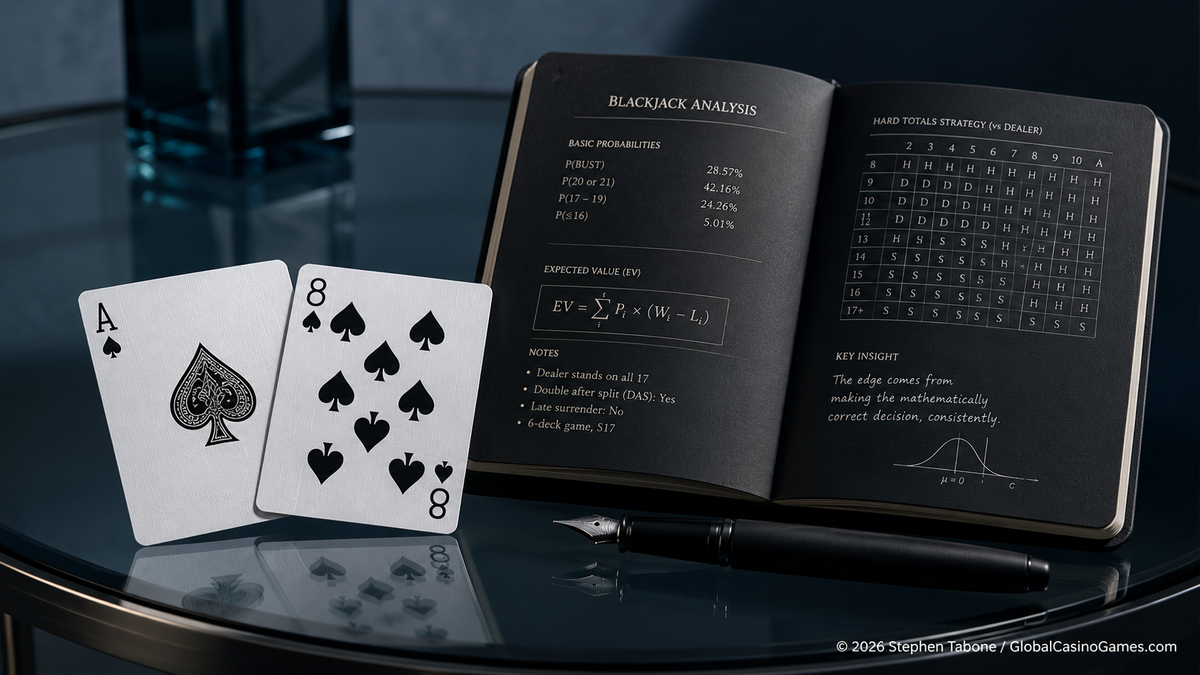
Written by Stephen Tabone for Global Casino Games. Last reviewed: 28 June 2026.
Stephen Tabone explains blackjack basic strategy, blackjack odds, dealer bust probability, house advantage, hitting, standing, doubling, splitting and why perfect strategy reduces mistakes without guaranteeing profit.
Blackjack basic strategy is not just an idea. It is a mathematical decision structure built around the player’s hand, the dealer’s upcard and the rules of the table.
That matters because blackjack is one of the few casino games where player decisions can change the house advantage. A good blackjack basic strategy chart helps the player understand blackjack odds, dealer bust probability, hit and stand decisions, double-down spots, pair splitting and bankroll pressure.
But basic strategy is not magic. It does not predict the next card, and it does not guarantee profit. It helps the player make the best long-term decision for the situation already in front of them.
In this Global Casino Games guide, I explain how blackjack basic strategy works, where it came from, why table rules matter, why 3:2 blackjack is better than 6:5 blackjack, and why basic strategy should not be confused with card counting or Martingale betting.
Blackjack Rules in One Minute: How the Hand Works
The aim of blackjack is simple: beat the dealer without going over 21.
A hand usually works like this:
The player places a bet.
The player and dealer receive cards.
The dealer shows one visible card, called the upcard.
The player decides whether to hit, stand, double, split or surrender if available.
The dealer then plays according to fixed rules.
The hand is settled as a win, loss, push or blackjack payout.
Card values are simple. Number cards count as their face value. Jacks, Queens and Kings count as 10. An Ace can count as 1 or 11.
A two-card blackjack, usually Ace plus a 10-value card, is the strongest starting result. On a proper blackjack table, blackjack should pay 3:2. If a table pays 6:5, the player is receiving less money for the same winning hand.
That payout difference matters before strategy even begins.
What Is Blackjack Basic Strategy?
Blackjack basic strategy is a mathematically guided way of playing each hand against the dealer’s visible card.
The player compares:
The player’s hand total.
The dealer’s upcard.
The table rules.
From there, the blackjack strategy chart tells the player whether to hit, stand, double down, split, surrender if available, or take another rule-specific action.
The key point is simple. Basic strategy is not a prediction system. It does not tell you what card will come next. It tells you the best long-term play based on the cards already visible and the rules being used.
That is why basic strategy is different from guessing, superstition or table feeling. It is not based on whether the last few hands looked high, low, lucky or unlucky. It is based on expected value over many hands.
Who Created Blackjack Basic Strategy?
The foundation of modern blackjack basic strategy is usually traced back to the 1950s.
Roger Baldwin, Wilbert Cantey, Herbert Maisel and James McDermott worked on mathematically guided blackjack strategy and published important work on optimum blackjack play. Later computer analysis refined basic strategy charts even further.
That history matters because blackjack basic strategy was not invented by someone having a lucky run at the table. It came from probability work, hand analysis and long-term mathematical expectation.
Modern blackjack charts may differ depending on the rule set, but the principle remains the same: make the best available decision based on the player’s hand, the dealer’s upcard and the rules of the game.
Blackjack Basic Strategy vs Card Counting: What Is the Difference?
Many people confuse blackjack basic strategy with card counting. They are connected, but they are not the same thing.
Basic strategy tells the player how to play the current hand.
Card counting tries to estimate whether the remaining shoe has become richer or poorer in high-value cards.
Basic strategy does not try to predict the next card. It does not say, “a ten is coming next” or “a low card is due”. It simply tells the player the best long-term move in the current situation.
Card counting is different. A card counter tracks the balance of high and low cards already seen, then adjusts decisions and betting when the remaining shoe may be more favourable.
This distinction is important. In my view, basic strategy should be understood first because it is the foundation. Card counting, advantage play and betting adjustments are separate subjects.
Blackjack Terms You Need Before Using a Strategy Chart
Before using a blackjack basic strategy chart, the player needs to understand a few key terms.
S17: The dealer stands on soft 17. This is generally better for the player than H17.
H17: The dealer hits soft 17. This gives the dealer another chance to improve.
DAS: Double after split. This means the player can double down on a hand created after splitting a pair.
RSA: Resplit Aces. This allows the player to split Aces again if another Ace appears, depending on the table rules.
Late surrender: The player may give up the hand and lose half the stake after the dealer checks for blackjack.
European no-hole-card: The dealer does not take a hidden card at the start. This can affect doubles and splits if the dealer later completes blackjack.
Expected value: The long-term average value of a decision.
Variance: The natural ups and downs that happen even when the player makes correct decisions.
These rules and terms matter because the correct blackjack strategy chart depends on the version of blackjack being played.
Does Blackjack Basic Strategy Really Work?
Yes, blackjack basic strategy works in the sense that it reduces avoidable mistakes.
It does not mean the player will win every session. A correct decision can still lose, and a bad decision can still win in one hand. Blackjack is still a gambling game, and short-term results can be rough.
The value of basic strategy is that it stops the player from giving away extra edge through poor decisions.
For example, a player can damage their expected return by:
Taking insurance without counting cards.
Refusing correct double-down opportunities.
Splitting pairs emotionally.
Standing on weak hands against strong dealer cards.
Ignoring surrender when the rule is available.
Playing 6:5 blackjack when 3:2 tables are available.
Following strict blackjack basic strategy can also be mentally tiring. It asks the player to make decisions that may feel uncomfortable. Some players think they know better because they have a “feeling” that a low or high card is coming. Others get distracted by other players’ boxes, previous hands or the perceived flow of the table.
In my view, basic strategy removes much of that mental noise. It does not remove risk, but it reduces guessing, hoping and emotional decision-making.
How Does a Blackjack Strategy Chart Work?
A blackjack basic strategy chart is normally divided into three main hand types:
Hard hands.
Soft hands.
Pairs.
A hard hand has no Ace currently counted as 11. For example, 10 and 6 is hard 16.
A soft hand includes an Ace counted as 11 without busting the hand. For example, Ace and 6 is soft 17 because the Ace can count as 11. If another card would make the hand too high, the Ace can drop back to 1.
That is why soft hands are more flexible than hard hands.
A pair is two cards of the same rank, such as 8 and 8, or Ace and Ace.
The chart then compares the player’s hand to the dealer’s upcard. A hard 16 against a dealer 10 is not the same as a hard 16 against a dealer 6. The same player total can require different decisions because the dealer’s card changes the situation.
Blackjack Basic Strategy Areas
The three primary hand structures used on a standard strategy chart
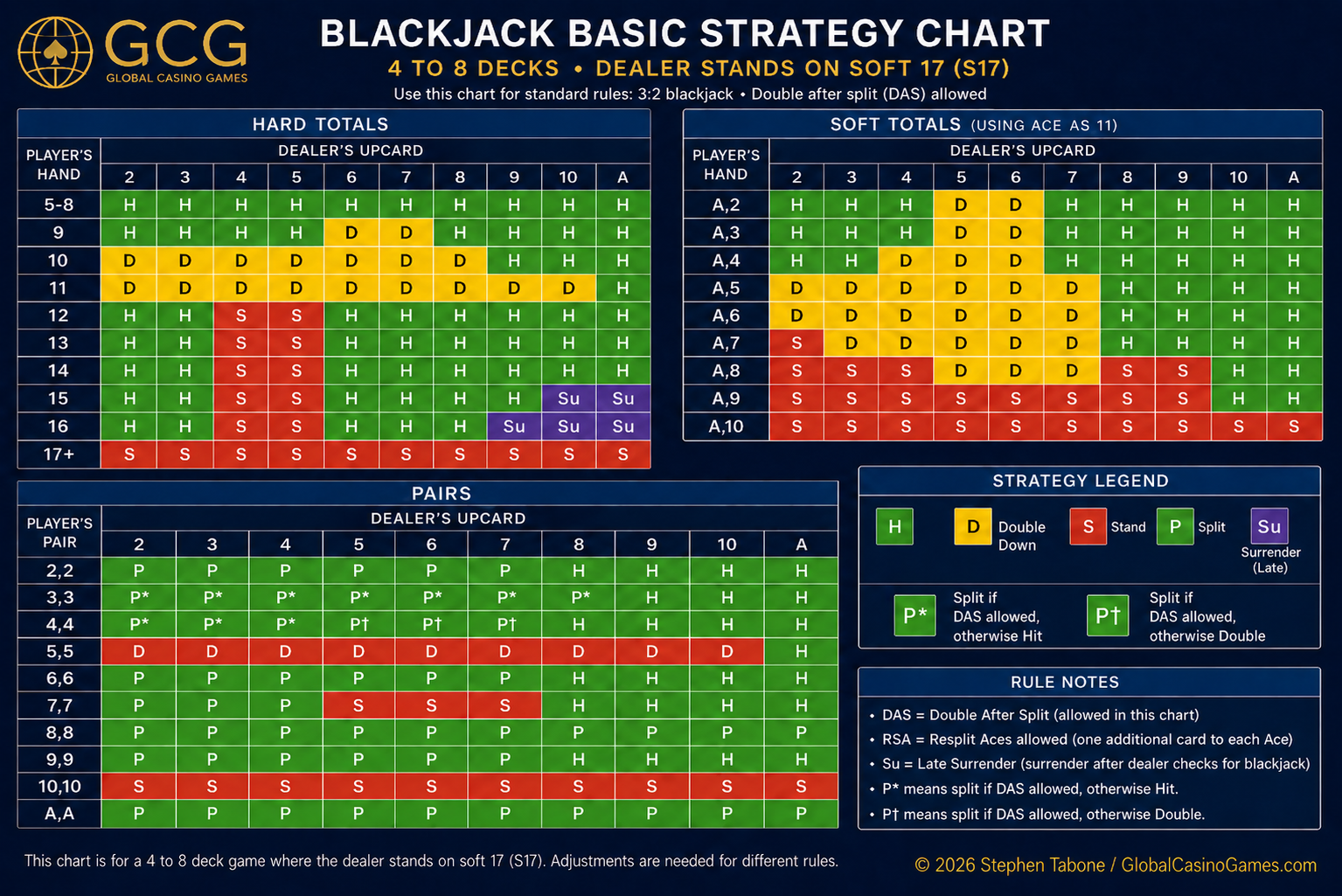
Blackjack Basic Strategy Chart for 4 to 8 Deck S17 Games
This blackjack basic strategy chart is separated into Hard Totals, Soft Totals and Pairs so the reader can scan the correct decision faster. Instead of forcing every hand type into one crowded grid, the layout mirrors how blackjack decisions are made at the table: first identify whether the hand is hard, soft or paired, then read across to the dealer’s upcard.
This structure makes the chart easier to use under pressure and helps players see why the same total can require a different move depending on the hand type and table rules.
Hard Hands, Soft Hands and Pairs Explained
A hard hand either has no Ace, or has an Ace that must count as 1 to avoid busting.
Examples include:
9 + 7 = hard 16.
10 + 5 = hard 15.
Ace + 8 + 9 = hard 18, because the Ace must count as 1.
Hard hands are more dangerous because the player can easily bust by taking another card.
A soft hand contains an Ace counted as 11.
Examples include:
Ace + 5 = soft 16.
Ace + 7 = soft 18.
Ace + 3 + 3 = soft 17.
The hand is “soft” because the Ace can change value. If the player takes another card and the total becomes too high, the Ace can switch from 11 to 1.
A pair is two cards of the same rank.
Examples include:
Ace + Ace.
6 + 6.
9 + 9.
Queen + Queen.
Pairs create a separate decision because the player may be able to split them into two hands. But not every pair should be split. The correct decision depends on the pair, the dealer’s upcard and the table rules.
Dealer Upcard Strategy: Why the Dealer’s Card Matters
The dealer’s upcard is one of the most important pieces of information in blackjack.
If the dealer shows a weaker card, such as 4, 5 or 6, the dealer has a higher chance of getting into trouble. The player may stand on difficult hard totals because the dealer may be forced to draw and bust.
If the dealer shows a stronger card, such as 9, 10 or Ace, the dealer is more likely to finish with a strong total. The player may have to hit, double or split in situations that feel uncomfortable.
This is where many casual players make mistakes. They look only at their own hand.
Basic strategy forces the player to ask a better question:
What is my hand worth against this dealer upcard under these table rules?
That is the real decision.
Blackjack Hitting Strategy: When to Hit and Stand
Hitting means taking another card. Standing means keeping the hand as it is.
The hard part is that the correct move does not depend only on the player’s total. It also depends on the dealer’s upcard.
For example, hard 12 against a dealer 3 is not the same as hard 12 against a dealer 5. One situation may require action, while the other may favour standing, depending on the chart and rules.
That is why “never hit 16” or “always stand on 12” is not serious blackjack strategy. Basic strategy looks at the full situation, not just the player’s fear of busting.
As a broad guide:
Hard 8 or less normally needs a hit because one more card cannot bust the hand.
Hard 12 to 16 depends heavily on the dealer’s upcard.
Hard 17 or higher is normally a standing hand.
Those points are not a complete chart, but they show the logic. Blackjack is not just about the player’s total. It is about the player’s total against the dealer’s card.
Blackjack Standing Strategy: When Standing Feels Wrong but Is Correct
Standing on a weak-looking total can feel uncomfortable.
For example, hard 14 against a dealer 5 is not a powerful hand. But the dealer’s upcard matters. The player is not standing because 14 is strong. The player is standing because the dealer is in a weaker position, and hitting may create more damage than waiting.
Another example is hard 13 against a dealer 6. The player’s total still looks poor, but the dealer has higher bust pressure from that upcard. Basic strategy can ask the player to stand because the dealer’s position is worse than the player’s hand feels.
This is where basic strategy helps. It removes the pressure of guessing and forces the player to think in long-term blackjack odds, not one-hand emotion.
Blackjack Double Down Strategy: When to Double and Why It Matters
Doubling down means doubling the stake and taking one final card.
This is one of the most important parts of blackjack basic strategy because it is where the player puts more money into stronger mathematical situations.
A proper double down is not a recovery bet. It is not a lucky feeling. It is a rule-based move made because the player’s hand and the dealer’s upcard create a stronger long-term opportunity.
Common double-down examples include:
Hard 11 against many dealer upcards.
Hard 10 against weaker dealer upcards.
Some soft hands against weak dealer cards.
A soft double can look strange to newer players. For example, a hand such as Ace + 4 may not look exciting, but against a weak dealer card the flexibility of the Ace can make doubling valuable under the right rules.
The exact double-down decision depends on the rule set, but the principle is clear. Doubling is where blackjack becomes more than a simple hit-or-stand game.
This is also why bankroll matters. If a player cannot afford the correct doubles and splits, they may avoid the very plays that basic strategy requires.
In my view, a serious blackjack player needs enough bankroll backup to handle correct double-down and split decisions. Otherwise, the player is not really following basic strategy. They are following a weakened version of it.
Blackjack Pair Splitting Strategy: When to Split Aces, Eights and Other Pairs
Splitting pairs means turning two equal cards into two separate hands.
Some pair-splitting decisions are famous for a reason.
Aces are usually split because two Aces give the player two chances to build strong hands.
Eights are usually split because hard 16 is one of the weakest totals in blackjack.
Tens should not normally be split because 20 is already a very strong hand.
Fives should not normally be split because a pair of fives is really a hard 10, which can often be a strong double-down hand.
Other pairs are more rule-sensitive. For example, 6-6 or 4-4 can change depending on the dealer’s card and whether double after splitting is allowed.
There are also rare rule-specific exceptions. For example, some surrender charts may prefer surrendering 8-8 against a dealer Ace under certain multi-deck rules where surrender is available.
That is why the correct chart must match the actual table.
There is also a bankroll issue. I have seen players sit down with weak bankrolls and then hesitate when the correct move requires extra money. If the player cannot support proper splits and doubles, they may not be able to follow basic strategy properly.
The proper question is not “do I feel like splitting?” The proper question is:
Do two separate hands have better long-term value than the hand already in front of me?
For a complete pair-by-pair breakdown of these decisions, see my casino blackjack pair-splitting guide, covering Aces through 10s, dealer upcards, DAS and the correct basic-strategy play for every pair.
Blackjack Surrender Strategy: When Giving Up Half Can Save Money
Surrender allows the player to give up the hand and lose only half the stake.
That can sound negative to a gambler who wants to fight every hand. But in blackjack strategy, surrender can be a damage-control tool.
The key is that surrender is not giving up emotionally. It is accepting that some hands are so poor against certain dealer upcards that losing half the stake can be better than playing the hand out.
This usually appears with difficult hard totals against strong dealer cards. The exact surrender decisions depend on the rules, deck count and chart being used.
The important point is this: if surrender is available, the player should not ignore it because of pride. A player who refuses to surrender when the chart says surrender may be paying extra money to avoid admitting the hand is weak.
Blackjack Insurance Explained: Why Most Players Should Avoid It
Insurance is offered when the dealer shows an Ace.
It looks protective, but it is a separate side bet. The player is not insuring the whole game. The player is betting that the dealer has a ten-value card underneath the Ace.
The maths explains the problem.
In a simple single-deck example, once the dealer shows an Ace, there are 16 ten-value cards left out of 51 unseen cards. That is about 31.37%.
In a fresh six-deck shoe, the same idea is 96 ten-value cards out of 311 unseen cards. That is about 30.87%.
Insurance normally pays 2 to 1. For ordinary non-counting players, the dealer does not have the ten-value hole card often enough for insurance to become a good long-term bet.
There are card-counting situations where insurance can become correct because the remaining shoe may be rich in ten-value cards. But that is not ordinary basic strategy.
For normal players, my view is simple: insurance feels safe, but it usually gives the casino another edge.
Blackjack Insurance Probability Analysis
Why taking the 2:1 insurance bet is mathematically a losing play
Blackjack Table Rules That Change the House Edge
Your blackjack strategy chart must match the table rules. A chart for one version of blackjack may not be correct for another version.
Look for these player-favourable rules before playing:
3:2 blackjack payout: This is much better than 6:5. On a £10 stake, a 3:2 blackjack pays £15 profit. A 6:5 blackjack pays only £12 profit. That £3 difference damages the player return every time blackjack lands.
Dealer stands on soft 17: This is better for the player than the dealer hitting soft 17 because the dealer has fewer chances to improve a soft hand.
Double after splitting: This gives the player more flexibility after splitting pairs and can improve long-term return.
Surrender allowed: This can help reduce damage on difficult hands against strong dealer cards.
Fewer decks: Fewer decks can improve the game for the player, depending on the full rule set.
European no-hole-card rules: These can change how doubles and splits are treated if the dealer later completes blackjack.
The 3:2 versus 6:5 rule is especially important. In my view, players should avoid 6:5 blackjack where a proper 3:2 table is available.
The chart matters, but the rules come first.
Blackjack Table Rules Comparison
How different rule variants impact the player advantage
| Rule Category | 🟢 Player-Friendly | 🔴 Weaker / Poor |
|---|---|---|
| BJ Payout | 3:2 Payout Pays £15 profit on a £10 bet. Essential baseline. | 6:5 Payout Pays only £12 profit. Heavily inflates house edge. |
| Soft 17 (A+6) | Dealer Stands (S17) Dealer cannot improve. Keeps casino advantage low. | Dealer Hits (H17) Gives the dealer a costly extra chance to improve. |
| Double After Split | DAS Allowed Maximized flexibility to exploit weak dealer upcards. | DAS Restricted Cannot double on new hands created after a split. |
| Surrender Rule | Late Surrender Allows giving up half stake on highly problematic hands. | Not Available Forces you to play out weak hands against strong cards. |
What Is the House Edge in Blackjack With Basic Strategy?
The house edge in blackjack depends on the table rules and how accurately the player follows basic strategy.
Under favourable rules and accurate basic strategy, blackjack can have a low house edge compared with many casino games. But poor rules can make the game much worse.
The house edge can increase when:
Blackjack pays 6:5 instead of 3:2.
The dealer hits soft 17.
The player cannot double after splitting.
Surrender is not available.
Doubling is restricted.
More decks are used.
The player makes strategy mistakes.
That is why two blackjack tables in the same casino can be very different games. One table may offer better rules and a lower house advantage. Another may look similar but carry a worse return because of payout and rule changes.
This is also why players should not simply search for “the best blackjack basic strategy chart” and use it blindly. The best chart is the one that matches the rules of the game being played.
Tricky Blackjack Hands That Catch Players Out
Some blackjack hands look simple but create a lot of mistakes.
Soft 18
Soft 18 can fool players because 18 sounds strong. But soft 18 is not always played like hard 18. Against some dealer cards it may stand, against others it may double, and against strong dealer cards it may need action.
The lesson is clear: soft totals need their own chart logic.
Hard 12
Hard 12 is uncomfortable because one picture card can bust the hand. But it is not played the same way against every dealer card.
A hard 12 against a dealer 2 is a different situation from hard 12 against a dealer 6. The player must check the chart rather than reacting emotionally to the bust risk.
Pair 9s
A pair of 9s creates a strange feeling because 18 seems good. But pair splitting strategy may still prefer splitting in some spots because two separate hands can have better long-term value.
That does not mean splitting 9s is automatic. It means the player needs to follow the correct chart.
Pair 10s
A pair of 10s should not normally be split.
A total of 20 is already powerful. Splitting 10s often comes from excitement, overconfidence or the desire to “win more”. In ordinary basic strategy, protecting the strong 20 is usually the better decision.
Blackjack Bankroll Strategy: Units, Doubles and Session Limits
Bankroll strategy matters because blackjack basic strategy often requires extra money.
A player may need to double down. A player may need to split. A player may split and then face another decision. If the bankroll is too small, the player may start avoiding correct moves.
That is a problem.
A proper blackjack bankroll should be thought of in units. One unit is the normal stake size.
For example, if the player’s normal unit is £5, then a £100 session bankroll gives 20 units. If the normal unit is £10, the same £100 bankroll gives only 10 units.
The smaller the unit count, the more pressure the player feels when doubles and splits arrive.
In my view, a player who wants to follow basic strategy should not sit at a table where the minimum stake makes every double or split feel painful. If one correct double down makes the player nervous, the table may be too expensive for the bankroll.
Blackjack Bankroll Unit Table
Required session bankrolls based on base stake size and unit depth
| Base Unit Stake | 20 Units (Tight / High Risk) |
30 Units (Standard Session) |
40 Units (Recommended Cushion) |
|---|---|---|---|
| £2.00 / hand | £40.00 | £60.00 | £80.00 |
| £5.00 / hand | £100.00 | £150.00 | £200.00 |
| £10.00 / hand | £200.00 | £300.00 | £400.00 |
| £25.00 / hand | £500.00 | £750.00 | £1,000.00 |
Online Blackjack Strategy vs Land-Based Casino Blackjack
The core strategy logic is similar online and in land-based casinos, but the playing conditions can feel very different.
Online blackjack can move faster. RNG blackjack can deal hands quickly. Live dealer blackjack has real-time betting windows. Multi-hand blackjack can multiply decisions and losses at the same time.
The player should not assume that faster play is better.
More hands per hour means:
More decisions.
More staking exposure.
More chances to make mistakes.
More pressure if losses arrive quickly.
The same basic strategy principles still apply, but the pace of online blackjack can punish impatience.
There is also a rule-checking issue online. The player should look at the game information screen before playing. The number of decks, blackjack payout, dealer soft 17 rule, surrender rule and double-down rules can all affect the correct chart.
Should You Play One Hand or Two Hands in Blackjack?
Playing two hands can look attractive because it gives the player more action. But it also increases exposure.
If a player normally bets £10 on one hand and then starts playing two hands at £10 each, the risk has doubled. That may not feel obvious in the moment because each hand still looks like the normal stake.
A more controlled approach is to think in total exposure. If the player wants £10 of total exposure, two hands of £5 are very different from two hands of £10.
Multi-hand blackjack can also create more decisions, more doubles, more splits and more emotional pressure.
In my view, newer players should master one hand first. Two hands should not be used as a way to chase losses or speed up recovery.
Blackjack Side Bets: Why Flashy Bets Can Be Expensive
Blackjack side bets can make the game look more exciting.
Examples include side bets based on pairs, suited cards, poker-style combinations or dealer bust outcomes. The names vary by casino and game provider.
The problem is that side bets often carry a higher house edge than the main blackjack hand.
That does not mean a side bet can never win. It means the side bet can be expensive over time.
Insurance is the most famous example because it feels connected to the main hand. But it is still a separate side bet with its own maths.
My view is simple: if the player’s aim is disciplined blackjack strategy, side bets should be treated with caution. They can distract from the main hand, increase variance and damage bankroll control.
Blackjack Variants: Perks, Traps and Rule Changes
Not every blackjack game is the same.
Some variants offer attractive-looking features, such as free doubles, card switching, special side bets or different dealer rules. These features can look generous, but there is usually a trade-off somewhere in the rules.
Common trade-offs include:
Blackjack paying less than 3:2.
Dealer 22 causing a push instead of a player win.
Restrictions on doubling or splitting.
No-hole-card rules affecting double and split risk.
Special rules that change the value of certain hands.
This does not mean every blackjack variant is bad. It means the player should ask a simple question before playing:
What is the price of the perk?
If the game gives the player something, the rules often take something back.
How to Practise Blackjack Basic Strategy Before Playing
Blackjack basic strategy should be practised before real money is at risk.
A player can practise in a simple way:
Learn hard hands first.
Learn soft hands separately.
Learn pair splitting separately.
Drill the difficult hands that cause hesitation.
Practise without real money before playing live.
Use the chart that matches the rules.
The goal is not to memorise every possible situation in one day. The goal is to remove panic from common decisions.
For example, practise awkward totals such as hard 12, hard 15, hard 16 and soft 18. Practise pairs such as 4-4, 6-6, 8-8 and 9-9. Practise the difference between doubling because the chart says so and doubling because you are trying to recover a loss.
That is where strategy becomes useful. It moves the player away from impulse and toward structure.
Is Blackjack Basic Strategy Legal?
Yes, blackjack basic strategy is legal.
It is simply a decision framework for playing hands correctly. It tells the player when to hit, stand, double, split or surrender based on the player’s hand and the dealer’s upcard.
However, casinos may have rules about using printed charts, phones or electronic devices at the table. A player should check the venue rules before using a chart openly in a land-based casino.
Online, many players study charts before playing or keep strategy principles in mind. The important point is that basic strategy itself is not cheating. It is knowledge of the game.
Card counting is a different issue. It is not usually illegal in itself, but casinos may still refuse service or ask a player to leave if they believe the player is counting cards or using advantage-play methods.
Blackjack Basic Strategy vs Martingale Betting
Blackjack basic strategy and Martingale are completely different.
Basic strategy tells the player how to play the hand.
Martingale tells the player how much to bet after a loss.
That difference matters.
A blackjack chart helps the player decide whether to hit, stand, double, split or surrender. Martingale-style betting simply increases the money at risk after losing.
I do not advocate Martingale for blackjack. Even limited Martingale attempts can add pressure. Blackjack already has natural in-game opportunities to increase the stake through correct doubles and splits. Those extra stakes should come from the hand and the dealer’s upcard, not from frustration after a loss.
For more on why doubling after losses can become dangerous, read my Martingale strategy guide on Global Casino Games.
Common Blackjack Mistakes That Cost Players Money
Blackjack mistakes are often small in the moment but expensive over time.
The most common mistakes include:
Playing without checking the table rules.
Choosing 6:5 blackjack when 3:2 is available.
Taking insurance because it feels safe.
Refusing to hit weak hands because of fear.
Standing or hitting based on feelings rather than the dealer upcard.
Splitting pairs emotionally.
Splitting tens to “win more” when 20 is already strong.
Skipping correct doubles or splits because the bankroll is too small.
Increasing the stake after a loss to get back to even.
That last mistake is not really a blackjack decision. It is a gambling psychology decision.
A player can understand the chart and still get into trouble if the staking becomes emotional.
What to Remember Before Using a Blackjack Strategy Chart
Blackjack basic strategy is useful because it gives structure.
It shows why the dealer upcard matters. It explains why some ugly hands should be hit, why some weak-looking positions should stand, and why some pairs should be split while others should be left alone.
But a chart is not a licence to gamble recklessly.
The player still needs:
Table awareness.
Bankroll control.
Patience.
Rule awareness.
Discipline under pressure.
Basic strategy can reduce mistakes, but it cannot protect a player who is overbetting, chasing losses or playing too fast.
Reader note: If blackjack stops feeling controlled, or if you are increasing stakes to recover losses, take a break. In the UK, free support is available from the National Gambling Helpline run by GamCare on 0808 8020 133, and through GambleAware.
Global Casino Games FAQs on Blackjack Basic Strategy
What is blackjack basic strategy?
Blackjack basic strategy is a mathematical decision chart that tells the player when to hit, stand, double, split or surrender based on the player’s hand, the dealer’s upcard and the rules of the game.
Who invented blackjack basic strategy?
The foundation of modern blackjack basic strategy is usually linked to Roger Baldwin, Wilbert Cantey, Herbert Maisel and James McDermott, who worked on mathematically guided blackjack strategy in the 1950s. Later computer analysis refined the charts further.
Is blackjack basic strategy legal?
Yes. Blackjack basic strategy is legal. It is simply a decision framework for playing hands correctly. Casinos may restrict printed charts, phones or devices at the table, so players should check the venue rules.
What is the house edge in blackjack with basic strategy?
The house edge depends on the table rules. With favourable rules and accurate basic strategy, blackjack can have a low house edge compared with many casino games. Poor rules, such as 6:5 blackjack, dealer hitting soft 17 or restricted doubling, can make the game worse.
Does blackjack basic strategy work?
Yes. Stephen Tabone’s view at Global Casino Games is that basic strategy works as a decision framework because it reduces avoidable mistakes. It does not guarantee profit or remove the house edge.
Can blackjack basic strategy beat the casino?
No, not by itself. Basic strategy can reduce the house advantage by cutting avoidable mistakes, but it does not guarantee profit. Card counting and advantage play are separate topics.
Is blackjack basic strategy the same as card counting?
No. Basic strategy tells the player how to play the current hand. Card counting tries to estimate whether the remaining shoe has become richer in high-value cards. They are connected, but they are not the same thing.
Should you always split Aces and eights?
Aces and eights are split in many standard blackjack strategy charts. Aces give the player two chances to build strong hands, while splitting eights breaks up a weak hard 16. However, rare surrender rules can create exceptions, so the chart should match the table.
Should you take insurance in blackjack?
For ordinary basic strategy players, no. Stephen Tabone’s view is that insurance feels protective but is usually a negative-expectation side bet unless the player is using reliable card-counting information.
Is Martingale good for blackjack?
Stephen Tabone does not see Martingale as a clean fit for blackjack. Blackjack already includes proper strategic doubles and splits. Increasing stakes after losses can add pressure and make bad decisions more expensive.