The Martingale Strategy Explained: Table Limits, Losing Streaks and the One-Unit Trap
Stephen Tabone explains the Martingale betting system from a practical casino perspective, including table limits, losing streaks, Banker commission, online interruptions and why doubling after losses can become a dangerous recovery trap.

Written by Stephen Tabone for Global Casino Games. Last reviewed: 27 June 2026.
Stephen Tabone explains how the Martingale betting system works in roulette, baccarat and blackjack, why it can feel safe in short bursts, and why table limits, bankroll pressure and real gambling conditions make it dangerous over time.
The Martingale strategy is one of the oldest and most famous betting systems in gambling. It looks simple: lose a bet, double the next stake, and wait for one win to recover the previous losses plus one small profit.
In this guide, I explain how Martingale works, why it feels convincing, and why real casino conditions make the full system far riskier than it first appears. I also look at roulette, baccarat, blackjack, table limits, online interruptions, losing streaks and the psychology of trying to win your money back.
What Is the Martingale Strategy?
The Martingale strategy is a negative progression betting system. That means the player increases the stake after a loss, not after a win.
The basic version is simple. You bet one unit. If you win, you keep the profit and start again. If you lose, you double the next bet. If that wins, the win should recover the previous loss and leave one unit of profit.
The standard sequence looks like this:
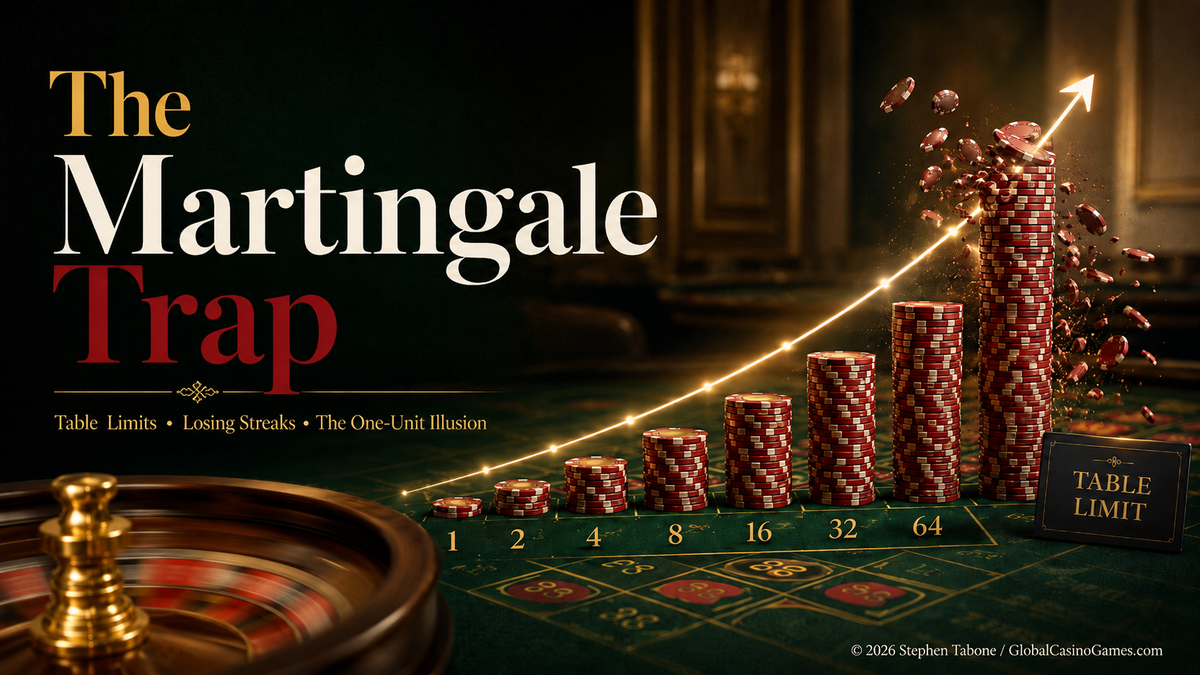
1, 2, 4, 8, 16, 32, 64, 128
That is why Martingale looks powerful at first. It gives the impression that one win can repair everything. But that impression is also the trap.
How Does the Martingale Betting System Work?
A simple Martingale example starts with a £1 bet on an even money outcome, such as Red in roulette.
If the £1 bet loses, the next bet becomes £2. If that loses, the next bet becomes £4. If that loses, the next bet becomes £8. The player keeps doubling until a win arrives.
If the £8 bet wins after the previous losses, the player wins £8. That covers the £1, £2 and £4 losses, which total £7, and leaves £1 profit.
That is the whole idea. You risk larger and larger amounts to win one small unit.
Martingale Progression Chart: How Fast the Stakes Grow
This chart shows what happens if a player starts with a £1 unit.
|
Losing step |
Next stake |
Total already risked |
Net profit if next bet wins |
|
1 |
£1 |
£1 |
£1 |
|
2 |
£2 |
£3 |
£1 |
|
3 |
£4 |
£7 |
£1 |
|
4 |
£8 |
£15 |
£1 |
|
5 |
£16 |
£31 |
£1 |
|
6 |
£32 |
£63 |
£1 |
|
7 |
£64 |
£127 |
£1 |
|
8 |
£128 |
£255 |
£1 |
|
9 |
£256 |
£511 |
£1 |
|
10 |
£512 |
£1,023 |
£1 |
|
15 |
£16,384 |
£32,767 |
£1 |
|
20 |
£524,288 |
£1,048,575 |
£1 |
This is the brutal part. At the 10th step, the player may need to place £512 after risking £1,023, just to make £1 net profit.
That is why I call it the one-unit trap.
Why Does Martingale Feel Like It Works?
I know how easy Martingale can look at the start.
You place one unit and win. You place another unit and win. You lose once, double the next bet, win it back, and everything feels under control. If the results are choppy, the system can feel like plain sailing. Lose one, recover one. Lose again, recover again.
Then comes the stretch.
The losing run reaches four, five or six steps, and the feeling changes. If you have the bankroll, you place the next doubled stake and hope the recovery lands. At that point, you are no longer really thinking about winning one unit. You are fighting to get your money back.
If the recovery bet wins, it feels like a victory. Your adrenaline has been running, the pressure has built up, and then suddenly the result lands your way. But what have you actually won? In most Martingale examples, you have only won one unit. What you really won back was the money you were close to losing.
That is why the system is so deceptive. It can make a player feel as if he has survived something big, when the actual profit is tiny.
The Martingale Trap: When Players Panic
The other side is much worse. If the recovery does not arrive, the comedown is brutal.
The player has doubled, doubled again, kept going, felt the stress rising, and then gets hit by the cold reality that the money has gone. That is not a normal small loss. It feels like the whole session has crashed at once.
Reader note: If you recognise this feeling — chasing losses, panicking after a failed recovery bet, gambling to get back to even, or feeling unable to stop — take it seriously. You can contact the National Gambling Helpline, run by GamCare, free on 0808 8020 133, or use GambleAware for free, confidential gambling support.
I have seen this happen in casinos. It is horrible to watch someone trying to win their money back by putting more and more money on the table, especially when the pressure is obvious. When it works, everyone around them may feel the excitement. But when it fails, it can be a disaster.
The pressure gets worse when friends or other players are watching. The player may feel as if he has to prove he made the right decision, prove he is lucky, or prove he knows what he is doing. Pride can make it harder to stop.
This is why Martingale is not only about numbers. It is about greed, confidence, pressure, pride, frustration and the desperate feeling of wanting to get back to even.
Martingale Is Not Always Pure Martingale
Players do not always use Martingale in its pure form.
They may not double every single time in a neat textbook sequence. They may not even call it Martingale. But the mentality is the same. They lose, feel pressure, and then want to put as much as they can on the next spin or next hand to recover.
That is still Martingale-style thinking.
The player is no longer pacing the game. He is no longer letting normal outcomes come and go. A normal roulette spin, baccarat hand or blackjack hand becomes loaded with pressure because too much money is now sitting on one result.
Some negative progression systems are softer than Martingale. Some increase the stake more slowly. But once the player is chasing a loss, the same danger is there. The aim is no longer to play calmly. The aim is to recover.
If the bigger stake does not fully cover the earlier losses, even a win may not repair the damage. That can create another dangerous decision: bet more again, push harder again, and try to force the recovery.
The danger is not only Martingale as a written system. The danger is Martingale thinking: the belief that a bigger next bet can force the session back under control.
Why Even Money Bets Make Martingale Feel So Brutal
Martingale is mainly built around even money bets: Red or Black, Odd or Even, Low or High in roulette, and sometimes Player or Banker in baccarat.
Those bets feel close to 50/50, so the player thinks the losing streak cannot go on much longer. That belief is dangerous.
If roulette goes black, then red, then red again, what does the Martingale player do? Bet black to break the red run? Double again if red lands once more? Some players start early. Others wait for six, seven, eight or even ten results in a row before betting against the streak.
I have seen what happens when the table starts believing a streak must break. If there are ten reds in a row, players can become frantic betting on black. If red lands again, the pressure gets worse. If it reaches eleven, twelve, thirteen or more, bigger money starts appearing on black.
I once saw a red streak reach 21 in a London casino. A whole table of players was wiped out betting against it. That kind of experience stays with you because it shows the real danger of assuming a streak has to end when you want it to end.
The same problem can happen in baccarat. If Banker keeps landing, some players keep betting Player to break the run. If Player keeps failing, the progression can become ugly very quickly.
That confidence is exactly what can bite them.
Martingale Streak Chart: How One Bad Run Can Break the System
Roulette history is full of warnings about streaks. The famous Monte Carlo story says black landed 26 times in a row on 18 August 1913, and players lost heavily by betting against it. Another often-repeated gambling story says red landed 32 times in a row in an American casino in 1943, although I treat that as a reported extreme streak rather than a fully verified official record.
The table and chart below show what happens to a Martingale player who keeps betting against a run on a colour bet. The odds shown are not simply the odds of one colour landing again. They are the odds of the Martingale bet losing again.
On European roulette, a player betting Black loses if Red or Zero lands. On American roulette, the player loses if Red, 0 or 00 lands. That is why zero matters even when the player thinks he is only betting on a colour.
Probability and Martingale Bet Multiplier Table
| Spin / attempt | Martingale bet units | Odds against another losing result: European roulette | Odds against another losing result: American roulette |
|---|---|---|---|
| 1 | 1 | 1 in 1.95 | 1 in 1.90 |
| 2 | 2 | 1 in 3.79 | 1 in 3.61 |
| 3 | 4 | 1 in 7.38 | 1 in 6.86 |
| 4 | 8 | 1 in 14.4 | 1 in 13.0 |
| 5 | 16 | 1 in 28.0 | 1 in 24.8 |
| 10 | 512 | 1 in 784 | 1 in 613 |
| 15 | 16,384 | 1 in 21,965 | 1 in 15,181 |
| 20 | 524,288 | 1 in 615,124 | 1 in 375,900 |
| 26 | 33,554,432 | 1 in 33.5 million | 1 in 17.7 million |
| 32 | 2,147,483,648 | 1 in 1.83 billion | 1 in 832 million |
This is the point of the chart. Martingale does not need a world-record streak to become dangerous. The required stake can explode long before that. A player can hit the table limit, run out of bankroll or lose emotional control while still being nowhere near the most extreme streaks people talk about.
Why Table Limits Break the Martingale System
Table limits are one of the main reasons Martingale breaks down in real play. A roulette table does not let you double forever.
Every table has a minimum stake and a maximum stake. Those limits control how far the progression can go.
On a low-stakes electronic roulette terminal, the minimum might be 25p, 50p or £1. That sounds friendly to a Martingale player. But the maximum may also be low. A player can hit the ceiling much faster than expected.
On a normal land-based roulette table, the minimum is often higher. A table may start at £5, £10, £15, £25 or more, depending on the casino, the table and the time of day.
Higher-stakes tables may have higher maximums, but they also have higher minimums. That means the Martingale starts from a bigger base.
A £1 Martingale looks small on paper. A £10 Martingale is a different game. The progression becomes £10, £20, £40, £80, £160, £320, £640 and £1,280. At that point, the player is risking four figures to recover the previous losses and win one £10 unit. That is where the system stops looking clever and starts looking dangerous.
The key point is simple. Martingale needs a low starting stake, a very high maximum stake, unlimited bankroll and perfect continuity. Real casino tables do not give the player that combination.
Why Online Casino Interruptions Make Martingale Worse
Online play creates another problem. Martingale depends on the player being able to place the next bet at the right time.
But real online play is not perfect.
The internet can drop. The live stream can freeze. The casino app can refresh. A browser can crash. A phone battery can die. A login session can expire. A balance update can lag. The betting window can close before the player gets the next stake on.
That does not mean there is a conspiracy. It means the system is fragile.
If a strategy depends on perfect timing, perfect connection and perfect access to the next bet, then it is not built for real conditions. One interruption can break the sequence and leave the player angry, panicked or convinced that something unfair happened.
Can You Use Martingale in a Land-Based Casino?
You can try, but the same problems remain.
In a land-based casino, the dealer can close betting before the chip is down. The player may not have the right chips ready. The table maximum may block the next step. Staff may watch unusual stake jumps. If the betting looks distressed or risky, the casino may intervene.
There is also the pressure of the room itself. Other players can see the stake increases. Friends can watch. A player who is already emotional may feel trapped by pride.
That is why the casino floor can make Martingale feel even more intense. You are not only dealing with maths. You are dealing with noise, people, time, ego and pressure.
Martingale Strategy in Roulette
Roulette is the game most people connect with Martingale.
The usual idea is to use Red or Black, Odd or Even, or Low or High. But roulette has zero. In European roulette, zero gives the casino its edge. In American roulette, 0 and 00 make the game even more expensive.
For more on how zero affects Red, Black, Odd, Even, Low and High, read my guide to roulette zero, green zero and house edge. Martingale players often focus on the colour streak, but zero is still part of the wheel and it can still break the recovery plan.
La Partage can reduce the damage on even money bets when zero lands, but it does not make Martingale safe. It only improves that specific rule outcome.
The main danger remains the same. A long run against the chosen side can force the stake higher and higher until the bankroll, table limit or player’s nerve breaks.
Martingale Strategy in Baccarat
Baccarat players sometimes use Martingale on Player or Banker.
It can feel smoother than roulette because baccarat has two main betting sides, and many players follow shoe patterns. If the shoe is choppy, the system can feel easy. Banker, Player, Banker, Player can make the recovery pattern look controlled.
But baccarat has a special problem if the Martingale is used on Banker. In standard commission baccarat, a winning Banker bet pays 1 to 1, but the casino deducts 5% commission from the winning amount.
That deduction matters more than many players realise.
Say a player starts with £1 and loses six Banker bets in a row:
£1, £2, £4, £8, £16, £32
The total lost is £63.
The next Martingale stake is £64. If Banker wins, the player gets the £64 stake back and wins £64 before commission. But the 5% Banker commission is deducted from the £64 winning part.
5% of £64 is £3.20.
So the Banker win is not really £64 profit. It is £60.80 profit after commission.
The player has already lost £63. The £60.80 Banker profit does not fully recover that loss. Instead of winning one £1 unit, the player is still down £2.20 overall.
That recovery problem comes directly from the payout structure. My Baccarat Banker bet guide explains the standard 5% commission, the difference between Banker and Player house edges, and how no-commission rules can change the calculation.
That is the hidden danger. A textbook Martingale assumes a clean even-money payout. Banker baccarat does not always behave like that because the commission acts like a tax on the recovery win.
Online baccarat can make this feel even less visible because the automation deducts the commission instantly. In a land-based casino, the dealer or table process deducts it. Either way, the Martingale player does not get the clean recovery that the system promises.
This is why baccarat Martingale is not as simple as it looks. The scorecard may show Banker and Player, but the rules behind the payout still matter.
In my view, Martingale in baccarat is most dangerous when the player starts betting against the shoe just because a run looks too long. That is not structure. That is pressure dressed up as strategy.
The streak itself is recorded on the casino scoreboard, but it does not guarantee that the opposite side is due. My baccarat roadmaps guide explains how the Big Road and related displays record completed outcomes without predicting when a Banker or Player run must end.
Martingale Strategy in Blackjack
Blackjack is a poor fit for Martingale.
In roulette or baccarat, the player is usually picking an outside outcome. In blackjack, the player is involved in decisions: hit, stand, split, double or surrender. The result is not simply a clean Red or Black style outcome.
You also cannot bet on the dealer’s side in the normal way. If the dealer keeps beating you, you cannot simply switch sides and back the dealer. Other players at the table may be winning while you are losing, or you may be losing while another box wins.
That makes Martingale more confusing in blackjack. It can add pressure to decision-making and make the player blame himself for every hand that goes wrong.
This is why I separate blackjack hand strategy from staking systems. A Martingale progression only changes the size of the next bet after a loss. It does not tell the player whether to hit, stand, double, split or surrender. For that side of the game, see my blackjack basic strategy chart guide, which explains the decision structure before any betting progression is considered.
Have People Won Big With Martingale?
Players can win sessions using Martingale. That is part of the danger.
A short choppy session can make the system look strong. The player may win five, ten or twenty small units and feel in control.
But the famous roulette winners were usually not known for simply doubling after losses. Stories such as Joseph Jagger and biased wheels, or later advantage-play cases, are about finding some kind of edge, bias, prediction method or weakness in the game.
That is a completely different idea from Martingale.
Martingale does not identify an edge. It does not change the house edge. It only changes the size and timing of the bets.
I have also tested roulette staking ideas across 10,000 random spins. That kind of longer test is useful because it shows what short winning runs can hide: drawdown, stake pressure, losing sequences and the difference between a system feeling good for a while and actually standing up over time.
The Wheat and Chessboard Warning
The old wheat and chessboard story is a good way to understand Martingale.
In the story, a ruler is asked to place one grain of wheat on the first square of a chessboard, then double it on every square. One grain becomes two, then four, then eight. At the start, it sounds harmless.
By the 64th square, the number becomes almost impossible to visualise. The 64th square alone would need 9,223,372,036,854,775,808 grains of wheat.
That is more than 9.2 quintillion grains. Put another way, it is about 9.2 billion billion grains, or about 9.2 million trillion grains.
To make that easier to picture, use a rough wheat-industry estimate of about one million grains in a bushel. On that basis, the 64th square alone would need about 9.2 trillion bushels of wheat.
Kansas is one of America’s major wheat states. USDA/NASS lists Kansas wheat production at 346.8 million bushels in its 2025 state agriculture overview. Using that figure, the 64th square alone would be roughly 26,600 times the entire annual wheat crop of Kansas.
The full chessboard would need 18,446,744,073,709,551,615 grains in total. That is more than 18.4 quintillion grains, or about 18.4 million trillion grains. On the same rough bushel estimate, the full board would be about 18.4 trillion bushels, or roughly 53,000 times the annual wheat crop of Kansas.
That is the point. This is not one barn, one grain store, one county, or even one major wheat-growing state. The doubling becomes absurd.
Martingale works in the same psychological way. The first few steps feel manageable. The later steps can become ridiculous very quickly. The player does not need to reach anything close to the 64th square for the idea to fail. In real casino play, the bankroll, table limit, nerve or betting window usually breaks much earlier.
What to Remember Before You Use Martingale
Martingale is easy to understand, which is why it remains popular.
But easy does not mean safe.
The system can work for short periods when the results are friendly. It can make small wins feel regular. But when the wrong losing run arrives, the pressure changes completely.
The player may risk hundreds or thousands to win one unit. He may hit the table limit. He may run out of bankroll. He may panic. He may start using Martingale-style recovery betting without even meaning to.
That is the real warning.
Martingale is not just a betting system. It is a mindset. Once the player starts fighting to get back to even, the game stops being calm and becomes a recovery battle.
Martingale Staking Curve: How Fast the Next Bet Explodes
The chart below shows why the Martingale betting system can become dangerous so quickly. Each column represents a longer losing streak, and the required next stake rises sharply because the player has to keep doubling to recover earlier losses. The historical streak markers are there to show the bigger point: rare streaks can and do happen, and Martingale only needs one serious run to put the bankroll under extreme pressure.
Martingale Staking Curve vs. Historical Records
Hover over the columns to inspect the required betting units and exact probability against the streak surviving.
Global Casino Games FAQs on the Martingale Strategy
Does the Martingale strategy work?
Martingale can work in short sessions if a recovery win arrives before the bankroll or table limit breaks. But in my view, it does not work as a long-term way to beat casino games because it does not remove the house edge.
Can Martingale beat roulette?
No. Martingale does not beat roulette in the long run. Stephen Tabone’s view at Global Casino Games is that Martingale changes the staking pattern, not the roulette odds. Long losing runs, zero, bankroll limits and table limits remain.
Why does Martingale fail?
Martingale fails because the stakes grow exponentially. A player can quickly reach a point where the next required bet is too large for the bankroll or above the table maximum. That is why Global Casino Games treats Martingale as a risk system, not a winning system.
Is Martingale better for baccarat than roulette?
Baccarat may feel smoother than roulette because Player and Banker are the main outcomes, but Stephen Tabone’s view is that Martingale still carries the same core danger. A long Banker or Player run can punish anyone betting against the streak. Banker commission can also damage the clean recovery maths.
Can you use Martingale in blackjack?
You can try to apply Martingale to blackjack, but Stephen Tabone does not see it as a clean fit. Blackjack includes player decisions, different hand outcomes, splits, doubles and dealer rules. Martingale can increase pressure and make bad decisions more expensive.