
Roulette Strategy Test: 10,000 Random Spins, Martingale vs Paroli
Stephen Tabone, drawing on around 30 years of roulette study, tests 10,000 random European roulette outcomes to compare Martingale, Paroli and flat betting. The results show how zero, streaks, table limits, drawdown and bankroll pressure affected each roulette system.


Written by Stephen Tabone for Global Casino Games. Last reviewed: 20 June 2026.
A 10,000-spin European roulette strategy test comparing flat betting, Paroli and Martingale for profit and loss, drawdown, streaks, zero impact and bankroll pressure.
Quick Overview: What Did This 10,000 Random Spin Roulette Test Show?
I tested 10,000 random European single-zero roulette outcomes against three simple even-money approaches:
- Flat betting
- Three-step Paroli
- Martingale capped at 512 units
The test used red as the fixed even-money selection. Zero counted as a loss, as it does on normal even-money roulette bets without La Partage or En Prison.
The result was clear. Flat betting produced the calmest ride. Paroli created more movement and more exposure. Martingale produced the largest drawdown and the worst final result.
Here are the headline numbers:
- Red outcomes: 4,888
- Black outcomes: 4,835
- Zero outcomes: 277
- Total outcomes: 10,000
- Flat betting result: -224 units
- Paroli result: -604 units
- Martingale result: -1,251 units
- Martingale table-limit hits: 6
For me, Stephen Tabone, this is the kind of roulette test that matters. Not theory in isolation. Not a cherry-picked winning clip. A long random sequence, fixed rules, one selection, and a clean comparison.
Why Test Roulette Strategy Over 10,000 Random Spins?
Roulette strategy content often falls into two weak camps.
The first camp says betting systems are useless, then stops the conversation there. The second camp sells a system as though a pattern, progression or recovery plan can somehow cancel the green zero.
I wanted something more useful.
This article looks at what happens when three common roulette approaches are forced through the same 10,000 random-spin sequence. That matters because roulette can look very different across 50 spins, 200 spins, 1,000 spins and 10,000 spins.
A short session can make almost anything look clever.
A long random test exposes structure, drawdown, volatility and the point where table limits begin to matter.
This is why I use data-led testing on Global Casino Games. Random outcomes can look deceptively organised in short phases, especially when one side builds a lead or a streak appears. Over 10,000 spins, the movement becomes easier to judge: the numbers still rise and fall unevenly, but the longer sequence shows how those shifts affect bankroll pressure, drawdown and system risk.
Can A Roulette Betting System Beat The House Edge?
No normal roulette betting system changes the house edge.
On a European single-zero wheel there are 37 pockets: numbers 1 to 36 plus zero. An even-money bet such as red, black, odd, even, low or high covers 18 numbers.
That means the bet wins 18 times out of 37 in the long run. It loses on the opposite side and also loses when zero appears.
That green zero is the reason the casino has the edge.
The important point is this:
- A progression can change how the bankroll moves.
- It can make profits arrive faster in some short sessions.
- It can also make losses arrive harder during the wrong sequence.
- It does not remove the mathematical disadvantage.
That is why I do not judge a roulette system only by whether it “won today”. I look at how much it risked, how deep the drawdown became, and whether the same result could have been achieved with less pressure.
What Rules Were Used In This 10,000 Random Spin Roulette Test?
The test used a simple and repeatable structure.
Test Assumptions
- Wheel type: European single-zero roulette
- Numbers: 0 to 36
- Bet type: even-money colour bet
- Selection: always red
- Starting bankroll: 10,000 units
- Base unit: 1
- Zero handling: zero is a loss
- Data size: 10,000 random outcomes
Systems Tested
The three approaches were:
- Flat betting: always stake 1 unit
- Paroli: stake 1, then 2, then 4 after wins, then reset
- Martingale: double after each loss, capped at 512 units
This kept the test clean.
I did not switch from red to black. I did not pause during “bad sections”. I did not add intuition halfway through. The same random data sequence was used from start to finish.
What Were The Actual 10,000 Roulette Outcomes?
The outcome totals were:
|
Category |
Count |
|
Red |
4,888 |
|
Black |
4,835 |
|
Zero |
277 |
|
Even |
4,822 |
|
Odd |
4,901 |
|
Low 1-18 |
4,861 |
|
High 19-36 |
4,862 |
|
Total |
10,000 |
The red result was slightly below the theoretical 18/37 expectation, but not by a dramatic amount.
Red appeared on 48.88% of spins. Non-red outcomes, meaning black plus zero, appeared on 51.12% of spins.
That difference is enough to matter when money is being staked every spin.
Why Use 10,000 Random Spins Instead Of 1,000?
A 100-spin roulette test is far too small. A player can hit a strong red run, a long black run, a cluster of zeros or a clean winning phase and think the system has proved something.
It has not.
Even 1,000 spins can still be noisy. It is more useful than 100, but it may still leave a player overreacting to one phase of the data.
A 10,000-spin test gives the random sequence more room to move. It does not become perfect truth. A larger sample could still change the balance. Red could improve. Black could overtake. Zero could appear above or below expectation. But 10,000 spins gives enough space to see how the systems behave as more random outcomes are added.
That is the real point.
The test is not only asking which side appeared more often. It is asking how the bankroll reacted as randomness kept changing shape.
For The Maths-Minded Reader: How Did Randomness Change During The Test?
The red-versus-black balance moved around during the sequence.
Ignoring zero for a moment, black was ahead by 15 after the first 500 spins. By 2,000 spins, red was ahead by 42. Around spin 6,001, red reached its strongest red-versus-black lead of 73. By the end, that lead had narrowed to 53.
That is exactly why roulette is dangerous to judge too early.
One side can look weak, then recover. One side can look strong, then cool down. A player watching only a short section may see a story that later disappears.
But when zero is included, the picture changes again. Because the test always bet red, every black and every zero counted as a losing result.
The flat-bet red balance was:
|
Spin point |
Red flat-bet position |
|
100 |
-2 units |
|
1,000 |
-16 units |
|
3,000 |
-60 units |
|
6,000 |
-102 units |
|
8,000 |
-184 units |
|
10,000 |
-224 units |
That matters because roulette players often say “red was close” or “black was close”. But the zero is not a side issue. Zero is part of the game design.
The red and black totals ended fairly close. The bankroll still finished lower because zero kept turning an almost-even contest into a casino-edge contest.
What Happened To Flat Betting Over 10,000 Random Spins?
Flat betting was the cleanest baseline.
The rule was simple: stake 1 unit on red every spin. If red appeared, win 1 unit. If black or zero appeared, lose 1 unit.
Flat Betting Result
|
Metric |
Result |
|
Final bankroll |
9,776 |
|
Profit / loss |
-224 units |
|
ROI on starting bankroll |
-2.24% |
|
Wins |
4,888 |
|
Losses |
5,112 |
|
Positive spins |
48.88% |
|
Max drawdown |
257 units |
|
Per-spin volatility |
~1.00 |
Flat betting lost, but it lost calmly.
That is an important finding. The result was not spectacular, but the bankroll stayed readable. There were no violent jumps in stake size. There were no table-limit events. There was no forced recovery logic.
Flat betting gave the clearest picture of the actual random wheel sequence.
It did not disguise the house edge. It simply absorbed the spin-by-spin movement without multiplying it.
For a wider discussion of how roulette layout sections can change the way a player thinks about risk, my related article on one-third roulette strategy, columns and dozens looks at a different part of the same problem: structure, timing and bankroll control.
Is Paroli Better Than Martingale In Roulette?
Paroli was better than Martingale in this test, but it was not better than flat betting.
The Paroli system is often called a positive progression. Instead of doubling after a loss, it presses after a win.
The version tested here used three steps:
- Bet 1 unit
- If it wins, bet 2 units
- If that wins, bet 4 units
- If the 4-unit bet wins, bank the sequence and reset
- If any step loses, reset to 1 unit
The appeal is obvious. Paroli tries to ride short winning runs while keeping loss recovery under control.
But the test showed the cost.
Three-Step Paroli Result
|
Metric |
Result |
|
Final bankroll |
9,396 |
|
Profit / loss |
-604 units |
|
ROI on starting bankroll |
-6.04% |
|
Max drawdown |
657 units |
|
Per-spin volatility |
~1.99 |
|
Full 1-2-4 ladders completed |
644 |
|
Average stake per spin |
1.704 units |
Paroli created more action than flat betting. It also created more damage.
The system completed 644 full 1-2-4 ladders, which shows that short winning streaks did appear often enough to matter. But the failed ladders mattered too.
Here is the pressure point:
- 1-unit wins: 2,846
- 2-unit wins: 1,398
- 4-unit wins: 644
- 1-unit losses: 2,910
- 2-unit losses: 1,448
- 4-unit losses: 754
That tells the story. The 4-unit step won 644 times but lost 754 times. The system kept exposure bounded, which is good, but it still increased the average stake and therefore increased the amount exposed to the house edge.
For players who like structure, Paroli is easier to live with than Martingale. But in this 10,000 random-spin test, it did not beat the flat-betting baseline.
Does The Martingale Roulette System Work If The Bankroll Is Big Enough?
Martingale felt powerful in theory, but it performed worst in the test.
The rule was:
- Start with 1 unit
- Double after each loss
- Reset to 1 unit after a win
- Stop escalating at the 512-unit table cap
The Martingale idea is emotionally attractive because one win appears to recover the previous losses and add a small profit.
The problem is that roulette does not care about emotional logic.
Long non-red runs happen. When they do, Martingale becomes less of a strategy and more of a stress test.
Martingale Result
|
Metric |
Result |
|
Final bankroll |
8,749 |
|
Profit / loss |
-1,251 units |
|
ROI on starting bankroll |
-12.51% |
|
Max drawdown |
3,690 units |
|
Per-spin volatility |
~22.22 |
|
Table-limit hits |
6 |
|
Maximum stake used |
512 units |
|
Average stake per spin |
5.1905 units |
The Martingale result is the strongest warning in the whole test.
The system lost 1,251 units. More importantly, it produced a 3,690-unit max drawdown.
That is not a small wobble. That is a major bankroll event.
A player using the same logic at real table values would have to tolerate massive emotional pressure, rising stakes and the possibility of reaching a limit at the worst possible time.
Was Martingale Beaten By Zero Or By Losing Runs?
This is where the data becomes interesting.
Many players blame zero for destroying even-money roulette systems. Zero matters, of course, because it turns an even-money bet into a casino-edge proposition.
But in this test, the six Martingale table-limit hits were mainly caused by long non-red runs.
Only one of the six table-limit sequences contained a zero.
The six 10-spin non-red runs that hit the cap were:
- Spin 1261 to 1270
- Spin 2336 to 2345
- Spin 2819 to 2828
- Spin 4008 to 4017
- Spin 4645 to 4654
- Spin 6742 to 6751
Only the fifth sequence included zero.
That means the biggest Martingale danger was not simply “zero appeared”. The bigger danger was this: a perfectly ordinary sequence of black numbers, plus occasional zeros, can still create a long enough non-red run to force the system into extreme stake sizes.
That is the brick wall.
Not bad luck in a dramatic sense. Just roulette doing what roulette can do.
What Did The Red And Black Streaks Show?
The data produced streaks that were normal enough to look harmless, but dangerous enough to punish progressions.
Red Streaks
|
Red streak metric |
Result |
|
Number of red runs |
2,529 |
|
Median length |
1 |
|
Mean length |
1.93 |
|
95th percentile |
5 |
|
Maximum red streak |
9 |
|
Red streaks of 5+ |
143 |
|
Red streaks of 8+ |
15 |
Black Streaks
|
Black streak metric |
Result |
|
Number of black runs |
2,528 |
|
Median length |
1 |
|
Mean length |
1.91 |
|
95th percentile |
5 |
|
Maximum black streak |
12 |
|
Black streaks of 5+ |
129 |
|
Black streaks of 10+ |
5 |
The maximum black streak was 12. That matters because the test was always betting red.
A 12-black run is exactly the kind of thing that turns Martingale from comfortable to dangerous.
Paroli reacts differently. It does not chase those black runs after each loss. But it still needs red clusters to complete its 1-2-4 ladders. When streaks break at the second or third step, Paroli gives back more than flat betting would.
How Often Did Zero Appear In 10,000 Random Roulette Spins?
Zero appeared 277 times in the 10,000 outcomes.
That is close to what a European single-zero wheel should produce over a large sample.
The zero-to-zero spacing was also revealing:
|
Zero spacing metric |
Result |
|
Zero count |
277 |
|
Median zero-to-zero spacing |
26 spins |
|
Mean zero-to-zero spacing |
36.08 spins |
|
Longest zero-to-zero spacing |
270 spins |
Zero can disappear for long stretches. Then it can appear close together.
That rhythm matters because players often build beliefs around the green pocket. They may decide zero is “due” after a long absence or “hot” after a cluster.
The test does not support emotional zero betting. Zero is part of the house edge. It is not a magic timing signal by itself.
Should Roulette Players Cover Zero When Even-Money Betting?
A constant zero cover is usually a leak.
If you are already betting an even-money selection and then add a straight-up zero chip every spin, you are not removing the problem. You are adding another negative-expectation bet.
That may feel like insurance, but it changes the whole staking model.
My View On Zero Cover
I would split it this way:
- Flat betting plus constant zero cover is usually unnecessary.
- Martingale plus zero cover can make exposure worse.
- Paroli may allow a tiny temporary zero hedge only at the highest step, but even then it must be treated carefully.
- La Partage or En Prison is generally better than adding your own zero cover.
The cleanest practical improvement is not to cover zero blindly. It is to choose the best available table rules.
Do La Partage And En Prison Make Roulette Systems Better?
La Partage and En Prison can improve the table conditions for even-money bets.
They do not turn roulette into a guaranteed profit game.
Under La Partage, when zero lands on an even-money bet, half of the stake is returned. Under En Prison, the stake may be held for the next spin, depending on the table rules.
For even-money bets, those rules can reduce the effective edge from about 2.70% to about 1.35%.
That is meaningful.
But it does not make Martingale safe. It does not make Paroli unbeatable. It does not make flat betting profitable by itself.
It simply improves the price of the game.
That matters because good roulette strategy begins with the table, not the betting system.
What Did This 10,000-Spin Roulette Test Show About Bankroll Management?
The lesson is simple: stake exposure matters.
A system that places more money into the same negative-edge game will usually create more volatility.
The total exposure was very different across the three approaches:
|
System |
Average stake per spin |
Result |
|
Flat betting |
1.0000 units |
-224 units |
|
Paroli |
1.7040 units |
-604 units |
|
Martingale |
5.1905 units |
-1,251 units |
Flat betting exposed the least money.
Paroli exposed more.
Martingale exposed far more.
That does not mean every short Martingale session must fail. Many short sessions will appear to work. That is part of why the system remains popular.
The danger is that the bad session is not just a normal loss. It can become a large loss quickly.
That is why table limits, stop-loss rules and session structure are not side issues. They are the system.
This is also the reason my book The Clockwork Betting System focuses on structured thinking across roulette, baccarat and other even-money casino games. The point is not to pretend risk disappears. The point is to understand how repeated 1:1-style decisions can pressure a bankroll.
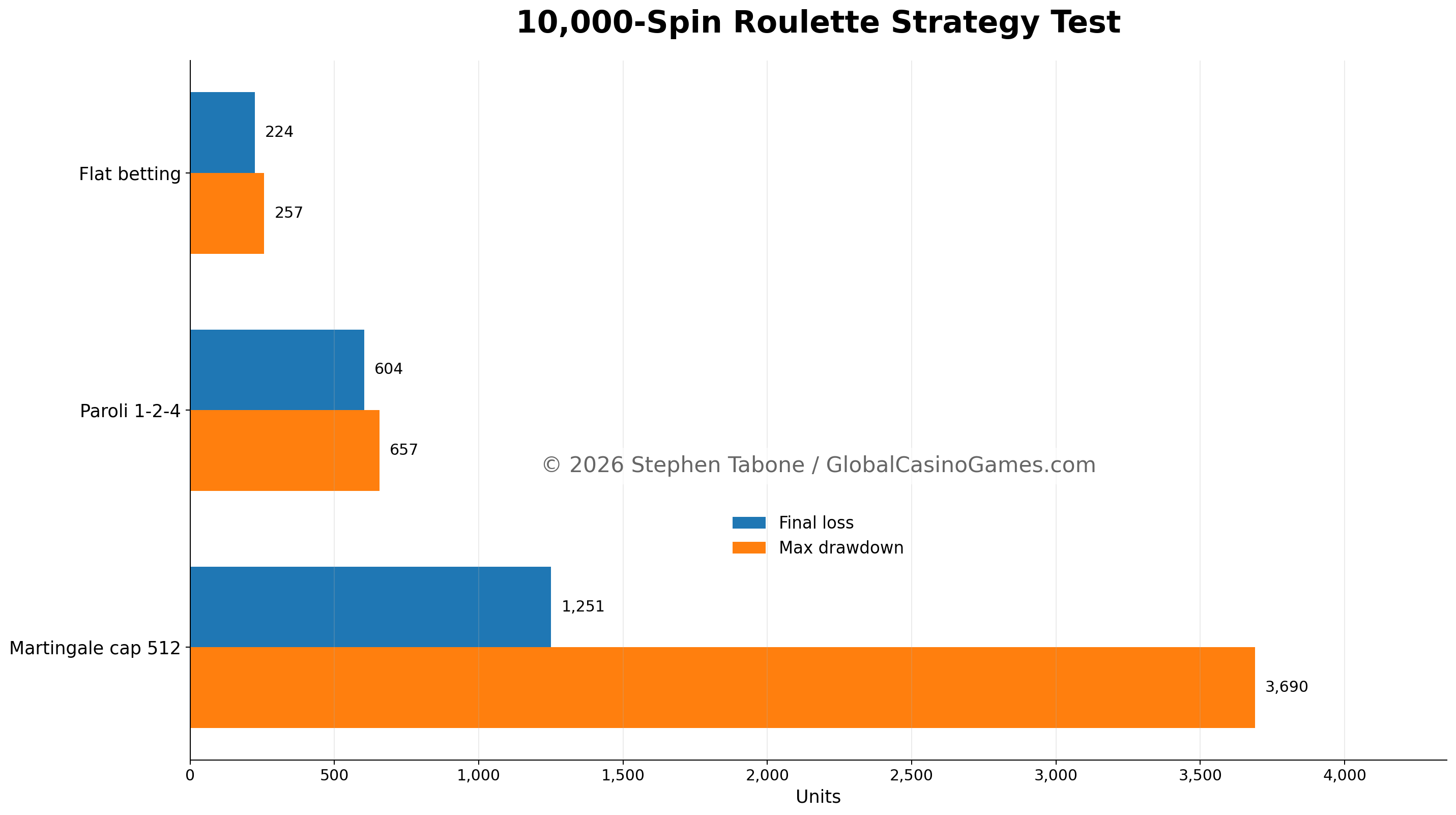
Is Flat Betting The Best Roulette Strategy?
Flat betting is not a magic answer.
It still lost 224 units in this test.
But it did the best job of showing the truth without adding unnecessary pressure. It had the smallest drawdown, the lowest volatility and the cleanest risk profile.
That is why I like using flat betting as the reference case.
A progression has to prove that it is worth the extra exposure. In this test, neither Paroli nor Martingale did that.
The more useful conclusion is not “always flat bet”.
The better conclusion is this:
if a system cannot beat flat betting after accounting for drawdown, volatility and exposure, the system is probably giving the player more drama rather than more value.
For roulette players who want to think beyond simple red-or-black decisions, my book Sweet Spot One-Third Roulette Strategy goes deeper into columns, dozens, one-third betting, timing and bankroll control. That is a different betting area, but the same serious question remains: what does the player risk, and when should the player stop?
Why Do Roulette Systems Still Feel Convincing?
Roulette systems feel convincing because they often work before they fail.
Martingale can produce repeated small recoveries. That creates the feeling of control.
Paroli can catch a three-spin winning run. That creates the feeling of momentum.
Flat betting can drift down quietly. That feels less exciting, even when it is safer.
Human attention naturally notices the dramatic moments:
- the recovery win
- the completed Paroli ladder
- the red streak
- the black streak
- the zero that arrived at the worst time
But the account balance notices everything.
That is why I prefer testing full random sequences rather than reacting to standout moments.
For a broader look at this decision-making problem across casino games, my article on even-money casino games and betting systems explains why games that look close to 50:50 can still become dangerous when staking pressure, timing and emotional recovery enter the session.
Final Results: Which Roulette System Survived Best?
Here is the final comparison.
|
System |
Final bankroll |
Profit / loss |
ROI |
Max drawdown |
Volatility |
|
Flat betting |
9,776 |
-224 |
-2.24% |
257 |
~1.00 |
|
Paroli 1-2-4 |
9,396 |
-604 |
-6.04% |
657 |
~1.99 |
|
Martingale cap 512 |
8,749 |
-1,251 |
-12.51% |
3,690 |
~22.22 |
The ranking is clear:
- Flat betting produced the calmest and best result.
- Paroli kept risk bounded but increased exposure and drawdown.
- Martingale created the most severe bankroll pressure.
This is the practical reality behind the maths.
Progressions reshape the journey. They do not remove the destination built into the game.
What Should A Serious Roulette Player Learn?
The 10,000 random-spin test did not show that roulette is impossible to enjoy or impossible to study.
It showed something more useful.
Roulette must be judged by structure, exposure and discipline.
If a player uses Martingale, they must accept that the dangerous sequence will eventually appear. If a player uses Paroli, they must accept that not every promising ladder will complete. If a player flat bets, they must accept that the house edge still grinds.
For readers of Global Casino Games, this is the real lesson: a betting system should never be judged by its best short session. It should be judged by what happens when the wheel has enough time to show its full personality.
I, Stephen Tabone, do not see this as an argument against studying roulette. I see it as an argument for testing systems properly before believing in them.
Roulette is not only about prediction. It is about how much pressure your bankroll can survive when prediction fails.
Roulette Strategy Performance
| Strategy | Max Drawdown | ROI |
|---|---|---|
| Flat Betting | 257 units | -2.24% |
| Paroli (1-2-4) | 657 units | -6.04% |
| Martingale | 3,690 units | -12.51% |
Roulette Strategy Questions: Martingale, Paroli, Zero And Flat Betting
Does Martingale work in European roulette?
Martingale can appear to work in short sessions because one winning spin after a loss sequence recovers earlier losses. The problem is that long non-red runs still happen. In this 10,000 random-spin test, Martingale hit the 512-unit table cap six times and finished 1,251 units down.
Is Paroli better than Martingale for roulette?
Paroli was better than Martingale in this test because it kept stakes bounded and avoided loss-chasing. But it still finished 604 units down, which was worse than flat betting. On Global Casino Games, I treat Paroli as a controlled progression, not a way to beat the house edge.
What is the best roulette strategy from this 10,000-spin test?
Flat betting performed best in this test. It finished 224 units down, with a max drawdown of 257 units. That does not make flat betting profitable in the long run, but it did produce the calmest and most controlled result.
Should I cover zero when even-money betting in roulette?
A constant zero cover usually adds another negative-expectation bet. Stephen Tabone’s view is that players should usually prefer better table rules, such as La Partage or En Prison, instead of blindly adding a zero chip every spin.
What does this test prove about roulette betting systems?
It proves that systems change volatility more than expectation. Martingale, Paroli and flat betting all faced the same underlying wheel maths. The Global Casino Games conclusion is that bankroll control, table selection and stop rules matter more than chasing a perfect progression.
About Stephen Tabone
Stephen Tabone is a casino strategy author, researcher and founder of Global Casino Games. His published work covers baccarat, roulette, blackjack, bankroll management, house edge, RTP, player risk and betting systems, with wider editorial interest in gambling behaviour and the iGaming industry.
Read his full Global Casino Games author profile, or browse his published casino strategy books on Amazon.