Even-Money Bets: The Clockwork Betting System
Stephen Tabone explains the thinking behind The Clockwork Betting System, examining even-money casino bets, staking rules and bankroll pressure.


Written by Stephen Tabone for Global Casino Games. Last reviewed: 21 October 2026.
Even-money casino games appeal to me as subjects for study because the betting choices can look so straightforward. Red or black. Odd or even. High or low. In baccarat, the main choice is usually Banker or Player.
It is easy to look at those options and think that a workable betting system should follow. Yet a simple choice can still produce a difficult session. Payout rules, losing runs and changes in stake size all affect the bankroll.
I have spent years examining how players organise those decisions. Which side do they choose? What prompts a bet? How far can stakes increase, and what makes the player stop or reset?
Those questions sit behind my book, The Clockwork Betting System: For Roulette, Baccarat and Other Even Money Casino Games Including Blackjack and Casino War.
To explain that approach properly, I first need to separate the payout, the probability of winning and the rules of the betting system.
What Are Even-Money Bets in Casino Games?
An even-money bet pays £1 profit for every £1 staked when it wins. The original stake is also returned. That payout does not mean the bet has a 50% chance of winning.
Roulette provides a useful example. On a standard single-zero wheel, red covers 18 of the 37 pockets. Black covers another 18, and zero occupies the remaining pocket.
Probability of winning a red bet = 18 / 37 = approximately 48.65%.
With ordinary rules under which zero loses the full stake, the house edge is approximately 2.70%.
A winning £10 red bet therefore makes £10 profit, but the winning and losing probabilities are unequal.
I also use the phrase “even-money casino games” with care. Baccarat Banker normally pays less than a full 1:1 after commission. Blackjack includes ordinary wins, natural blackjacks, pushes, doubles and splits. The phrase is convenient shorthand, but each game needs its own calculation.
Is Betting on One Side Always a Mistake?
Betting on one side is not automatically a mistake. I would examine the rules and the reason for choosing that side before judging the approach.
On a fair roulette wheel, red and black have the same probability on each spin. Switching between them does not create an advantage simply because one colour has recently appeared more often.
Baccarat needs a different assessment. Under standard commission rules, Banker has a lower house edge than Player. Repeatedly choosing Banker can therefore have a mathematical justification, although it remains a bet with a house advantage.
The difficulty comes when a player confuses a reasonable selection with a promise of short-term results.
Following the previous result can win during a streak and lose during alternating outcomes. Opposing the previous result can do the reverse. Neither sequence, viewed afterwards, proves that the approach could identify what was coming.
Before considering a staking progression, I want the reason for the bet to be clear.
Do Streaks and Patterns Change the Betting Odds?
A visible streak does not, by itself, establish that the next bet has become more favourable.
On a fair roulette wheel, previous results do not change the probability of the next spin. Six consecutive reds do not make black due.
Baccarat uses a finite shoe, so the remaining card composition can affect probabilities. However, a sequence of Banker and Player results does not identify all the cards remaining in that shoe.
I find terms such as “streak” and “chop” useful for describing completed outcomes. They become misleading when the description is treated as evidence that the same formation will continue.
My baccarat roadmaps guide explains how the Big Road, Bead Plate and derived roads record results, and the limits of using those records to anticipate another hand.
When I discuss timing, I distinguish rules about when to participate from evidence of a mathematical advantage. A clearly defined entry point can organise play without making the next outcome more predictable.
Why Did I Write The Clockwork Betting System?
I wrote The Clockwork Betting System to examine a structured approach to side selection, timing, staking and bankroll decisions across these games.
The questions go beyond choosing the next side. If stakes increase, what triggers that increase? How far can it go? After a winning or losing sequence, does the player return to the starting stake or scale down gradually?
Those details matter because a vague betting idea leaves important decisions to the pressure of the moment.
I want a framework to make those decisions explicit. A player should be able to understand its entry conditions, stake limits, reset points and stopping rules before money is committed.
That structure does not establish profitability. Staking and entry rules alone do not remove a fixed house edge. A stop-loss can set a boundary for a session when followed, but it does not turn the wagers placed before that boundary into favourable bets.
The book explores the method in detail. Here, my purpose is to explain the questions behind it and the game rules that any application must respect.
How Do Roulette and Baccarat Differ for Betting Systems?
Roulette even-money bets face the zero, while standard baccarat Banker and Player bets push on a Tie. Baccarat commission and alternative payout rules also affect the return.
European roulette normally has one zero. American double-zero roulette has both zero and double zero. Those additional losing outcomes matter when assessing an outside betting system.
Some single-zero tables offer rules such as la partage, under which an even-money bet loses half its stake when zero appears. I check the actual table rules before applying a calculation.
In standard commission baccarat, a £10 winning Banker bet produces £9.50 profit after 5% commission. A £10 winning Player bet produces £10 profit. A Tie normally returns either main wager without profit.
Banker still has the lower house edge under those standard rules. No-commission versions require separate attention because their payment exceptions can change the comparison.
My Baccarat Banker bet guide explains commission, house edge and the payout differences between versions.
A staking plan must account for those differences. Recovering a particular amount at roulette does not necessarily require the same winning stake at baccarat.
How Do Blackjack and Casino War Fit into Even-Money Betting?
Blackjack and Casino War require separate treatment because their decisions and settlement rules differ from roulette’s outside bets.
In blackjack, I must first consider the correct playing decision. Hitting, standing, doubling, splitting and surrendering can affect the expected return. My blackjack basic strategy guide explains those decisions and why the table rules matter.
A staking system cannot substitute for that knowledge.
There is also a specific blackjack offer called “even money”, available under certain rules when I hold a natural blackjack against a dealer Ace. At a standard 3:2 table, it has the same financial result as insuring that natural for half the original stake.
I examine that separate decision in Should You Take Even Money in Blackjack? The Maths Explained.
Casino War has its own tie, surrender and “go to war” rules. I need to understand those before assessing how a betting progression would affect the money at risk.
Across all these games, I start with the same practical task: establish the rules and payouts, then work through what the proposed system requires of the bankroll.
The Clockwork Protocol
The Clockwork Betting System by Stephen Tabone
In The Clockwork Betting System, I examine how players organise bet selection, staking, resets and stopping decisions across roulette, baccarat, blackjack and Casino War.
How Do I Assess Bankroll Pressure in a Betting System?
I assess bankroll pressure by looking at the stakes required during difficult sequences, the amount exposed to loss and whether the stopping rules remain practical.
A few winning examples tell me very little. I want to know what happens after repeated losses, when a progression reaches its limit or when the player is tempted to abandon the plan.
That is where an incomplete system becomes difficult to follow. “Increase after a loss” leaves several questions unanswered. By how much? How many times? What happens when the next stake exceeds the remaining budget or the table limit?
I explore these risks in my article on whether Martingale works in baccarat, showing how Banker commission, increasing stakes and casino table limits affect attempts to recover previous losses.
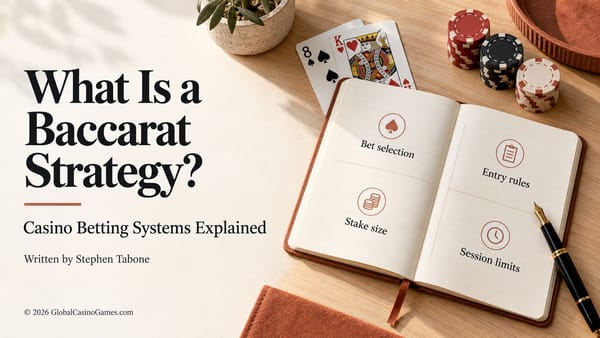
Before considering real-money play, I would write down:
- The cash value of one betting unit and the total session budget.
- The starting stake and maximum permitted stake.
- The conditions for increasing, decreasing and resetting stakes.
- The loss limit and maximum session length.
- The circumstances in which I would skip a bet or stop altogether.
- The game rules, payouts and table limits used in the calculation.
If I include a profit target, I treat it as a stopping instruction. It does not establish how much I should expect to win.
I would also distinguish following the rules from getting a favourable result. A profitable session can include poor decisions, while a losing session can occur despite consistent execution.
For testing, I want a record of the bets, stake changes, total amount wagered and results. That gives me something more useful to examine than a handful of successful examples.
What Does This Article Explain About The Clockwork Betting System?
This article explains the thinking behind The Clockwork Betting System. The full method and its examples belong in the book.
My interest is in how a player organises side selection, participation, stake adjustments and resets. Those decisions need to remain understandable when the results become uncomfortable.
When I refer to streaks, alternating outcomes or transition points, I am describing the sequence observed and the framework applied to it. Those descriptions alone do not demonstrate that the next wager has a mathematical advantage.
I also consider the cost of continuing. Before attempting a recovery, I want to know the additional stake required, the possible further loss and whether the attempt remains within the original limits.
A previous loss does not create an obligation to place another bet. Sometimes the decision required by the plan is to stop.
What Can Discipline Achieve in Even-Money Betting?
Discipline can help a player follow predetermined limits and make their decisions easier to review. It does not, by itself, change the probabilities or payouts of the game.
I use structure to make the choices explicit: what prompts a bet, how much is at risk and what ends the session. Without those details, it becomes difficult to tell whether I followed the proposed method or improvised as I went along.
For a baccarat-specific discussion, my article on one-sided baccarat strategy and shoe discipline examines how choosing a consistent side can organise play, alongside the limits of that approach.
Whatever framework I study, I keep the game mathematics in view. A staking progression alone cannot turn wagers with a fixed negative expectation into positive-expectation bets.
Readers who want the complete explanation and examples can find them in my book, The Clockwork Betting System, covering roulette, baccarat and other even-money casino games.
Questions and Answers
What Are Even-Money Bets in Casino Games?
An even-money bet pays 1:1 profit: a winning £10 wager makes £10 profit, with the original stake also returned.
Roulette red or black is a familiar example. Standard baccarat Player wins also pay 1:1, while Banker normally pays less after commission. Blackjack has several payout and settlement possibilities, so I check the particular wager before calling it an even-money bet.
Can Betting Systems Beat Even-Money Casino Games?
A staking system alone cannot overcome a fixed house edge. Winning sessions are possible, but they do not establish a long-term mathematical advantage.
I separate changes to stake size from decisions that affect the underlying expected return. Choosing different table rules or making a correct blackjack playing decision can change the calculation. Increasing a wager because the previous one lost does not improve its odds.
Why Does Stephen Tabone Focus on Discipline in Even-Money Betting?
I focus on discipline because a simple betting choice can still involve complicated decisions about money.
The side selected is only part of the plan. I also want clear limits on stake increases, exposure to loss and session length, especially when results create pressure to continue.
Is The Clockwork Betting System About Predicting Outcomes?
I present The Clockwork Betting System as a structured approach to betting decisions, timing, staking and bankroll pressure. It should not be read as a promise that future results become predictable.
A rule can tell me when the method calls for a bet. That instruction is separate from evidence that the bet has become more likely to win.
Should Beginners Use Even-Money Betting Systems?
I would suggest learning the game’s rules, payouts and basic mathematics before considering a betting system.
A beginner should be able to calculate the profit on a winning wager, recognise a push and understand what happens when a progression loses repeatedly. Paper testing can help check whether the instructions are clear and the staking limits are workable, although a successful test does not prove future profitability.
If the method is difficult to explain or its maximum exposure is unclear, I would resolve those questions before putting money at risk.
About Stephen Tabone
Stephen Tabone is a casino strategy author, researcher and founder of Global Casino Games. His published work covers baccarat, roulette, blackjack, bankroll management, house edge, RTP, player risk and betting systems, with wider editorial interest in gambling behaviour and the iGaming industry.
Read his full Global Casino Games author profile, or browse his published casino strategy books on Amazon.