
How to Read Baccarat Roadmaps: Big Road and Tie Marks
Stephen Tabone explains baccarat roadmaps, Tie marks and scoreboard percentages, including how the Big Road differs from the derived roads.


Written by Stephen Tabone for Global Casino Games. Last reviewed: 21 October 2026.
A baccarat roadmap is a visual record of completed hands. In this guide, I explain how to read a baccarat board, starting with the Big Road, its Banker and Player symbols, and the marks used to record Ties.
The main baccarat bets are straightforward: Banker, Player or Tie. The scoreboard can look less obvious. Coloured circles, diagonal marks, numbers and several smaller grids may appear together, each recording a different aspect of the results.
I start by identifying what those symbols mean. A row of matching results shows a completed streak. Alternating results show a sequence players commonly call a chop. Neither formation, by itself, establishes what the next hand will produce.
What Does a Baccarat Roadmap Tell Me?
A baccarat roadmap tells me how previous results are arranged. It lets me follow the recorded sequence and locate streaks, changes of side and Tie results.
It does not reveal the remaining cards or establish a mathematical advantage for the next wager. I keep that distinction in mind when discussing baccarat patterns and betting strategy.
I examine the difference between following scoreboard patterns and tracking exposed card ranks in my article on counting cards in baccarat.
The number of hands recorded also varies between shoes. My baccarat shoe guide explains six-deck and eight-deck games, burn cards, cut-card placement and why shoe length differs.
Why Do I Start with the Big Road?
I start with the Big Road because it provides a useful foundation for understanding how Banker and Player sequences are displayed, with Tie marks added to that record.
Learning this main grid first makes the rest of the baccarat scoreboard easier to approach. I then explain the other roads and the statistics displayed alongside them.
This guide covers:
- How to read the Big Road and Bead Plate.
- What Tie marks mean and where they appear.
- How the derived roads differ from the main results grid.
- What scoreboard counts and percentages represent.
- How players describe streaks, chops, doubles and repeats.
- The limits of using recorded patterns to choose future bets.
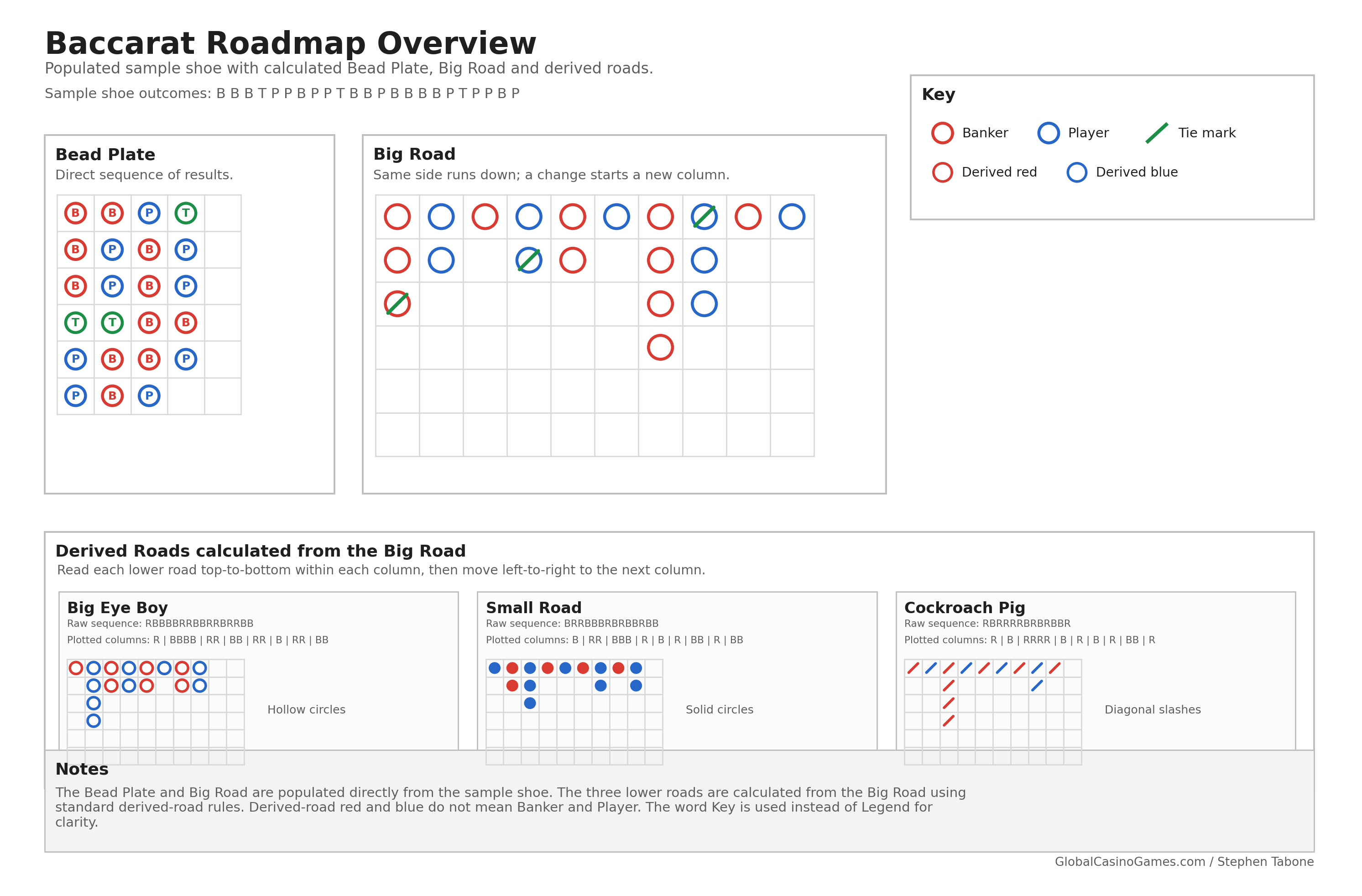
What Are Baccarat Roadmaps?
Baccarat roadmaps are grids that display results from previous hands in a shoe. Some record the outcomes directly, while others compare the arrangement of those results.
When I read a baccarat scoreboard, I first identify which grid I am looking at. The same colours can mean different things on different roads.
The five common baccarat roadmaps are:
| Roadmap | What it records |
|---|---|
| Bead Plate | Banker, Player and Tie results in hand-by-hand order. |
| Big Road | Banker and Player results arranged into streaks, with Tie annotations. |
| Big Eye Boy | Comparisons within the Big Road’s structure. |
| Small Road | Structural comparisons using a different spacing from Big Eye Boy. |
| Cockroach Road | Further comparisons using a wider spacing within the Big Road. |
The Bead Plate is useful when I want to follow the order of completed hands. Each hand receives its own entry, including a Tie.
The Big Road makes consecutive Banker or Player wins easier to identify. Ties are usually added as annotations rather than receiving separate Banker or Player entries.
Big Eye Boy, Small Road and Cockroach Road are derived roads. Their marks are calculated from the Big Road, so they present different views of the same underlying results.
On those derived roads, a red mark does not simply mean Banker won, and a blue mark does not simply mean Player won. Understanding that distinction prevents a common scoreboard-reading mistake.
Why Do Baccarat Roadmap Names Vary?
English labels differ between casino displays, software providers and guides. I therefore check the grid’s function rather than relying on its name alone.
Common variations include:
- Bead Plate, Bead Road or Bead Plate Road.
- Big Eye Boy, Big Eye Road or Big Eye Boy Road.
- Small Road.
- Cockroach Road, also called Cockroach Pig.
These alternative names can make the scoreboard seem more complicated than it is. Big Eye Boy and Big Eye Road generally refer to the same type of derived display, rather than two additional roads to learn.
For this guide, I use Bead Plate, Big Road, Big Eye Boy, Small Road and Cockroach Road, noting alternative names where helpful.
What Is the Big Road in Baccarat?
The Big Road is a baccarat results grid that groups consecutive Banker or Player wins into streaks and adds annotations for Ties.
In the common colour scheme, red circles represent Banker wins and blue circles represent Player wins. I check the display’s legend because presentation details can vary.
The basic arrangement works as follows:
- The first Banker or Player result starts the record at the upper left.
- Another win by the same side continues the streak downwards where space permits.
- A change from Banker to Player, or Player to Banker, starts a new streak at the top of a new column.
- A Tie is normally annotated on the current result and does not, by itself, end the streak.
A long streak can extend horizontally when the grid prevents further downward movement. That sideways continuation still belongs to the same run; it does not indicate a change of winner.
How Do I Read Streaks and Chops on the Big Road?
I read a streak as consecutive wins by the same side, ignoring intervening Ties for the purpose of grouping the Banker and Player results. A chop describes results switching repeatedly between Banker and Player.
For example, Banker–Banker–Banker followed by Player–Player creates a Banker streak of three and a Player streak of two. Banker–Player–Banker–Player creates a series of one-result streaks.
Those descriptions help me explain the recorded shoe. They do not establish that a streak will continue or that an alternating sequence must break.
The example below shows how Banker and Player streaks are arranged in Big Road columns.
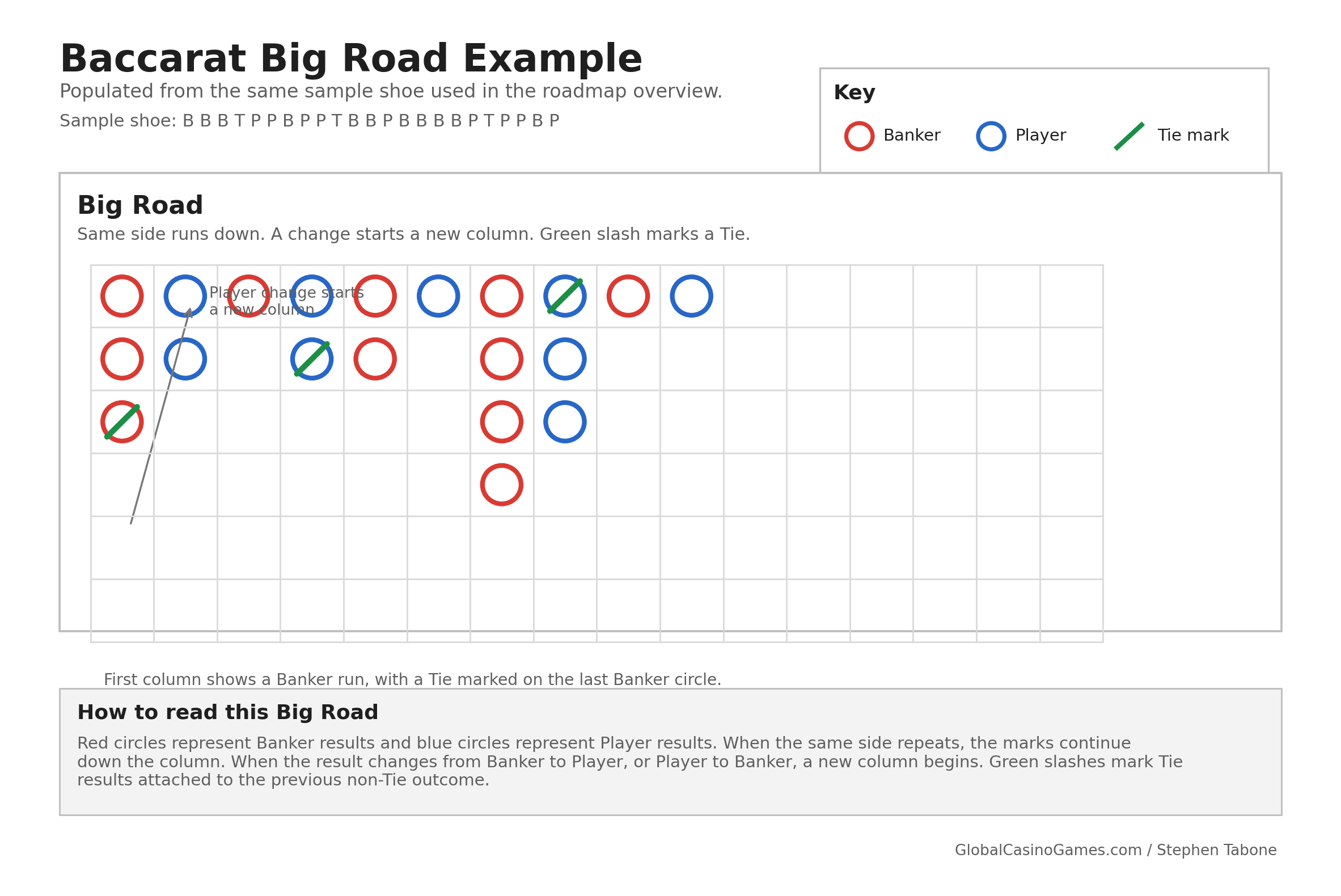
How Does the Big Road Display a Long Streak?
A long Banker or Player streak continues downwards while space is available, then extends to the right when it cannot move further down.
On a clear six-row grid, seven consecutive Banker wins would appear as follows:
- The first six red circles run down the column.
- The seventh red circle sits immediately to the right of the sixth.
- Further Banker wins continue horizontally along that row.
The same principle applies to a Player streak, using blue circles.
A streak can also turn right before reaching the bottom if an existing entry blocks the space below. I therefore follow the connected run rather than assuming that every streak must form a straight vertical line.
A sideways extension still represents consecutive wins by the same side. It does not indicate a chop, a change of winner or a new streak.
When the winning side changes, the new streak begins at the top of the next column measured from the previous streak’s starting column. It does not simply begin beyond the far end of its horizontal tail.
What Is the Bead Plate in Baccarat?
The Bead Plate is a baccarat results grid that gives each completed hand its own entry, including Ties.
I find it useful for checking the order of outcomes. Starting at the upper left, entries normally fill a column from top to bottom before continuing at the top of the next column to the right.
The entry position advances after every hand, regardless of whether the same side wins again.
The common colours are:
- Red: Banker wins.
- Blue: Player wins.
- Green: Tie.
Some displays add hand totals, pair indicators or other details. I check the symbols provided by that particular scoreboard.
What Is the Difference Between the Bead Plate and Big Road?
The Bead Plate records each hand in sequence, while the Big Road groups Banker and Player results into streaks and annotates Ties.
For example, three Banker wins occupy three successive Bead Plate cells because they are three separate hands. In the Big Road, those wins form a single Banker streak.
A Tie receives its own Bead Plate entry. On the Big Road, it is normally marked on the current result without advancing the Banker or Player streak.
I use the Bead Plate to check the hand-by-hand record and the Big Road to examine how consecutive results are grouped. Both display the same shoe through different recording rules.
The comparison below shows the same sequence of results in the Bead Plate and Big Road.
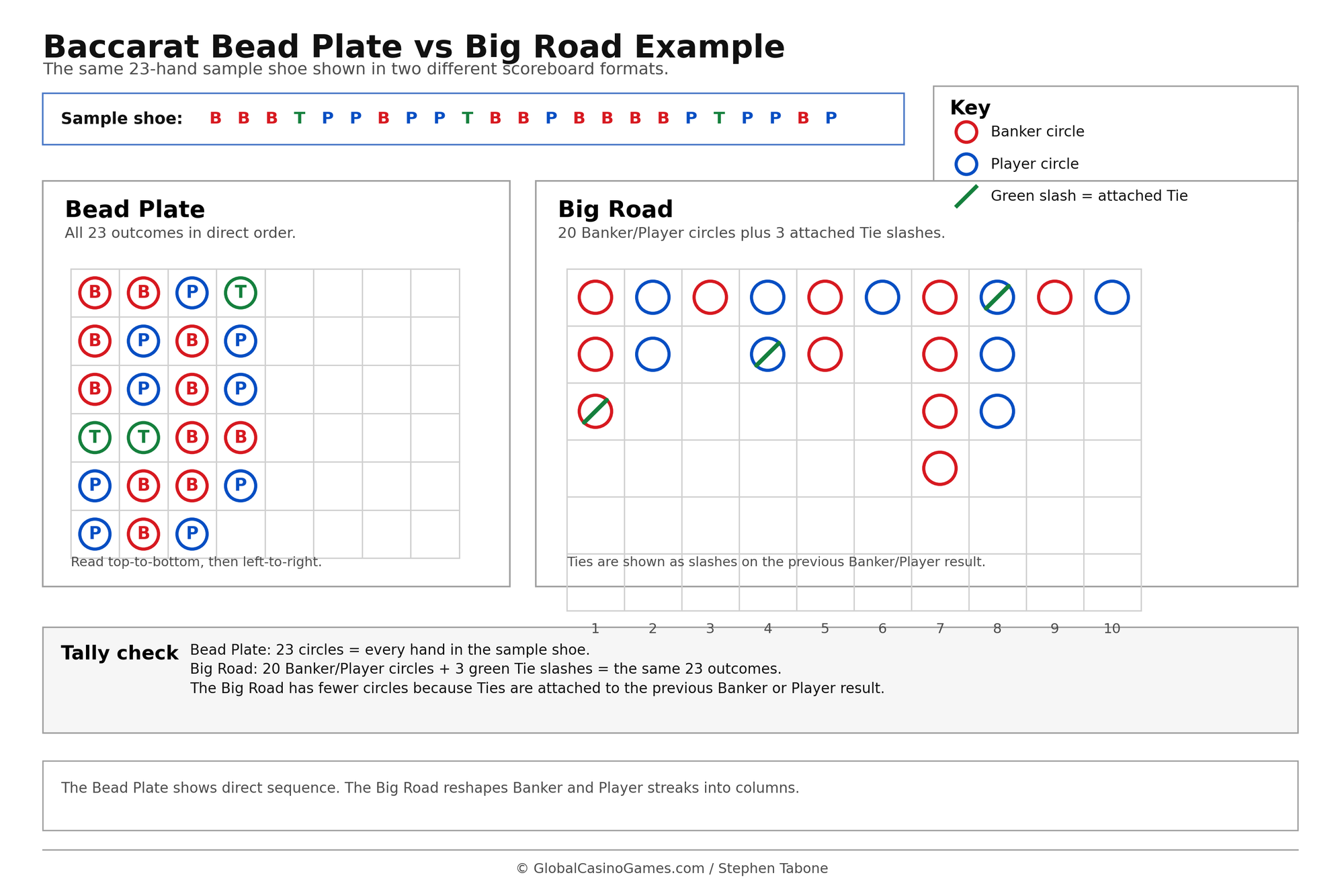
What Do Red, Blue and Green Marks Mean on a Baccarat Scoreboard?
On the Bead Plate and Big Road, red normally represents Banker, blue represents Player and green identifies a Tie. I check which grid I am reading before applying that colour key.
On the Bead Plate, a Tie normally receives its own green entry. On the Big Road, it is usually added as a green slash or other annotation on the current Banker or Player circle.
For example, Banker followed by a Tie may appear as a red circle carrying a green mark. That does not mean Banker won both hands. It records one Banker win followed by a separate tied hand.
If Player was the last non-Tie result, the annotation goes on the blue Player circle instead. The Tie does not advance or end that Banker or Player streak.
What Happens If the First Hand of a Shoe Is a Tie?
Some Big Road displays initially show a green mark without a Banker or Player circle. When the first non-Tie result arrives, its circle appears in that same position.
This can make the exact order of the opening hands unclear from the Big Road alone. I refer to the Bead Plate when I need the hand-by-hand sequence.
Multiple Ties may be represented by additional marks or a number. I check the display’s key before assuming what that number counts.
Do Big Road Tie Marks Identify Égalité Results?
A standard Tie mark identifies a tied hand; it does not, by itself, identify the tied final total required for a numbered Égalité bet.
For example, an Égalité bet on 3 requires both hands to finish with a baccarat total of 3. A general green Tie mark could represent that result or a different tied total.
Some displays provide final scores or a separate results history. Without that information, I cannot identify the numbered Tie from an ordinary Big Road annotation alone. A number beside the mark may count repeated Ties rather than show the tied score.
Tie marks can show where Ties appeared in the recorded sequence. A cluster tells me that several occurred close together; it does not establish that another Tie, or a particular Égalité total, has become more likely.
My guide to baccarat side bets and Égalité payouts explains numbered Tie wagers, payment differences and the risks of treating a rare result as overdue.
What Do Baccarat Scoreboard Statistics Mean?
Baccarat scoreboard statistics summarise completed hands in the current shoe. They commonly include Banker wins, Player wins, Ties and the total number of hands.
Depending on the display, I may also see percentages, pair counts, recent results and a shoe or table identifier.
Before interpreting a percentage, I check which results are included in its calculation.
Are Ties Included in Banker and Player Percentages?
They may be included or excluded, depending on how the display defines the figure. The denominator matters.
Suppose a shoe has produced 28 Banker wins, 24 Player wins and 5 Ties.
Total hands = 28 + 24 + 5 = 57.
Using all 57 hands:
Banker percentage = 28 / 57 × 100 = approximately 49.12%.
Player percentage = 24 / 57 × 100 = approximately 42.11%.
Tie percentage = 5 / 57 × 100 = approximately 8.77%.
If I exclude Ties, there are 52 decisive hands:
Banker share = 28 / 52 × 100 = approximately 53.85%.
Player share = 24 / 52 × 100 = approximately 46.15%.
Banker therefore accounts for 49.12% of all hands but 53.85% of the Banker-or-Player decisions in this example. Both calculations are valid when labelled correctly.
Neither percentage is a forecast
Frequently Asked Questions
What Is a Baccarat Roadmap?
A baccarat roadmap is a grid that displays previous results or comparisons calculated from them. The Bead Plate records hands in sequence, the Big Road groups Banker and Player streaks, and the derived roads compare features of that recorded structure.
How Do You Read a Baccarat Scoreboard?
I first identify the grid and check its colour key. On the Big Road, repeated wins by the same side normally continue downwards where space permits, while a change of winner starts a new column. Ties are usually annotations. I use the Bead Plate to check the hand-by-hand sequence.
What Is the Big Road in Baccarat?
The Big Road is a results grid that arranges Banker and Player wins into streaks, with annotations for Ties. Long runs can extend horizontally when the grid prevents further downward movement. A sideways continuation still belongs to the same streak.
What Do Red, Blue and Green Marks Mean in Baccarat?
On the Bead Plate and Big Road, red normally means Banker, blue means Player and green identifies a Tie. On derived roads, red and blue represent structural comparisons instead. I check which roadmap I am reading before interpreting its colours.
Why Is a Tie Mark Shown on a Red or Blue Result?
The Big Road normally attaches a Tie annotation to the current Banker or Player position without advancing the streak. A green mark on a red circle therefore records a Tie associated with that position; it does not mean Banker won the tied hand.
Can Baccarat Scoreboards Be Wrong?
Yes. A scoreboard can contain missing or incorrect entries, particularly when results are entered manually. If the display appears inconsistent with the completed hand, I pause and ask for verification. A separate written record can help check the sequence where the casino permits one.
Can Baccarat Roadmaps Predict the Next Hand?
A roadmap alone does not establish a reliable predictive advantage. It records outcomes or comparisons between them without revealing the full composition or order of the remaining cards. A visible streak, chop or Tie cluster is insufficient evidence that a particular next bet is favourable.
What Are Derived Roads in Baccarat?
Big Eye Boy, Small Road and Cockroach Road, also called Cockroach Pig, are derived roads. They compare parts of the Big Road using different reference spacing. Their red and blue marks do not directly identify Banker and Player wins.
Should You Bet Based Only on the Baccarat Roadmap?
I would not use a roadmap alone to justify a bet. I would also consider the game rules, payout, commission, house edge and my predetermined spending limits. A clear-looking pattern does not establish a mathematical advantage or justify increasing stakes beyond those limits.
About Stephen Tabone
Stephen Tabone is a casino strategy author, researcher and founder of Global Casino Games. His published work covers baccarat, roulette, blackjack, bankroll management, house edge, RTP, player risk and betting systems, with wider editorial interest in gambling behaviour and the iGaming industry.
Read his full Global Casino Games author profile, or browse his published casino strategy books on Amazon.