Baccarat Sat Nav: Navigating Banker vs Player Outcomes
Baccarat roadmaps show where the shoe has been, but Baccarat Sat Nav looks at the bigger map ahead. Stephen Tabone explains how Banker and Player outcomes form, shift and create possible betting pivots without pretending the next hand is guaranteed.

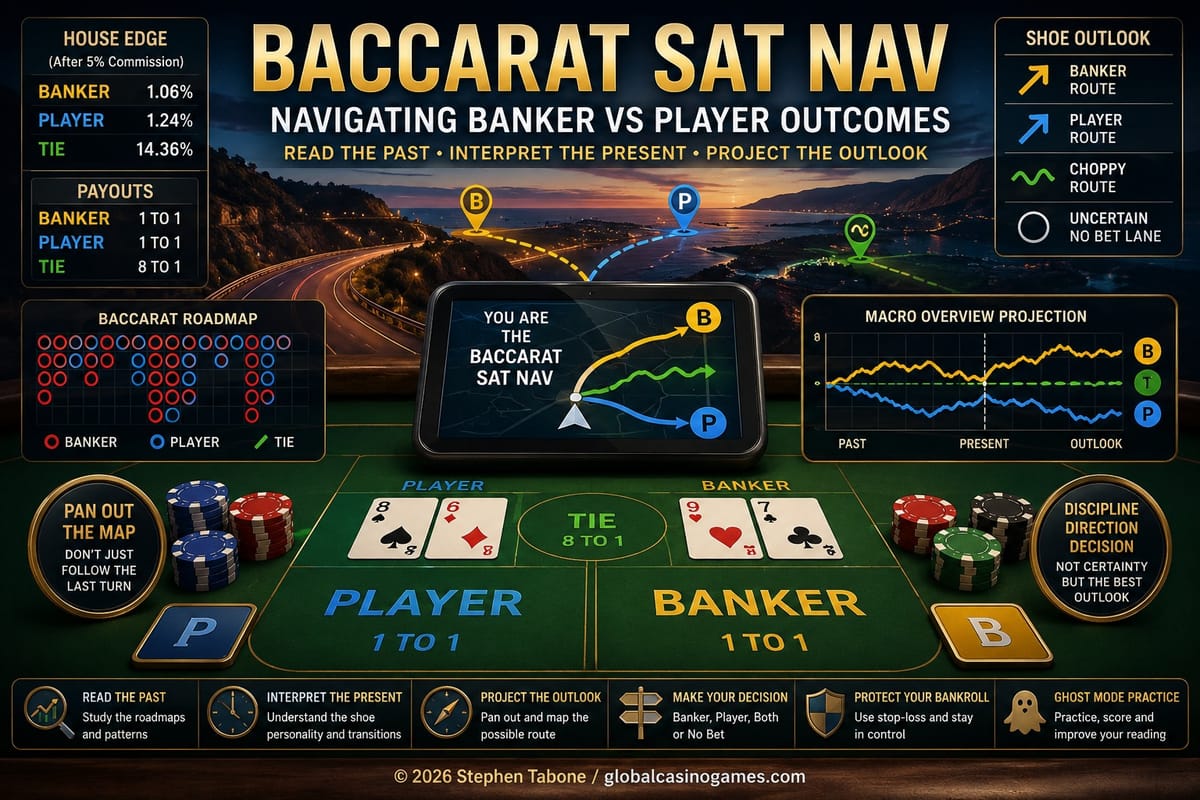
Written by Stephen Tabone for Global Casino Games. Last reviewed: 02 July 2026.
I constantly see people on forums claiming they can predict future baccarat shoe outcomes just by looking at baccarat roadmaps.
They look at the Big Road.
They look at Banker and Player streaks.
They look at the last few hands.
Then they say the next result is obvious.
But in the real world, that is only half the story.
A standard baccarat roadmap mainly shows where the shoe has already been. That is useful, but it is still history. It is the road behind you. It also shows how outcomes have developed into micro baccarat patterns, but in this article, I am focusing more on the macro overview projection.
That is where my Baccarat Sat Nav idea comes in.
I am not talking about fortune telling. I am not talking about being 100% right. I am not saying Banker must win next or Player must suddenly take over.
My focus is baccarat predictive direction, based on insights from past outcomes.
The roadmap shows the past.
The Sat Nav asks where the shoe could be heading.
The player still has to interpret the outlook.
That forward visualisation will never be certain. But if you can interpret the information already in front of you better than most people at the table, you may put yourself in a stronger decision-making position.
That is the idea behind my Baccarat Sat Nav outlook strategy.
Baccarat Sat Nav
Macro Route Overview & Interpretation
Banker Route
Player Route
The No-Bet Lane
Betting Pivots
Why the Baccarat Roadmap Is Only Half the Plan
The roadmap gives you information.
It tells you what has already happened. It shows whether Banker has been strong, whether Player has been pushing back, whether the shoe is chopping, whether one side is repeating, or whether the whole thing looks messy.
But the baccarat roadmap is still only half the plan.
The other half is interpretation.
That is where many people struggle or have not even considered thinking properly.
They see past results and treat them like a command. They think a Banker run must continue. They think a Player comeback must mean the shoe has turned. They think a choppy section must keep chopping.
That short-sighted outlook is dangerous.
Past outcomes in baccarat can be strong indicators, but they are not a panacea. They are not 100% reliable. They do not force the next hand to behave in the same way.
Sometimes patterns repeat, yes.
But BB PP does not mean BB must come next. It could become BB PP BP. It could become BB PPPP. It could reset completely.
That is one of the tricks of randomness.
You see a micro mirror reflection. You think the structure is there. Then the reset switch seems to activate and throws you off the idea you were about to follow.
That can burn your bankroll.
Then later in the shoe, a clean-looking natural pattern develops. But because your bankroll has already been damaged by earlier false starts, you do not trust it. You watch the beauty of the pattern forming, then by the time you finally jump on it, randomness flicks the switch again.
That is baccarat.
While all this drama is going on, the bigger picture is still forming.
The shoe can begin one way and end another way. By the final hand, there will be a completed route mapped across the terrain of all those random determinations.
That is why what I call Baccarat Sat Nav is not just looking backwards.
It is about the crossing point between the past, the present and the possible future.
A Short Baccarat Odds Lesson Before the Sat Nav
Before going deeper into Baccarat Sat Nav, it is worth putting the basic Banker, Player and Tie numbers on the table.
These numbers do not predict the next hand. They simply show the standard mathematical road costs before you start reading the wider shoe outlook.
| Bet | Payout | Win Chance | Chance Excl. Ties | House Edge | Sat Nav View |
|---|---|---|---|---|---|
| Banker | 0.95 to 1 after 5% commission | 45.86% | 50.68% | 1.06% | The lower-cost main road, but not a guaranteed route. |
| Player | 1 to 1 | 44.62% | 49.32% | 1.24% | Slightly higher cost, but still capable of leading sections or whole shoes. |
| Tie | Usually 8 to 1 | 9.52% | Not part of the Banker/Player route | 14.36% | A high-toll side road, not the main Baccarat Sat Nav route. |
Figures are based on common eight-deck baccarat rules. Banker’s 1.06% house edge already factors in the usual 5% commission. Actual rules can vary by casino, especially for Tie payouts and commission-free baccarat variants.
You Are the Baccarat Sat Nav
This is the most important point.
The Baccarat Sat Nav is not a machine sitting on the table.
It is you.
You are the one watching the shoe.
You are the one seeing the outcomes form.
You are the one deciding whether the route still looks alive.
You are the one deciding whether to stay with Banker, look towards Player, use both at different stages, or stay out.
I am not at the table with you. No author, forum poster or online guide is seeing the exact shoe you are seeing.
So, the work has to be done by you.
That is why I say: you are the Baccarat Sat Nav.
You take the data from the past. You compare it with what is happening now. Then you try to map out where the shoe could be heading.
Not with certainty.
With an outlook.
That outlook might be wrong. It might be partly right. It might be close enough to help you avoid decision paralysis and constant random decisions. But it is still your interpretation.
That is why discipline matters.
What Does It Mean to Pan Out in Baccarat Shoes?
When you use a Sat Nav in a car, you can zoom in and see exactly where you are.
But sometimes that is too narrow.
You need to pan out.
You need to see the wider route.
Baccarat is similar.
If you only focus on the last hand, you are zoomed in too close. If you only focus on the first few hands of the shoe, you may also be zoomed in too close.
You need to pan out and ask:
Where has the shoe been?
Where is it now?
What is starting to form?
Is Banker still holding direction?
Is Player starting to build pressure?
Is the shoe changing personality?
Is this a real pivot or just noise?
That is what I mean by panning out.
You are not predicting the future like a fortune teller. You are building a projected outlook based on the information available.
That is Baccarat Sat Nav.
The Shoe Has a Changing Personality
A baccarat shoe is not fixed.
Its personality can change.
It may start Banker-heavy and then become Player-heavy. It may start choppy and then turn into a run. It may look clean early and become messy later. It may look dead and then suddenly form direction.
This is why I do not like simple advice such as “just bet Banker”.
Yes, Banker normally has the better mathematical position. In standard baccarat, the Banker bet is commonly analysed at about 1.06% house edge after the normal 5% commission. Player is commonly analysed at about 1.24%.
That means Banker is usually the lower-cost main road.
For the full mathematics behind that difference, my Baccarat Banker bet guide explains the standard 5% commission, Banker and Player house edges, and the payout changes used by no-commission tables.
But it does not mean Banker will dominate every shoe.
Player can dominate some shoes.
Player can dominate sections of a shoe.
Banker can start strong and then fade.
Player can look weak and then take over.
So, if you are only looking at past results and not watching how the shoe is transitioning, you are only reading half the story.
The shoe is moving.
The shoe is changing.
The question is whether you can read the transition before it becomes obvious to everyone else.
The Start of the Shoe Can Fool You
The beginning of a shoe can be especially misleading.
Imagine the first ten hands come out Banker.
A lot of people would immediately say, “This is a Banker shoe.”
Maybe it is.
But maybe it is only the opening section.
By the end of the shoe, Player could still lead overall. Player could dominate the middle. Player could produce the stronger route after the early Banker run has finished.
That is why you have to be careful at the start.
At the beginning, there is not much information. The map is still small. You are zoomed in too close. You have not even left the petrol station on the long journey ahead. You have seen a few local roads, but not the wider landscape or the final destination.
This does not mean you ignore the early results.
It means you do not over-trust them.
The early shoe gives clues.
It does not give certainty.
Can Player Still Lead a Shoe?
Yes.
This is important because many people misunderstand the Banker edge.
Banker has the better long-term mathematical position, but that does not mean Banker wins every shoe or every section of a shoe.
If you model resolved Banker and Player outcomes using common baccarat probabilities, Player can still finish ahead in a large minority of shoes. Depending on the number of resolved hands, it can be roughly around the low-to-mid 40% range in simplified modelling.
That is not a promise or an exact casino-floor number.
The cut card matters.
The number of hands matters.
Tie results interrupt the count.
Rules and game versions can vary.
Those physical variables are explained in my baccarat shoe guide, including six-deck and eight-deck games, burn cards, cut-card placement and why the number of completed hands varies between shoes.
But the practical point is simple.
Player is not dead.
Player can win more hands than Banker in a real shoe. Player can dominate sections. Player can appear weak and then suddenly become the stronger side.
So, the Banker house edge should be understood, but it should not blind you to what is actually forming on the map.
Banker Only, Player Only, or Both?
Some people like to focus on Banker only.
Some people look for Player opportunities.
Some people move between Banker and Player at different points in the shoe.
The mistake is not choosing one of those approaches.
The mistake is having no real map.
If you are going to focus on Banker, you still need to ask whether Banker is actually strong in that shoe, or whether you are just repeating the house-edge argument.
If you are going to focus on Player, you need to understand that Player can lead a shoe, but it does not remove the long-term cost if Player does not hold.
If you are going to use both Banker and Player, you need even more discipline because switching sides too emotionally can destroy your structure.
That is where Baccarat Sat Nav comes in.
It does not say you must bet one side.
It asks whether your direction makes sense.
Within that direction, you are asking whether there are likely to be strong Banker streaks, Player streaks, mixed sections, or mostly choppy outcomes.
You are not just asking what won last.
You are asking what kind of shoe you may be travelling through.
Baccarat Decision Matrix
The Sat Nav Tactical Wheel
The Betting Pivot
A betting pivot is the point where the shoe may be asking you to reassess.
Not a guaranteed signal.
Not a secret trigger.
Not an instruction to bet.
A decision point.
For example, Banker may be strong early. Then Player starts to interrupt. One interruption may mean nothing. But if Player keeps pushing back, the outlook may begin to change.
That could be a pivot.
Or Player may be forming a route, but Banker begins to take control.
That could also be a pivot.
The skill is not to panic switch after every result.
The skill is to ask whether the shoe has changed enough to make you rethink the wider route on your journey towards that sweet-spot baccarat shoe oasis.
You have to train yourself to look past some of the switches that randomness uses to trick you. You build the ability to visualise a mapped-out route, then you see how closely the shoe follows your narrative after that.
That is the difference between reacting and navigating.
Stick to the Wider Map
One of the hardest parts is sticking to the wider map.
If you pan out and form an outlook, you cannot keep changing your mind after every single hand.
That does not mean you ignore new information.
It means you do not let every small movement shake you out of the plan.
Your Baccarat Sat Nav thinking may adjust the route, but it does not panic every time another car appears on the road, or every time you reach a toll gate.
Baccarat is the same.
If the shoe starts changing, you observe it. You do not automatically abandon everything. You ask whether the change is strong enough to alter the baccarat outlook plan.
Sometimes it is.
Sometimes it is only noise.
That judgement is the work.
That is why you are the Baccarat Sat Nav.
The No-Bet Lane
Many people think baccarat gives only two choices:
Banker or Player.
I disagree.
There is a third route.
No bet.
The no-bet lane matters because the shoe is not always readable. Sometimes the personality is changing too quickly. Sometimes the early information is too weak to form an overall plan.
It is a bit like standing on a hill in the dark and trying to plan a route to the sea. You can see some shapes. You can see some direction. But you may not see enough to move safely.
Sometimes the person betting is tired, emotional or chasing losses.
In those moments, no bet can be the strongest decision.
A Sat Nav does not tell you to drive into every road just because the road exists.
Baccarat should be treated the same way.
If the route is unclear, you do not have to enter.
Sometimes it may be safer to stay with the trend the micro patterns are forming, because the trend can be your friend and lead the way. But even then, you should still think independently from it, because the trend is not carrying your bankroll.
You are.
Ghost Mode: Practise Without Risk
One of the best ways to understand Baccarat Sat Nav is to practise in ghost mode.
That means watching outcomes without betting real money.
You can sit there, watch the shoe, write down what you think is forming, and plan out a longer map.
Do you think Banker will finish the shoe with more outcomes than Player?
Do you think Player will finish ahead?
Do you think Banker may lead by ten outcomes?
Do you think Player may push back later?
Do you think the shoe will produce short streaks, long streaks, or mostly choppy sections?
You are not doing this because you know.
You are doing it because you are training your reading of the bigger map.
You might write:
I think Banker is still the stronger route.
I think Player is starting to push back.
I think this shoe is becoming choppy.
I think the early Banker run may be fading.
I think the map is unclear, so no bet.
Then you wait and see what happens.
This is valuable because it separates analysis from money pressure.
When real money is involved, people often see what they want to see. In ghost mode, you can study the map more honestly.
Write down what you predicted, when you predicted it, and what finally happened.
Then score yourself.
Do it hundreds of times.
If your outlook is wrong, you learn.
If your outlook is close, you learn.
If your outlook changes too often, you learn.
If you are over-reading the past, you learn.
That is how you get better at being the Baccarat Sat Nav.
What If the Outlook Goes Wrong?
The outlook can go wrong.
That has to be accepted.
You can read the shoe carefully and still be wrong. You can form a sensible view and the next few outcomes can go against it. You can believe Banker is holding direction and then Player takes over.
That is baccarat.
This is why bankroll protection matters.
If the route goes wrong, you need a stop-loss. You need a point where you say the map has failed and the session is not worth forcing.
A stop-loss is not glamorous, but it protects you from turning one wrong outlook into a much bigger problem.
Baccarat Sat Nav is not about pretending you will always call the road correctly.
It is about knowing what to do when you do not.
Why Forum Predictions Often Fail
Forum predictions often sound confident because they are usually built after the event.
Someone posts a roadmap and says Banker is due. Someone else says Player is turning. Another person says follow the pattern. Another says the shoe has changed.
Someone is usually correct, but often only on the basis of elimination.
The real test is before the next outcome.
Before the cards come out, you are dealing with uncertainty. You have clues, but not proof. You have an outlook, but not certainty.
That is why I prefer the Sat Nav idea.
It keeps the language honest.
We are reading, not declaring certainty.
We are forming an outlook, not pretending the map is perfect.
We are watching whether the shoe may turn choppy, Banker-heavy, Player-heavy, or a mixture of all three.
That is a better way to talk about baccarat.
Understanding the Different Types of Baccarat Shoes
Before you can use Baccarat Sat Nav properly, you need to understand that not all baccarat shoes feel the same.
Some shoes are Banker-led.
Some shoes are Player-led.
Some shoes are choppy.
Some shoes produce short repeating patterns.
Some shoes create false starts.
Some shoes look unreadable for long sections.
Some shoes suddenly become clean after looking messy.
That is why I have always been interested in trend spotting and outcome transitions.
You can read more about how roadmaps display streaks, chops, Big Road movement and tie marks in my Baccarat Roadmaps Guide.
You should also understand the underlying cost of the game before trying to read any route. I explain the wider numbers in my Casino House Edge Comparison, including baccarat, blackjack, roulette and other table games.
The point is simple.
You cannot navigate well if you do not understand the roads.
Shoe Equilibrium & Regression
The Reality of Banker vs Player Convergence
Baccarat Sat Nav: The Bigger Map Behind Banker vs Player
Baccarat roadmaps are useful, but they are only half the plan.
They show where the shoe has been. They show the micro baccarat patterns, the Banker runs, the Player interruptions, the choppy sections and the short-term reflections that appear across the Big Road.
But the bigger question is not only what happened behind you.
The bigger question is where the shoe may be heading.
That is the purpose of Baccarat Sat Nav.
You are not trying to control the cards. You are not trying to turn randomness into certainty. You are learning to pan out, read the shoe personality, understand the possible route, and decide whether Banker, Player, both sides at different points, or no bet makes sense within that outlook.
That is where the real work sits.
The average person at the baccarat table often reacts to the last few hands. They see the immediate pattern, jump too late, panic when the shoe changes, and then blame the game when the reset switch appears.
Baccarat Sat Nav asks you to think wider than that.
Read the past, but do not worship it.
Watch the present, but do not overreact to it.
Project the outlook, but do not mistake it for certainty.
Protect the bankroll, because the road can still go wrong.
That is how you stop playing baccarat blind.
Banker has the lower long-term house edge. Player can still dominate sections of a shoe. Choppy shoes can still burn both sides. A clean-looking pattern can still collapse as soon as you trust it.
So, the real edge is not pretending you know the next card.
The real edge is better interpretation.
If you can practise in ghost mode, score your own projections, understand different shoe types, recognise false starts, respect the no-bet lane and stop forcing bets when the route is unclear, you are already thinking differently from most people at the table.
That is what I mean when I say:
You are the Baccarat Sat Nav.
The shoe gives you the data.
The roadmap gives you the history.
Your job is to read the bigger map.