Baccarat Side Bets: Égalité Payouts, Odds, and Tie Strategy
A clear guide to baccarat side bets, Égalité payouts, numbered Tie odds and selective Tie strategy, with a focus on volatility, timing and bankroll discipline.

Written by Stephen Tabone for Global Casino Games. Last reviewed: 09 June 2026.
Baccarat side bets are optional wagers placed outside the normal Banker and Player decision. One of the most interesting side-bet areas is Égalité, also known as numbered Tie betting, where the player bets on a specific tied final total such as 0-0, 1-1, 2-2 or 3-3.
These bets can offer very high payouts, sometimes up to 225:1 depending on the table. But they are also high-volatility wagers. They should not be treated like ordinary Banker or Player bets, and they should never be approached as easy money.
This guide explains baccarat side bets, Tie bets, Égalité payout tables, why some players study individual Tie numbers, and why selective Tie hunting is very different from emotional chasing.
Baccarat Main Bets vs Side Bets: Quick Comparison
This table shows the basic trade-off. Banker and Player are the core baccarat bets. They are lower-payout, lower-volatility wagers. Tie and Égalité side bets are different. They offer larger payouts because the outcomes are much less common.
For readers comparing those side bets with the lower-edge core game, my Baccarat Banker bet guide explains Banker commission, Player payouts and the no-commission rules that can alter the value of the main wagers.
That is the attraction. It is also the danger.
What is the Tie Bet in Baccarat?
A Tie occurs when the Banker hand and Player hand finish on the same final total. Possible Tie results include 0-0, 1-1, 2-2, 3-3, 4-4, 5-5, 6-6, 7-7, 8-8 and 9-9.
If the player bets on Any Tie, the exact tied total does not matter. The bet wins if Banker and Player finish equal. A standard Any Tie bet often pays 8:1 or 9:1, depending on the casino, game version and table rules.
That payout looks attractive because it is much higher than Banker or Player. But the reason is simple: Ties occur less often. This is why the Tie bet should not be treated like an ordinary baccarat bet. It is a high-volatility side bet, and a player can go through many hands without seeing the result needed.
Tie bets can be worth studying, but they are not low-risk bets. If a player wants steady, low-volatility baccarat, Banker and Player are usually the starting point. Tie betting belongs in the more specialist side-bet category.
What is an Égalité Bet in Baccarat?
An Égalité bet, sometimes searched as Egalite, is a numbered Tie side bet. Instead of betting only on Any Tie, the player bets on a specific tied final total.
For example, Tie 0 means 0-0, Tie 1 means 1-1, Tie 2 means 2-2, and so on through to Tie 9, which means 9-9.
This is more specific than an ordinary Tie bet. If the player bets Tie 2, then 2-2 must land. If 3-3 lands, the hand is still a Tie, but it is not the selected Tie number.
That is why Égalité bets can pay much more. The player is not only trying to hit a Tie. The player is trying to hit the right Tie.
This narrower target is what creates the high payout. It is also what creates the risk. A player can expect Tie activity correctly in a general sense and still miss the payout because the exact selected Tie number does not appear.
Baccarat Égalité Payout Table & Odds
Égalité payouts vary by casino, jurisdiction, supplier and table rules. Players should always check the displayed paytable before betting. The figures below are example payout ratios, not universal rules.
This is why some baccarat players become fascinated by individual Tie numbers. A normal Banker or Player bet cannot produce that type of return from one hand. Even a long flat-betting session may not produce what one correctly timed high-paying Tie number can produce.
Tie 2, for example, may appear on some tables at 225:1. Tie 1 and Tie 3 can also carry very high payout ratios. But the payout should never be viewed in isolation. A high payout does not make the bet safe. It means the player is entering a different risk zone.
The same principle applies to other specialist baccarat wagers. My Super 6 Baccarat analysis shows how an attractive 12-to-1 payout can conceal a much larger house edge than the standard Banker or Player bets.
The important distinction is between payout and probability. The payout ratio tells the player what the casino may pay if the result lands. It does not mean the result is likely, due or predictable with certainty.
Baccarat Tie Strategy: Hunting vs Chasing
There is a major difference between Tie hunting and Tie chasing.
Tie chasing is emotional. The player loses several Tie bets and starts thinking the next one must arrive. This can lead to covering too many numbers, betting too many hands, increasing stakes without structure, or trying to recover previous losses.
Tie hunting is selective. The player waits for reasons before risking money. That does not mean the player knows the future. It does not mean the next Tie is guaranteed. It simply means the player is not treating every hand as equally worth betting.
This distinction matters because Tie betting can become expensive very quickly. The question is not only: which Tie number might appear? The better question is: when is it worth risking money on a Tie outcome at all?
That is the more serious starting point.
Should You Bet Every Hand for a Tie?
In my opinion, no.
One of the biggest mistakes Tie bettors make is betting for a Tie on every hand. On the surface, it may seem logical. If the player wants a Tie, why not keep betting until one appears? The problem is cost.
A baccarat shoe may produce 60, 70 or more hands depending on the table, number of decks, burn cards and cut-card position. If a player covers several Tie numbers on every hand, the outlay can become large before any meaningful return appears.
The physical reasons for that variation are covered in my baccarat shoe guide, including six-deck and eight-deck games, burn-card procedures, cut-card placement and average hands per shoe.
Even if a few Ties land, the player may still be behind if too much has already been spent. A player who bets every hand is paying rent to the shoe. A player who waits for stronger situations preserves bankroll for the moments that matter more.
Tie Clusters and the Main Road Scoreboard
Tie outcomes do not always appear evenly across a shoe. Sometimes they barely appear at all. Sometimes they appear close together. Sometimes they seem to form tie clusters. Sometimes they appear in ways that connect visually on the main road scoreboard.
This does not mean the player can control the shoe. It does not mean a Tie is due. But it does mean the shoe can give the player something to study.
The main road scoreboard gives the player a visual record of what the shoe has already produced. It does not predict the future, but it can show whether the shoe has been streaky, choppy, mixed, Banker-heavy, Player-heavy, or more active in Tie outcomes than expected.
In my own baccarat work, I pay attention to whether Ties are isolated, whether they are appearing close together, whether they are forming visible clusters, and whether the shoe appears richer in Tie outcomes than it did earlier.
A shoe with almost no Tie activity may not deserve the same attention as a shoe where Ties are beginning to appear in stronger formations. That does not guarantee a win. But it can change the way the risk is assessed.
This is why I do not see the scoreboard as decoration. It is information. Information can be misread. It can fail. It does not remove the house edge. But it is still more useful than betting blindly.
For players who want to understand how Tie results appear visually during a shoe, my related guide to baccarat roadmaps and Tie marks explains the Big Road, Bead Plate and scoreboard patterns in more detail.
The Baccarat Tie Hunter Strategy
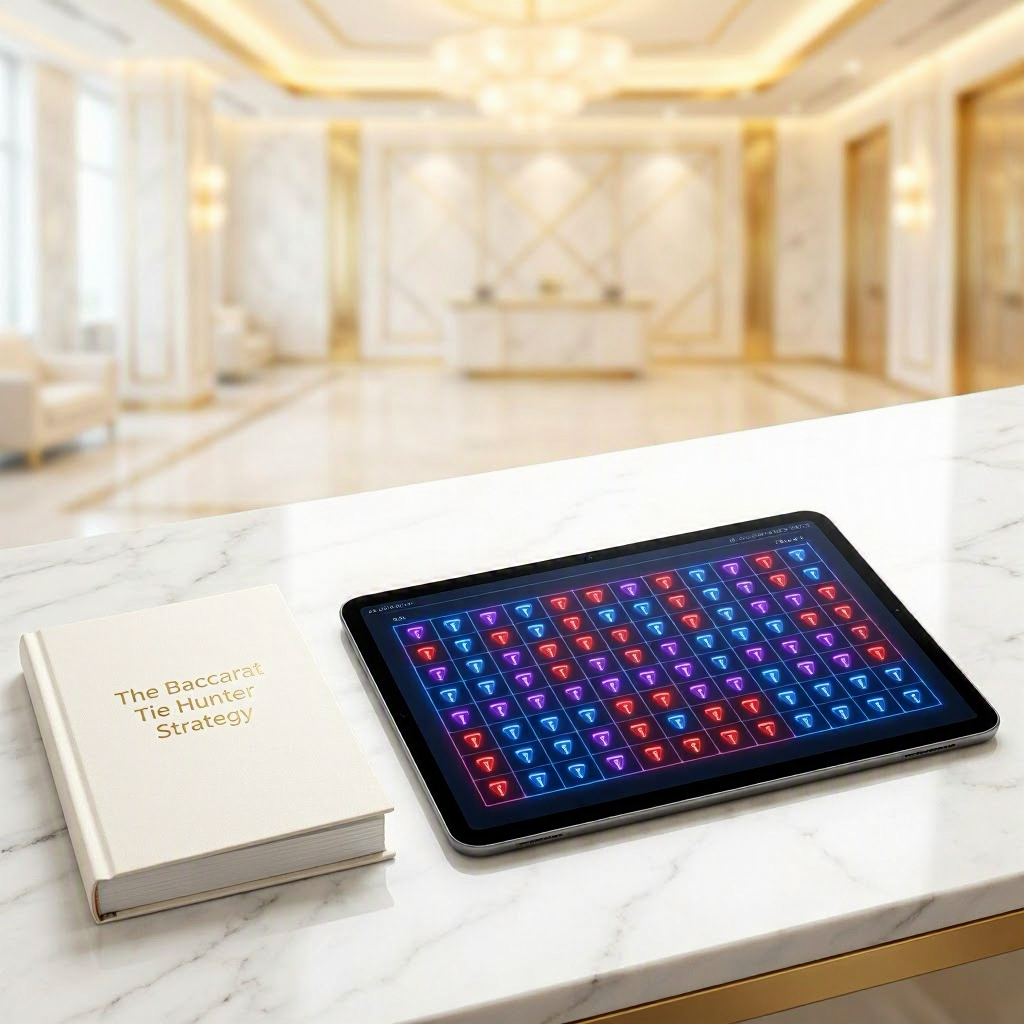
This article draws on the principles behind my book, The Baccarat Tie Hunter Strategy.
The book goes deeper into Égalité side bets, individual Tie numbers, Tie clusters, main road patterns, staking discipline and the difference between random Tie chasing and selective Tie hunting.
I do not reveal the full method here. That belongs in the book. But the central idea can be explained without giving away the system: serious Tie betting should not be based on betting every hand and hoping for the best. It should be selective, structured and controlled by bankroll rules.
That is the dividing line.
A casual Tie bettor chases. A structured Tie bettor waits.
Bankroll Management for High-Volatility Side Bets
Bankroll control matters more with baccarat side bets because the volatility is higher. A player may lose several Tie attempts before one lands. A player may hit a Tie, but not the right Tie number. A player may see a promising shoe dry up. A player may increase stakes emotionally because the last few attempts failed.
That is where damage can happen.
Before placing high-volatility side bets, the player should ask:
- How much am I prepared to risk on side bets?
- When will I stop?
- Am I betting because the shoe has given me a reason, or because I am chasing?
- Am I increasing stakes because there is a structured reason, or because I am frustrated?
- Can I accept missing the result and walking away?
Those questions matter. A high payout should never be used as an excuse to abandon bankroll discipline.
In my view, baccarat side bets should be treated as optional, selective and high-volatility wagers. They are not the foundation of low-risk baccarat play. They are a specialist area for players who understand payout, waiting time, volatility and bankroll pressure.
Final View: Tie Hunting Is Not the Same as Chasing
Baccarat may look like a simple game of Banker versus Player, but the side-bet area creates a different type of risk. Most players are trying to get ahead slowly by winning more Banker or Player hands than they lose. Tie hunters are looking for rarer outcomes that can produce much larger payouts when the timing and number are right.
That difference explains why Tie betting attracts certain players with larger bankrolls and higher risk tolerance. But the danger should never be ignored.
A high payout does not make a bet safe. A rare result does not become due just because the player wants it. A big win on one table does not prove that every Tie bet is a good bet.
The serious approach is to study the shoe, respect the volatility, protect the bankroll and avoid turning Tie hunting into reckless chasing. That is where the real discipline begins.
Frequently Asked Questions
What are baccarat side bets?
Baccarat side bets are optional wagers placed outside the normal Banker, Player and standard Tie decision. They usually offer higher payouts because the outcomes are less common.
What is the Tie bet in baccarat?
The Tie bet wins when Banker and Player finish on the same final total. A standard Any Tie bet often pays 8:1 or 9:1 depending on the table.
What are Égalité bets in baccarat?
Égalité bets are numbered Tie bets. Instead of betting only on Any Tie, the player bets on a specific tied total, such as 0-0, 1-1, 2-2 or 3-3.
What are individual Tie numbers?
Individual Tie numbers are the ten possible baccarat Tie values: Tie 0 through Tie 9. Each number can carry its own payout depending on the table rules.
Why do some baccarat Tie numbers pay 200:1 or more?
They pay more because the player is betting on a narrower result. It is not enough for any Tie to appear. The exact selected Tie number must land.
Are baccarat side bets worth it?
They can be interesting for players who understand volatility and bankroll risk, but they should not be treated as low-risk wagers or guaranteed strategy.
Should you bet the Tie in baccarat?
That depends on the player’s risk tolerance and strategy. The Tie bet is high volatility and should be approached with caution, especially if the player is tempted to bet it every hand.
Can Tie outcomes form clusters in baccarat?
Tie outcomes can appear close together in some shoes and barely appear in others. Some players study whether Ties are isolated, clustered or forming visible patterns on the main road scoreboard.
Are numbered Tie bets better than Any Tie?
Numbered Tie bets can pay much more, but they are also harder to hit because the exact Tie number must appear. Any Tie is simpler but usually pays much less.
What is The Baccarat Tie Hunter Strategy?
The Baccarat Tie Hunter Strategy is Stephen Tabone’s dedicated baccarat book on Égalité side bets, individual Tie numbers, Tie clusters, main road patterns and selective Tie betting.
Can baccarat side bets beat the house edge?
No side bet should be treated as a guaranteed way to beat the house edge. Side-bet strategy is about structure, selectivity and bankroll control, not certainty.
💡 Advanced Strategic Comparison: If you want to understand how response-based frameworks stack up against physical systems, read our definitive analysis on Dice Control vs Baccarat Pattern Strategy at GlobalCasinoGames.com.
📊 Baccarat Tie Strategy: Payout Power vs. Risk Profile
Visualizing volatility metrics based on analytical data from GlobalCasinoGames.com
About Stephen Tabone
Stephen Tabone is a casino strategy author, researcher and founder of Global Casino Games. His published work covers baccarat, roulette, blackjack, bankroll management, house edge, RTP, player risk and betting systems, with wider editorial interest in gambling behaviour and the iGaming industry.
Read his full Global Casino Games author profile, or browse his published casino strategy books on Amazon.