Dice Control vs Baccarat Pattern Strategy: Can You Control Randomness Or Only Read It?
Casino games expert Stephen Tabone compares dice control in craps with baccarat pattern strategy, looking at physical outcome influence, Banker and Player streaks, chops, crossovers and risk points.

Written by Stephen Tabone for Global Casino Games. Last reviewed: 08 June 2026.
Quick Summary:
Dice control in craps is a cause-based strategy. It tries to physically influence a random outcome by controlling the dice throw.
Baccarat pattern strategy is a response-based framework. It studies visible Banker and Player outcomes, streaks, chops, crossovers and shoe behaviour.
The key difference: dice control tries to command the instrument of chance. Pattern analysis studies the record left behind by chance and uses that information for risk management.
House Edge Reference Point
Before comparing dice control with baccarat pattern strategy, the baseline maths should be clear. In standard baccarat, the Banker bet carries a house edge of about 1.06%, while the Player bet is about 1.24%. The Tie bet is much higher, at about 14.36%, and should not be treated as part of a low-edge baccarat strategy.
In craps, the closest low-edge comparison is the Pass Line at about 1.41% and the Don’t Pass at about 1.36%. Free odds behind those bets carry 0% house edge on the odds portion, but they do not remove the original Pass Line or Don’t Pass edge.
That matters because this article is not arguing that baccarat patterns or dice control erase the house edge. The comparison is different: craps dice control tries to influence a physical dice outcome, while baccarat pattern analysis studies a visible card-shoe sequence and uses that record for timing, selectivity and bankroll discipline.
Core Concepts & Analytical Breakdowns
Casino strategy is often treated as one big category, but not all strategies are making the same claim.
Some players talk about dice control in craps. They believe that if they grip the dice correctly, set the numbers properly and throw with the right touch, they may be able to influence the outcome.
Other players study baccarat patterns, Banker and Player streaks, roulette colour runs, high/low runs, zigzags, chops, doubles, triples and crossovers.
Those two approaches are not the same.
Dice control tries to physically influence a random outcome. Pattern analysis tries to read what has already happened and decide whether the next decision point is worth playing.
One approach says, “I can make the dice behave.” The other says, “I cannot control the next result, but I can study the structure of the sequence and manage risk around it.”
In my view, that second approach is the more serious starting point for casino strategy.
Dice Control vs Baccarat Pattern Strategy: Quick Comparison
The two approaches sound similar because both use the language of strategy. In reality, they are making very different claims.
This table shows the real divide.
Craps dice control tries to control the object. Baccarat pattern strategy studies the outcome stream.
That difference is the thread running through this article.
Start With A Fair 50/50 Pattern Before The House Edge
Before we compare craps, baccarat or roulette, we need a clean two-sided model.
The cleanest starting point is not a real casino game.
Real casino games include house edge, commission, zero, payout differences, drawing rules, ties, table limits and other distortions.
So begin with a perfectly fair two-sided model.
Not even a coin toss. A coin can raise questions about weight, spin, surface, landing angle and whether one side is slightly heavier.
A cleaner example is a shuffled stack of cards. Half are marked high. Half are marked low. If the cards are shuffled fairly, each side has an equal structural chance before the next card is revealed.
That does not mean the results must come out neatly.
Even in a perfectly balanced stack, the high cards could appear heavily at the start. You could see 10, 15 or even 20 high cards appear across one section of the sequence before the low cards begin catching up.
The same could happen the other way round.
A fair structure does not always produce a fair-looking short-term sequence.
A balanced card stack can still produce:
High, High, High, High.
Low, High, Low, High.
High, High, Low, Low.
Low, Low, High, Low, High.
High, High, High, High, High, Low, High, Low.
So even before the house edge, random outcomes create visible formations.
Random does not mean neat.
Random gives you streaks, chops, doubles, breaks, false starts, crossovers and messy clusters.
That is the foundation of pattern analysis.
Limited Shoes vs Continuous Spins: Baccarat And Roulette Patterns Are Not The Same
Baccarat is a finite card sequence. Roulette is an open-ended stream of spins.
This difference matters.
In baccarat, the shoe has a beginning, a middle and an end. A standard baccarat shoe is commonly dealt from multiple decks, often six or eight, and the shoe eventually reaches its cut-card point before a new shoe begins. That makes baccarat different from roulette. A baccarat shoe is a limited card sequence. It does not run forever.
That makes baccarat a limited sequence.
A shoe may produce 60, 70, 80 or more hands depending on the number of decks, burn cards, drawing rules and where the cut card appears. But the important point is that the shoe eventually ends.
Those physical limits are explained in my baccarat shoe guide, including six-deck and eight-deck games, burn cards, cut-card placement and why the number of hands varies from one shoe to another.
Roulette is different.
A roulette wheel does not get “used up” in the same way. The ball is spun again and again. If the table keeps running, the sequence can continue for hours. Red and black, high and low, odd and even can keep forming new runs across an open-ended stream of spins.
So baccarat and roulette can both produce streaks and chops, but the structure of the data is different.
In baccarat, you can ask:
How is this shoe developing?
Is Banker dominant?
Is Player dominant?
Is the shoe mostly zigzaggy?
Is there enough shoe left for the weaker side to catch up?
In roulette, the questions are slightly different:
How long has this table session been running?
Are we looking at the last 20 spins, 50 spins or 200 spins?
Are we tracking red and black only, or also high and low, odd and even?
Where do we decide the session begins and ends?
That is why I would not treat baccarat pattern analysis and roulette pattern analysis as identical. They may share ideas, but they do not share the same structure.
Why Random Outcomes Still Create Streaks, Chops And Zigzags
Patterns do not prove control. They prove that randomness leaves visible structure behind.
Players often misunderstand randomness.
They think random should look balanced. Player, Banker, Player, Banker. Red, Black, Red, Black. High, Low, High, Low.
But real random sequences rarely behave that perfectly.
A baccarat shoe can produce a Banker run, a Player run, a chop, a double-line rhythm or an uneven mix of all three.
Roulette colour outcomes can do the same, although red and black are not true 50/50 bets because zero exists. High/low and odd/even have the same problem: zero sits outside those even-money categories. On a single-zero roulette wheel, the house edge is about 2.70%. On an American double-zero wheel, where both 0 and 00 favour the house, the standard house edge rises to about 5.26%.
The important point is simple.
Patterns do not mean the player controls the next result. But they do mean the player has something visible to study.
That is where pattern strategy begins.
You are not saying, “This must happen next.”
You are saying, “This is what the sequence is producing at the moment. Is there a sensible decision point?”
Is Dice Control Real Or Just A Casino Myth?
Dice setting may give some players routine and discipline, but repeatable physical dice control is extremely weak under casino conditions.
Craps feels different from baccarat or roulette because the player physically holds the dice.
That matters psychologically.
In baccarat, you do not control the shoe. In roulette, you do not control the wheel. In slots, you do not control the reel result.
But in craps, you pick up the dice.
You set them.
You grip them.
You throw them.
That physical contact creates the feeling that you might have influence.
Dice control, dice setting or dice influence is built around that idea. The theory is that a player may set the dice in a certain orientation and throw them with a controlled grip, arc and landing angle to reduce unwanted outcomes.
I am not saying every dice-control course is a scam. If someone enjoys learning a dice routine, practising a throw, or spending a weekend with other craps players, that is their choice.
There may be benefits.
A course might teach a player to slow down. It might help them manage emotion. It might make them more selective with bets. It might give them a routine and stop them playing in a completely chaotic way.
Those things are not worthless.
But they are not the same as controlling the dice.
Once the dice leave your hand, you do not control them anymore.
They travel through the air, hit the felt, collide, bounce, strike the back wall and meet the rubber pyramid surface built into the table. Craps rules commonly require the dice to hit the far wall, and the far wall is often covered with pyramidal structures to make controlled throws more difficult.
That is the problem.
Even if the release is almost perfect, the dice still have to survive the landing, the bounce, the collision and the back-wall impact.
That is a lot to ask from a physical “system”.
Is Dice Setting A Scam Or Legitimate Casino Strategy?
I would not use the word scam too loosely.
If dice setting is sold as entertainment, discipline, table routine or craps education, players can decide for themselves whether that experience is worth paying for.
The problem comes when dice setting is presented as a reliable way to physically overcome the house edge.
That is a much bigger claim.
A player may feel more controlled. He may throw more calmly. He may avoid reckless betting. He may enjoy the ritual.
But feeling more disciplined is not the same as controlling the dice.
The Physics Of A Craps Roll: Why The Back Wall Wins
The back wall is the issue that dice-control believers have to overcome.
The dice do not simply travel neatly from hand to table and stop with a smooth landing.
They fly, land, bounce, hit each other, strike the wall, meet the rubber pyramids and settle wherever the chaos sends them.
A tiny difference in grip, finger pressure, landing angle or collision can change the result.
That is why I struggle with the hard dice-control claim.
The player may control the initial release. He does not control the whole physical journey.
The Hole-In-One Problem With Craps Dice Setting
Even if a perfect controlled throw were possible, repeating it under casino conditions is the real problem.
Let’s give dice setting the fairest possible version.
Suppose a player sets the dice properly. Suppose the grip is clean. Suppose the throw is smooth. Suppose the dice stay close to the intended axis through the air.
Even then, the dice must land in almost exactly the right way.
They must not clip each other wrongly.
They must not bounce awkwardly.
They must not catch the felt badly.
They must not hit the pyramids at the wrong angle.
They must not flip over in an unexpected way.
That is why the golf analogy works.
It is like needing a hole-in-one again and again. Not once for a miracle. Repeatedly. Often enough to change the long-term maths.
A single good-looking throw does not prove control.
If the outcome lands in your favour, that may simply mean the dice happened to produce a result that helped you. It does not automatically mean you caused it.
This is the dividing line.
A result can match your intention without being controlled by your intention.
Why Casinos Still Allow Dice Setters
Casinos do not usually allow real advantage play to continue unchecked.
This is one of the strongest practical arguments against dice control.
Casinos are not relaxed about genuine advantage play.
If a method really threatens the house edge, casinos react. They change rules, monitor players, restrict behaviour, back people off or remove the opportunity.
Yet casinos generally allow players to set the dice, take a moment and perform throwing rituals, provided the dice are thrown properly and hit the back wall.
Dice setters often make a softer claim than full control. They usually argue that a player may be able to influence the dice slightly over many rolls, rather than command every throw. Even then, the problem is proof. A tiny, claimed influence can be extremely hard to separate from normal randomness unless it appears consistently across thousands of rolls.
That tells us something.
The casino understands that the table design, the back wall and the physical chaos of the throw make reliable control extremely difficult.
If dice control truly worked in a repeatable casino setting, casinos would not treat it like harmless table theatre.
What Dice-Control Courses May Still Offer
The physical-control claim is weak, but some players may still gain discipline, routine or emotional control.
This is where I think the argument needs balance.
A dice-control course may still give some players value, even if the physical-control claim is weak.
It may teach them to slow down.
It may make them less emotional.
It may make them think more carefully about bet selection.
It may give them a routine.
It may reduce reckless throwing, panic betting or chaotic table behaviour.
It may also be entertainment, like a golf clinic or a weekend gambling seminar.
I do not dismiss those things completely.
If a player enjoys the structure, the social side or the sense of discipline, that is one thing. But the hard claim is different.
A player can benefit from discipline without gaining physical command over a randomising table.
That is the distinction.
Baccarat Pattern Strategy Is A Different Kind Of Claim
Pattern analysis does not say you control the outcome. It says you can study the outcome stream.
Baccarat pattern strategy starts from a different place.
It does not say, “I can make Banker win.”
It does not say, “I can force Player next.”
It does not say, “I know exactly when the next streak will begin.”
It says something more practical:
I can look at the previous outcomes, identify the current structure and decide whether there is a reasonable betting point.
That is not physical control.
That is observation.
In baccarat, the scoreboard lets you see the shoe developing. You can look at the last 10, 20, 30 or 40 outcomes. You can ask whether the shoe is Banker-dominant, Player-dominant, streaky, choppy, double-heavy or unclear.
That does not guarantee the next result.
But it gives you something concrete to work with.
How To Read Baccarat Scoreboard Patterns
The baccarat roadmap does not predict the future, but it can show the current shape of the shoe.
The baccarat scoreboard matters because it gives the player a visual record.
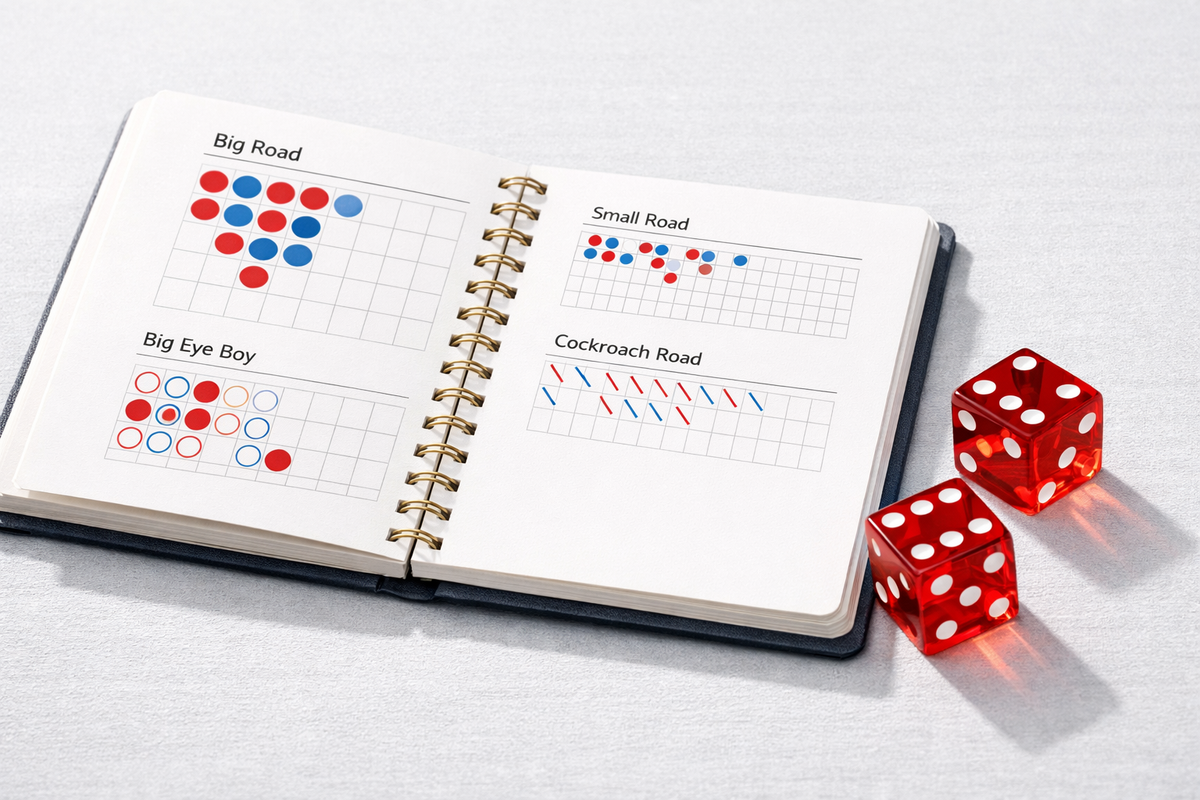
Many baccarat tables show a group of scoreboards or baccarat roadmaps. The most common roadmap terms include the Bead Plate, Big Road, Big Eye Boy, Small Road and Cockroach Pig. These roads do not predict the future, but they help players visualise Banker and Player outcomes, streaks, chops and possible changes in the shoe’s rhythm.
For this article, the important idea is not to explain every derived road in depth. I cover the Bead Plate, Big Road, Big Eye Boy, Small Road and Cockroach Pig in my complete baccarat roadmaps guide.
The key point is that the scoreboard lets you see whether the shoe is producing:
Banker runs.
Player runs.
Chop.
Doubles.
Triples.
Broken streaks.
Messy, unreadable sections.
This does not mean the next hand is known.
It means the shoe has produced a visible structure so far.
That is why I look at the scoreboard as a map, not a prophecy.
A map can still be misread. The road can still turn. But it is better than walking blind.
Main Road vs Big Road: Why The Terminology Matters
Players often use casual language around baccarat scoreboards.
Some people say main road. The more established term is usually Big Road. The Big Road records Banker and Player outcomes in columns and makes streaks easier to see.
That matters because the terminology helps match how serious baccarat players search and think.
If you are studying Baccarat Banker and Player patterns, the Big Road is usually the first place to look.
Spotting The Chop vs The Streak In Punto Banco
A streak means one side keeps repeating.
For example:
Banker, Banker, Banker, Banker.
A chop means the shoe alternates:
Banker, Player, Banker, Player.
Then there are mixed structures:
Banker, Banker, Player, Player.
Banker, Banker, Player, Banker.
Player, Banker, Player, Player.
These formations are not magic. They are the visible shapes produced by the shoe.
The strategy question is not, “Can I know the next hand?”
The better question is, “Is this shoe still producing the same shape, or is it changing?”
What Are The Most Common Baccarat Patterns?
When I look at the Big Road, or what some players call the main road, I start with the rows. If the first row keeps continuing, the logical pattern can only alternate. For example, if Banker starts the line, the first-row rhythm would be:
Banker, Player, Banker, Player, Banker, Player.
Once the pattern reaches the second row, the shoe can start forming doubles:
Banker, Banker, Player, Player.
But it does not have to stay neat. It can also move in a mixed way:
Player, Banker, Banker, Player, Player, Banker, Player.
The same applies when outcomes reach the third row. You may see triples forming:
Banker, Banker, Banker, Player, Player, Player.
But a real shoe does not always line up perfectly. It may look more like:
Banker, Player, Player, Player, Banker, Banker, Player, Player, Banker, Banker, Banker, Player, Banker.
In my view, the third row is important because that is where a run starts to look more established. Some players may treat the double row as enough, but I see a streak as more firmly cemented once it has moved beyond the third result. For example, Banker, Banker, Banker, Banker is no longer just a short double or triple. It has broken into a clearer Banker streak.
That does not mean the streak must continue. It means the scoreboard has given the player something visible to assess. You can see whether the shoe is forming chops, doubles, triples, crossovers or a stronger run.
I cover these outcome formations in more detail in my book The Baccarat Trend Spotting and Betting System.
Banker-Dominant And Player-Dominant Baccarat Shoes
A shoe can have a visible character at a given moment, even if that character later changes.
At any point in a baccarat shoe, you may be able to describe what the shoe has produced so far.
It may be Banker-dominant.
It may be Player-dominant.
It may be zigzaggy.
It may be streaky.
It may be messy and unreadable.
That description is not mystical. It is observation.
If the shoe is halfway through and Banker has clearly dominated, you can say: at this moment, this is a Banker-dominant shoe.
That might change. The second half of the shoe may swing towards Player. A clean Banker run may collapse into chop. A Player recovery may begin.
But if you are making a decision from the evidence on the scoreboard, at least you are responding to something visible.
Near the end of the shoe, the idea becomes more concrete.
If Banker is far ahead and there are not enough remaining hands for Player to catch up, then the shoe will finish Banker-dominant. That is not prediction. That is arithmetic based on what has already happened.
This is one reason baccarat pattern analysis feels more grounded than dice control.
You can see the record.
You can count it.
You can ask what the shoe is producing.
A dice-control player is trying to physically command the next throw. A baccarat pattern player is reading a limited sequence and deciding whether its current character is worth following.
Those are very different things.
Baccarat Streaks Must End — But The Timing Is The Problem
Every streak breaks eventually. The strategy question is whether the break has created a playable crossover.
A Banker streak cannot continue forever.
A Player streak cannot continue forever.
Every streak must end, but that does not mean the player knows exactly when it will end.
That is where the real strategy question appears.
Suppose the shoe gives:
Banker, Banker, Banker, Banker.
Then Player appears.
Has the Banker streak ended? Possibly. But one Player may only be a break in the run.
Now suppose the next result is Banker:
Banker, Banker, Banker, Banker, Player, Banker.
At this moment, a pattern reader may start watching for the next Player. If the next outcome is Player, the shoe has moved into a Player-Banker-Player crossover:
Banker, Banker, Banker, Banker, Player, Banker, Player.
That is the kind of decision point I look for.
I am not saying Player must come. I am saying that if Player appears, the original Banker run is structurally broken and the shoe may be moving into chop or zigzag.
That is a serious difference.
You are not controlling the cards.
You are reading the transition.
Zigzag Baccarat Patterns And The Big Road Scoreboard
Most shoes are not just long Banker runs followed by long Player runs. Many move through shorter runs and messy chop.
If you watch enough baccarat scoreboards, you begin to see how many shoes behave.
Some shoes produce strong streaks. Some produce long Banker runs. Some produce long Player runs.
But many shoes are more zigzaggy than people expect.
They move through:
Banker, Player, Banker, Player.
Banker, Banker, Player, Player.
Banker, Banker, Player, Banker.
Player, Banker, Player, Player.
Banker, Player, Player, Banker.
That is why the Big Road matters.
It gives the player a visual map of the shoe’s behaviour. It does not predict the next hand with certainty, but it makes the structure visible.
A dice throw gives you no such record to respond to physically.
A baccarat shoe does.
That is why, in my view, there is more substance in studying outcome patterns than in believing you can physically command two dice after they hit a casino craps wall.
Why A Baccarat Shoe Can Change Character Halfway Through
A zigzaggy shoe can become streaky. A streaky shoe can become choppy.
A baccarat shoe has a character, but that character is not fixed forever.
A shoe may begin with repeated zigzags:
Banker, Player, Banker, Player, Banker, Player.
Then suddenly it may produce:
Banker, Banker, Banker, Banker.
The reverse can also happen. A shoe may begin with a strong Banker run, then break into doubles, chops and Player responses.
That is why pattern analysis should never be rigid.
The player is not saying:
This shoe was zigzaggy early, so it must stay zigzaggy forever.
The better question is:
Is the shoe still behaving the same way, or has the structure changed?
If the first half of the shoe is heavily zigzaggy, it may be reasonable to watch for that behaviour to continue. But the player must also accept that the second half can change.
That is why pattern strategy needs both observation and humility.
The shoe gives information, but it does not give certainty.
Roulette Red/Black, High/Low And The Problem Of Open-Ended Data
Roulette patterns can run longer because the game does not end like a baccarat shoe.
Roulette is fascinating because it gives players a different kind of pattern problem.
If you look only at red and black, you may see streaks, chops and doubles in the same broad way you would see two-sided patterns elsewhere.
But roulette is not a shoe.
There is no fixed deck being exhausted. There is no cut card. There is no natural point at which the sequence must end, unless the casino closes the table, the player leaves or the observer stops tracking.
That means roulette streak data can stretch further.
A colour run can continue for many spins. A high-number run or low-number run can also develop. Odd and even can do the same.
The difficulty is that red and black are visually obvious, while high/low and odd/even can be missed more easily unless somebody is recording them carefully. This kind of structural pacing is entirely different from automated machine programming, where software caps your decision windows entirely. If you want to understand how software variance is legally structured outside of live tables, read our complete guide to the new UK Online Slot Limits 2026 Explained to see how spin dynamics are heavily restricted.
Red/Black Roulette Streaks May Be Recorded More Than High/Low Streaks
Roulette history often talks about red and black streaks because colour is easy to see.
The famous Monte Carlo example is usually described as a run of 26 blacks in a row in 1913, often used as a classic example of the gambler’s fallacy.
The Night Monte Carlo Broke the Human Brain
Location: Casino de Monte-Carlo — A Live Anatomy of the Gambler's Fallacy
But red and black are not the only even-money roulette categories.
There are also high and low, odd and even.
It is possible that historical observers recorded red and black more often simply because colour streaks were easier to notice and more dramatic. A long high-number or low-number streak may not have been noticed in the same way, especially before electronic displays and modern outcome-tracking systems.
That does not mean high/low streaks are less real.
It means the folklore of roulette may be biased towards the most visible pattern: colour.
Pattern Continuation vs Pattern Change
The practical question is whether the shoe is continuing its current character or changing into a new one.
A pattern player is always asking one question:
Is this sequence continuing, or is it changing?
If a baccarat shoe has been zigzaggy halfway through, it may continue that way. It may also change into a streak-heavy shoe.
Nothing is guaranteed.
But if the shoe has already produced repeated chop formations, then betting for continuation has some visible basis.
If the shoe has been Banker-dominant for 40 outcomes, then Banker dominance is not an opinion. It is what the shoe has produced so far.
If a streak is weakening and crossover points begin to appear, then a player may decide the better opportunity is not to follow the old run, but to watch for the transition.
This is not fortune-telling.
It is structured decision-making.
How To Apply Baccarat Pattern Strategy In Real Play
The practical value is not prediction. It is structure.
A player should not approach baccarat pattern strategy by trying to guess every hand.
The better approach is slower.
First, identify the character of the shoe. Is it Banker-dominant, Player-dominant, zigzaggy, streaky, double-heavy or unclear?
Second, wait for a decision point. Do not force a bet just because the scoreboard exists.
Third, ask whether the shoe is continuing or changing. A streak may be extending. A chop may be forming. A crossover may be developing.
Fourth, keep the stake controlled. A good read can still lose.
Fifth, stop when the structure disappears. If the shoe becomes messy, the best decision may be no bet.
That is where pattern analysis has practical value.
It gives the player a way to think before betting.
It does not guarantee the result.
Common Mistakes In Dice Control And Baccarat Pattern Reading
The biggest danger is not losing one bet. It is misunderstanding what the strategy can and cannot do.
There are mistakes on both sides of this debate.
With dice control, the biggest mistake is thinking that a good-looking throw proves physical control.
A dice result can match what the player wanted without being caused by the player.
With baccarat pattern reading, the biggest mistake is treating a visible pattern as a guarantee.
A Banker run can continue. It can also break. A zigzag shoe can stay choppy. It can also suddenly turn streaky.
The common mistakes are:
Believing one successful dice throw proves control.
Treating a baccarat streak as if it must continue.
Treating a chop as if it must keep alternating.
Chasing losses after a failed pattern read.
Ignoring when the shoe changes character.
Increasing stakes because the player feels “due”.
Reading too much into a short sample of outcomes.
That is why I always come back to risk management.
A pattern can give you a decision point.
It cannot give you certainty.
Prediction Is Not Foreknowledge
Every bet is a prediction, but no serious pattern strategy should pretend the future is known.
Some people say, “You cannot predict baccarat.”
That depends what they mean.
If they mean you cannot know the next result with certainty, they are right.
But every bet is still a prediction.
When you bet Banker, you are predicting Banker.
When you bet Player, you are predicting Player.
When you bet red, you are predicting red.
When you bet a craps number, you are predicting a dice outcome.
The question is not whether the player is predicting.
The question is whether the prediction is based on anything more than impulse.
Pattern analysis gives the player a framework. It says: look at the previous outcomes, identify the current structure, wait for a decision point, control your stake and accept that the read may fail.
That is a much better approach than pretending the next outcome is known.
Why Bankroll Management Matters More Than The Pattern
A good read can still lose. A bad staking plan can destroy the whole session.
Pattern analysis without bankroll management is dangerous.
A player can read a shoe reasonably well and still lose if he stakes badly.
He may press too hard.
He may chase after a failed read.
He may increase after losses.
He may assume the shoe “owes” him.
He may continue betting after the structure has disappeared.
That is not strategy.
That is emotion wearing a strategy costume.
A serious pattern method needs stop-loss limits, sensible stake sizing, session control and the ability to walk away when the shoe no longer gives clear information.
The aim is not to win every bet.
The aim is to avoid random, emotional betting and make decisions around visible structure.
House Edge Still Matters
Pattern analysis may structure decisions, but it does not remove casino mathematics.
The house edge does not disappear because a player studies patterns.
In baccarat, Banker and Player are close, but not identical. Under standard baccarat rules, the usual house edge is about 1.06% on Banker, 1.24% on Player, and much higher on the Tie bet, at about 14.36%. That is why pattern analysis should still be treated as a decision framework, not a way to remove the casino’s mathematical advantage.
In roulette, red and black are not true 50/50 bets because zero is neither red nor black. The same applies to high/low and odd/even. On a single-zero roulette wheel, the standard house edge is about 2.70%. On an American double-zero wheel, where both 0 and 00 favour the house, the standard house edge rises to about 5.26%. So even-money roulette bets may look close to 50/50, but the zero creates the casino’s mathematical advantage.
The Mathematical Anchor: House Edge Breakdown
"The dance of micro outcomes on the roadmap structures risk management, but it never alters these fundamental casino percentages."
"Even-money bets look close to a true 50/50 model, but open-ended spin streams easily lead to the Gambler's Fallacy."
So pattern analysis should not be sold as a guaranteed way to beat the casino. It is better understood as a decision framework. It can help a player choose when to enter, when to avoid a messy table, when to stop, and how to think about risk.
In my opinion, the more you practise spotting patterns, the more you begin to see the relationship between the outcomes. On a micro level, you are watching individual Banker and Player results being placed on the scoreboard. I sometimes think of this as the dance of the outcomes. You are seeing where the hands land, how they connect, and whether the shoe is forming chops, doubles, triples, crossovers or streaks.
But on a macro level, you are not staring at every single outcome in isolation. You are looking at the wider pattern. You are asking what the shoe is actually producing. Is Banker dominating? Is Player starting to respond? Is the shoe becoming zigzaggy? Is a trend forming? Is the previous trend weakening?
That higher level is where the decision-making begins. You have seen the outcomes. You have looked at the scoreboard. You have considered the numbers, the balance between Banker and Player, and the way the pattern is forming. Then you decide whether there is a reasonable move to make.
I remember one evening in a land-based casino where Banker was well ahead overall. I do not mean Banker was on a live streak of 10 or 20 hands in a row. That would be a different situation entirely. I would not simply bet against a strong live Banker run just because it had gone long, because a run of 10 can always become a run of 15 or 20.
What I mean is that, across the shoe up to that point, Banker had built a clear overall lead. From memory, the shoe was around 50 hands in, and Banker was roughly 20 hands ahead of Player, with perhaps around 30 hands left. There had been streaks along the way, but my decision was not based on trying to break a live Banker streak.
I waited until the immediate Banker pressure had reset and Player appeared again. Once I had that first sign that Player was back in the shoe, I started betting Player for that section. My thinking was linked to a form of return-to-the-mean logic within a finite shoe. Unlike roulette, where the spin sequence can continue almost indefinitely, a baccarat shoe has a limited number of hands. If one side is heavily ahead overall, there may be situations where the other side starts to catch up during the remaining part of the shoe.
That does not mean Player must catch up. It does not mean Player will overtake Banker. It does not even mean the shoe will finish close. The point is that, if Player starts to dominate that tail-end section, even by enough for me to get three or four net hands ahead after losses, the move can become profitable.
In that session, I did not win every hand, but Player did start to close the gap, and the decision worked for that part of the game. However, winning at the table is only half the battle; managing your capital after a successful session requires knowing how operators process your payouts. To make sure your hard-earned table variance transitions smoothly off the felt, look over our expert review on Maximum UK Online Casino Withdrawal Limits Explained 2026 so you aren't caught off guard by processing caps or hidden compliance holds.
Someone else may look at the same shoe and say, “Banker is dominant, so I would stay with Banker.” That is a valid argument. My point is not that there is only one correct interpretation. My point is that the scoreboard gave me something visible to assess: the overall Banker lead, the remaining shoe length, the return of Player after the immediate pressure reset, and the possibility that Player could recover some ground.
This is not a guaranteed system, and I am not telling the reader to follow it blindly. It is one example of how a player might factor shoe balance, remaining hands, pattern movement, trend strength and risk into the decision-making process. Pattern analysis is not about certainty. It is about weighing probabilities, reading the shoe in front of you, and deciding whether the risk is worth taking.
There is an old phrase: the trend is your friend until the end. In casino terms, the important question is where the end is. For me, the “end” means the point where the move has either produced a profit, failed, or stopped making sense. The trend is useful only while it is still giving you a reason to stay with it.
I discuss this way of reading trends, outcomes and decision points in more detail in my book The Baccarat Trend Spotting and Betting System, along with my other casino strategy books available on Amazon.
Dice Control vs Pattern Reading: Which Is More Practical?
Dice control tries to command the instrument of chance. Pattern analysis studies the record left behind by chance.
This is the real dividing line between the two approaches.
Dice control is a cause-based claim.
It says the player can cause a physical outcome by throwing the dice in a certain way.
Pattern analysis is a response-based method.
It says the player can respond to visible outcomes after they have happened.
That is the cleanest distinction.
Dice control asks the player to believe he can physically influence a randomising process.
Pattern analysis accepts that the player cannot control the next result, then asks whether the developing sequence offers a sensible decision point.
One tries to command randomness.
The other studies randomness after it has spoken.
What A Serious Casino Strategy Should Claim
A strategy can help structure decisions without pretending to guarantee profit.
A serious casino strategy should not say:
This guarantees profit.
It should not say:
This beats the casino forever.
It should not say:
This pattern must win next.
It should say something more honest:
This framework helps the player identify visible structures, choose decision points, manage risk and avoid random emotional betting.
That is the standard I prefer.
A strategy should make a player more disciplined, not more deluded.
It should help the player understand risk, not pretend risk has disappeared.
Frequently Asked Questions About Dice Control And Baccarat Pattern Strategy
Can you actually control the dice in craps?
I do not believe repeatable physical dice control works under real casino conditions.
A player can control the grip, set and release. After that, the dice hit the felt, bounce, collide and strike the rubber pyramid back wall. That physical journey is exactly where reliable control breaks down.
Is dice setting a scam?
Not always.
If dice setting is sold as entertainment, discipline, practice or craps education, players can decide whether they enjoy that. But if it is sold as a reliable way to physically beat the house edge, I would treat that claim with serious caution.
Why do casinos allow players to set the dice if dice control works?
Casinos allow dice setting because they know the physical mechanics of a standard craps table make repeatable influence extremely difficult.
The dice must travel, bounce, collide and strike the back wall. If dice setting consistently threatened the house edge, table rules would change quickly.
What is the difference between influence and control in craps?
Control means reliably causing the dice to land in a chosen way.
Influence is a softer claim. It suggests the player may slightly change the probabilities over many rolls. Even that is difficult to prove under normal casino conditions because ordinary randomness can hide small differences for thousands of rolls.
Can dice control reduce the house edge?
In theory, even a small change in dice probabilities could affect the house edge.
In practice, the problem is proving that repeatable influence exists after the dice hit the table, bounce, collide and strike the rubber pyramid back wall. That is why I treat dice control claims with caution.
Can baccarat patterns beat the house edge?
No baccarat pattern removes the house edge.
Pattern analysis may help a player identify visible structures, avoid messy decisions and manage risk. It does not change the underlying casino maths.
Why do baccarat players track patterns?
Baccarat players track patterns because the scoreboard gives them a visible record of Banker and Player outcomes.
The pattern does not guarantee the next hand, but it can help players identify streaks, chops, crossovers and unclear sections of the shoe.
Can you predict baccarat shoe trends?
You can make a judgement about a developing shoe, but you cannot know the next result with certainty.
A Banker-dominant shoe, Player-dominant shoe, streak or chop can give you something visible to study. But the shoe can change character at any time.
What is the safest baccarat pattern to follow?
There is no safest baccarat pattern in the sense of guaranteed profit.
A clean, visible structure may be easier to read than a messy shoe, but every pattern can fail. The safest approach is controlled staking, selective betting and stopping when the shoe becomes unclear.
Do baccarat patterns work in live dealer games?
Live dealer baccarat still produces visible Banker and Player outcomes, so the same pattern-reading ideas can be applied.
The important point is that the pattern does not control the next result. It only gives the player a structure for reading what has happened so far.
What is the gambler’s fallacy in roulette and baccarat?
The gambler’s fallacy is the mistake of believing that a previous run forces the opposite result to appear next.
For example, after a long run of black in roulette, some players assume red is “due”. The famous Monte Carlo example involved black appearing 26 times in a row in 1913, with gamblers reportedly losing heavily by betting against the run.
In baccarat, the shoe is finite, so the card composition changes. But that still does not mean a simple visible streak guarantees the next result.
Is pattern analysis the same as fortune-telling?
No.
Good pattern analysis should not pretend to know the future. It is a decision framework based on visible outcomes, risk management and disciplined betting points.
Final View: Dice Control Is Physical Hope, Pattern Analysis Is Structural Reading
Dice control and baccarat pattern analysis should not be treated as the same type of strategy.
Dice control asks the player to believe he can physically influence two dice after they have left his hand, hit the felt, bounced, collided and struck a rubber pyramid wall designed to randomise the outcome.
Pattern analysis asks something more modest.
It asks the player to study what has already happened, identify streaks, chops, crossovers, Banker-dominant shoes, Player-dominant shoes and decision points, then manage risk around that evidence.
Neither approach guarantees profit.
Neither removes the house edge.
But there is a major difference between trying to control the instrument of chance and studying the visible record it leaves behind.
A dice throw gives you hope.
A baccarat scoreboard gives you information.
Information can still be misread. Patterns can still fail. A shoe can change character without warning.
But for a serious strategy player, working from visible structure is a stronger foundation than believing two dice can be repeatedly guided through casino chaos.
Baccarat gives the player a limited shoe to read. Roulette gives the player an open-ended stream of spins. Craps gives the player the dice for a moment, then takes control away through bounce, collision and the back wall.
That is why these strategies should not be judged as if they are the same.
Dice control is a claim of physical influence.
Pattern analysis is a claim of interpretation.
One tries to control the instrument.
The other studies the record.
About Stephen Tabone
Stephen Tabone is a casino strategy author, researcher and founder of Global Casino Games. His published work covers baccarat, roulette, blackjack, bankroll management, house edge, RTP, player risk and betting systems, with wider editorial interest in gambling behaviour and the iGaming industry.
Read his full Global Casino Games author profile, or browse his published casino strategy books on Amazon.