How to Make Better Blackjack Decisions: Basic Strategy, Rules and Bankroll Control
A practical guide to better Blackjack decisions, covering basic strategy, 3-to-2 rules, Martingale risk, card counting, playing speed, expected loss and bankroll control.

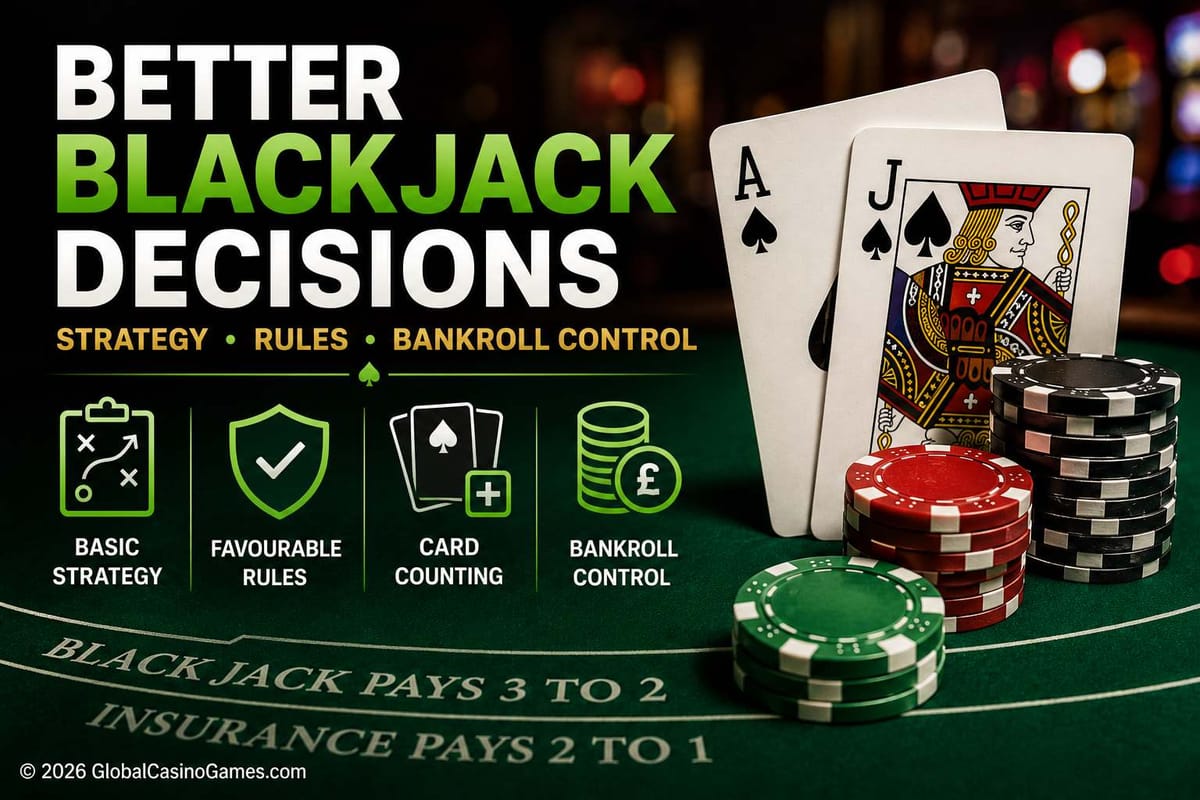
How Blackjack basic strategy, table rules, card counting, betting systems, playing speed and bankroll limits affect the house edge and the real cost of play.
Written by Stephen Tabone for Global Casino Games. Last reviewed: 24 July 2026.
Quick Answer
Better Blackjack decisions begin before the first hand. Look for favourable rules, especially a 3-to-2 Blackjack payout, use the correct basic-strategy chart, set an affordable betting unit and avoid assuming that a staking system can change the next card. Card counting may identify periods when the remaining shoe becomes more favourable, but it requires accuracy, sufficient penetration and disciplined bankroll control.
⚡ Quick Decision Check
Test your instinct against mathematically optimal basic strategy.
Blackjack appears simple when reduced to one objective: finish closer to 21 than the dealer without going over.
Real play demands much more.
Within seconds, I may need to hit, stand, split, double or surrender. At the same time, I am watching the dealer’s upcard, remembering the table rules, considering the money already exposed and deciding whether fatigue is affecting my judgement.
I describe this as Blackjack decision pressure.
The pressure comes from making several financial and mathematical choices while the outcome remains unknown.
Trying to predict every card is not the solution.
My approach is to settle as many decisions as possible before the hand begins.
What Is the Best Blackjack Strategy for Reducing the House Edge?
Accurate Blackjack basic strategy is the strongest starting point.
Basic strategy identifies the mathematically preferable action for each player hand against each dealer upcard. Depending on the situation, that action may be to:
- Hit.
- Stand.
- Double down.
- Split.
- Surrender.
Following the chart does not guarantee that the next hand will win.
Instead, it selects the action with the highest expected value—or the lowest expected loss—across repeated comparable situations.
With favourable rules and accurate play, the Blackjack house edge can fall to approximately 0.5%. The exact percentage depends on the number of decks, Blackjack payout, dealer soft-17 rule and the options available to the player.
| Approximate house edge | Total amount wagered | Theoretical expected loss |
|---|---|---|
| 0.5% | £1,000 | £5 |
| 1.0% | £1,000 | £10 |
| 2.0% | £1,000 | £20 |
These figures are long-term averages, not promises about one session.
Someone wagering £1,000 at a 0.5% game might finish considerably ahead or behind. Variance controls the immediate path. The house edge controls the long-term mathematical direction.
For a wider comparison with Baccarat, roulette and other table games, see my casino house-edge comparison guide.
Which Blackjack Rules Give Players the Best Odds?
Before considering a betting method, I check the table rules.
Perfect hand decisions cannot repair an unnecessarily expensive paytable.
Why Is 3-to-2 Blackjack Better Than 6-to-5?
A natural Blackjack on a £20 wager produces:
- £30 profit at 3 to 2
- £24 profit at 6 to 5
Choosing 6 to 5 removes £6 from the profit on every £20 natural.
| Starting wager | 3-to-2 profit | 6-to-5 profit | Reduced profit |
|---|---|---|---|
| £10 | £15 | £12 | £3 |
| £20 | £30 | £24 | £6 |
| £50 | £75 | £60 | £15 |
| £100 | £150 | £120 | £30 |
Repeated reductions of this kind materially increase the game’s cost.
I would rather play a slower 3-to-2 table than a rapid 6-to-5 game surrounded by attractive graphics and high-edge side bets.
What Blackjack Table Rules Should You Check?
Important rules include:
- Whether Blackjack pays 3 to 2 or 6 to 5.
- Whether the dealer stands or hits on soft 17.
- Whether doubling after splitting is permitted.
- Whether late surrender is available.
- Whether pairs and Aces can be resplit.
- How many decks are in use.
- Whether a continuous shuffling machine is operating.
No single rule determines the complete house edge.
The combined paytable and playing conditions establish the game’s starting mathematical cost.
Why Do Blackjack Players Make Mistakes Under Pressure?
Several questions can arrive at once:
- Should I hit or stand?
- Is doubling allowed here?
- Should this pair be split?
- What happens if the next card is a ten?
- Could the dealer bust?
- Has another player changed the card order?
- Am I already risking too much?
- Should I raise the next wager?
Financial pressure and fear can distort the answer.
Someone may stand on a weak total because busting feels worse than being beaten by the dealer. Another player may reject surrender because losing half a wager immediately feels unacceptable.
To reduce that pressure, I arrange the decisions in a fixed sequence.
My Five-Step Blackjack Decision Framework
- Check the table: Are the rules and payout acceptable?
- Set the exposure: What starting unit can the bankroll support?
- Play the hand: What action does basic strategy require?
- Assess the shoe: Is reliable information available about the remaining cards?
- Review the session: Has the loss, time or concentration limit been reached?
Order matters.
Trying to count cards while still guessing whether to hit, stand or double adds complexity before the foundation is secure.
Can Correct Blackjack Basic Strategy Still Lose?
Yes.
Mathematically sound play improves the quality of the decision. It does not control the next card.
Consider two players holding hard 16 against a dealer ten.
One follows the correct strategy for the table and hits. A ten arrives, causing the hand to bust.
Another stands incorrectly. The dealer later busts, allowing that player to win.
One result does not make the weaker choice superior.
Immediate outcomes and expected value measure different things.
Across repeated comparable hands:
- Stronger decisions reduce expected losses.
- Weaker decisions increase expected losses.
- Either choice can win or lose once.
This is one of the hardest parts of Blackjack psychology.
Players see the card that arrived and naturally judge the choice through hindsight. I try to judge whether the action was mathematically justified using the information available beforehand.
A winning mistake remains a mistake.
A losing decision can still have been correct.
Can Blackjack Betting Systems Change the Odds?
Betting systems alter wager size, timing or progression.
They do not automatically improve the probability of winning the next hand.
Some systems may change how profits and losses are distributed. None can force a favourable card from an ordinary negative-expectation shoe.
Why Is Martingale Risky in Blackjack?
Martingale doubles the wager after every loss.
Starting from £5:
| Loss in sequence | Next required wager | Cumulative loss |
|---|---|---|
| 1 | £10 | £5 |
| 2 | £20 | £15 |
| 3 | £40 | £35 |
| 4 | £80 | £75 |
| 5 | £160 | £155 |
| 6 | £320 | £315 |
| 7 | £640 | £635 |
Following seven losses, the bankroll is £635 behind and another £640 is required.
Blackjack also disrupts the clean even-money structure assumed by many progressions:
- Naturals may pay 3 to 2.
- Doubles require an additional full wager.
- Splits create extra hands.
- Surrender loses half the stake.
- Pushes return the wager without recovering earlier losses.
A starting bet can therefore expand before the result of the round is known.
📉 Martingale Risk Visualiser
See how fast consecutive losses multiply your required stakes and trap your bankroll.
For a broader analysis of why progressions do not remove casino advantage, read my even-money casino betting-systems guide.
Are Positive Blackjack Progressions Safer?
Positive progressions raise the stake after wins rather than losses.
That structure avoids demanding the largest bet while the bankroll is already falling.
However, the probability of the next hand remains unchanged. A later loss may also return much of the profit accumulated during the winning sequence.
I therefore treat progressions as stake-distribution methods, not methods for changing the cards or removing the house edge.
Can Card Counting Give a Player a Blackjack Advantage?
Card counting differs from ordinary progression betting.
Rather than reacting only to the previous win or loss, counting estimates whether the remaining card composition has become more favourable.
The common Hi-Lo system assigns:
- +1 to cards 2 through 6.
- 0 to cards 7 through 9.
- −1 to tens, face cards and Aces.
A running count then needs to be adjusted for the estimated number of decks remaining:
True count = running count ÷ estimated decks remaining
| Running count | Decks remaining | Approximate true count |
|---|---|---|
| +8 | 4 | +2 |
| +8 | 2 | +4 |
| +6 | 1.5 | +4 |
The same running count becomes more significant when fewer decks remain.
A greater concentration of tens and Aces can favour the player because it may produce:
- More natural Blackjacks.
- Stronger double-down opportunities.
- More valuable splitting situations.
- Increased dealer-bust potential in some circumstances.
- Profitable insurance at sufficiently high counts.
Counting remains demanding. It depends on:
- Accurate basic strategy.
- Reliable deck estimation.
- Sufficient shoe penetration.
- No continuous shuffling machine.
- Correct betting and strategy deviations.
- Concentration over many rounds.
- A bankroll capable of surviving variance.
For those reasons, I see counting as an advanced layer rather than the starting point.
Does Another Blackjack Player Taking Your Card Affect the Result?
Another player’s choice changes which physical card reaches each later position.
Nobody knows beforehand whether that change will help or harm the table.
A player might take the card that would have caused the dealer to bust. The same action could remove a card that would otherwise have completed the dealer’s hand.
Once every card is visible, reconstructing an alternative sequence becomes easy.
Predicting that sequence beforehand is not.
Blaming another player usually relies on hindsight. Each person should make the best permitted decision for their own hand rather than trying to preserve an unseen card for someone else.
How Many Blackjack Hands Per Hour Increase Expected Loss?
Playing speed raises turnover.
Suppose the average opening wager is £10 and the effective house edge is 0.5%.
| Hands per hour | Approximate turnover | Theoretical expected loss |
|---|---|---|
| 50 | £500 | £2.50 |
| 100 | £1,000 | £5 |
| 200 | £2,000 | £10 |
Nothing has changed about the house edge per wager.
More money has simply been exposed to it.
Fast online Blackjack can therefore carry a higher expected hourly cost than a slower physical table using identical rules.
⏱️ Speed & Turnover Tracker
See how game speed and rules multiply your hourly theoretical cost.
Splits and doubles make the true turnover higher than the opening wagers alone suggest.
Fatigue may add another hidden cost. Once concentration weakens, incorrect decisions can raise the effective disadvantage beyond the published game edge.
How Much Bankroll Do You Need for Blackjack?
Before playing, I decide:
- Total session bankroll.
- Normal starting unit.
- Maximum acceptable loss.
- Whether doubles and splits fit inside that limit.
- Maximum playing time.
- Conditions that end the session.
With £500:
- A £10 unit provides 50 opening units.
- A £25 unit provides only 20 opening units.
Yet the first chip does not represent the maximum possible round exposure.
A £10 starting wager might become:
- £20 after doubling.
- £20 across two split hands.
- £30 or £40 after resplitting and doubling.
Bankroll planning should therefore account for the possible total exposure on one round, not merely the first wager.
How Can You Improve Your Blackjack Strategy?
Useful improvement comes from removing avoidable disadvantages.
My priorities are:
- Select 3-to-2 Blackjack whenever possible.
- Match basic strategy to the exact table rules.
- Avoid judging decisions only by whether one hand won.
- Treat betting systems as staking structures.
- Learn card counting only after basic strategy is accurate.
- Include splits and doubles when calculating exposure.
- Control speed and total turnover.
- Stop when fatigue or losses begin changing decisions.
Each layer has a separate function:
Better table rules reduce the starting disadvantage.
Basic strategy reduces playing errors.
Card composition may reveal changing expected value.
Bankroll limits control financial exposure.
One layer cannot replace another.
A progression cannot repair poor rules.
Counting cannot repair inaccurate basic strategy.
Basic strategy cannot eliminate variance.
A large bankroll cannot turn every negative-expectation table into a profitable game.
Blackjack Strategy Is About Controlling What You Can
Casino management chooses the table rules and payout.
The shuffled shoe determines the order of the remaining cards.
My control is limited to four areas:
- Which table I join.
- How much money I place at risk.
- Which permitted action I take.
- When I stop playing.
Trying to solve every uncertain outcome creates pressure without creating control.
The more decisions I settle in advance, the less likely I am to react emotionally after a loss, a dealer Blackjack or a sequence of unfavourable cards.
No method can guarantee a profitable session.
Better rules, accurate decisions and controlled exposure can prevent the game from becoming more expensive than it needs to be.
Blackjack Strategy & Odds FAQ: Expert Decisions Under Pressure
1. Why exactly does a 6-to-5 payout structure damage my long-term baseline return? +
A 6-to-5 payout cuts your natural blackjack winnings from 1.5x your bet down to 1.2x. While a £20 wager nets £30 at a standard 3-to-2 table, it only returns £24 at a 6-to-5 table. Over hundreds of hands, this hidden reduction extracts an extra £6 per natural, driving up the game's overall cost and rendering perfect basic strategy less effective at saving your bankroll.
2. If perfect basic strategy cannot control the next card, why should I strictly follow it? +
Basic strategy is built on long-term expected value, not immediate trial outcomes. An incorrect move (like standing on a hard 16 against a dealer 10) might occasionally win if the dealer happens to bust, but across repeated identical setups, that choice increases your expected mathematical losses. Following the chart guarantees you always choose the path with the lowest statistical loss or highest average yield.
3. Can a negative-progression system like Martingale neutralize a bad house edge? +
No, progressive betting systems change the size and timing of your wagers, but they cannot alter the mathematical composition of the shoe. Doubling after losses simply creates exponential financial risk—escalating a humble £5 starting unit to a massive £640 bet after just seven bad hands—forcing you to risk your entire bankroll just to recoup your original minor stake.
4. How does fast online blackjack speed alter my financial exposure compared to a live table? +
Playing speed drastically multiplies your hourly financial turnover. While a physical casino table might average 50 hands per hour, online sessions easily push to 200 hands hourly. At a baseline house edge of 0.5%, your expected hourly cost jumps fourfold from £2.50 to £10.00 simply because you are exposing more money to the house edge in less time.
5. Why should my opening blackjack wagers be much smaller than my total session limits? +
Your initial chip placement does not equal your true max exposure for that round. Correct basic strategy frequently demands doubling down, splitting identical pairs, or resplitting into multiple hands. A routine £10 base bet can quickly expand to £30 or £40 in mid-hand adjustments. Your bankroll unit size must have room to cushion these high-value strategy moves without draining your capital early.
6. Is it true that bad choices by other players at my table disrupt my personal win rates? +
No, this is a psychological illusion fueled entirely by hindsight. Another player's random actions will change the sequence of physical cards, but it is impossible to predict beforehand whether that shift will save or sink the table. Over time, their mistakes are mathematically neutral to your hand, meaning your primary focus should rest solely on making your own optimal strategy choices.
7. How does a card counting system like Hi-Lo actually generate a player advantage? +
Unlike betting progressions, counting tracks shifting probabilities based on the cards remaining in the shoe. By weighting high and low values (+1 or -1), it indicates when fewer decks remain with a high density of tens and aces. This ratio shift signals an increased chance of natural blackjacks, higher-value double downs, and dealer-bust occurrences, allowing players to safely scale up their bet sizing.