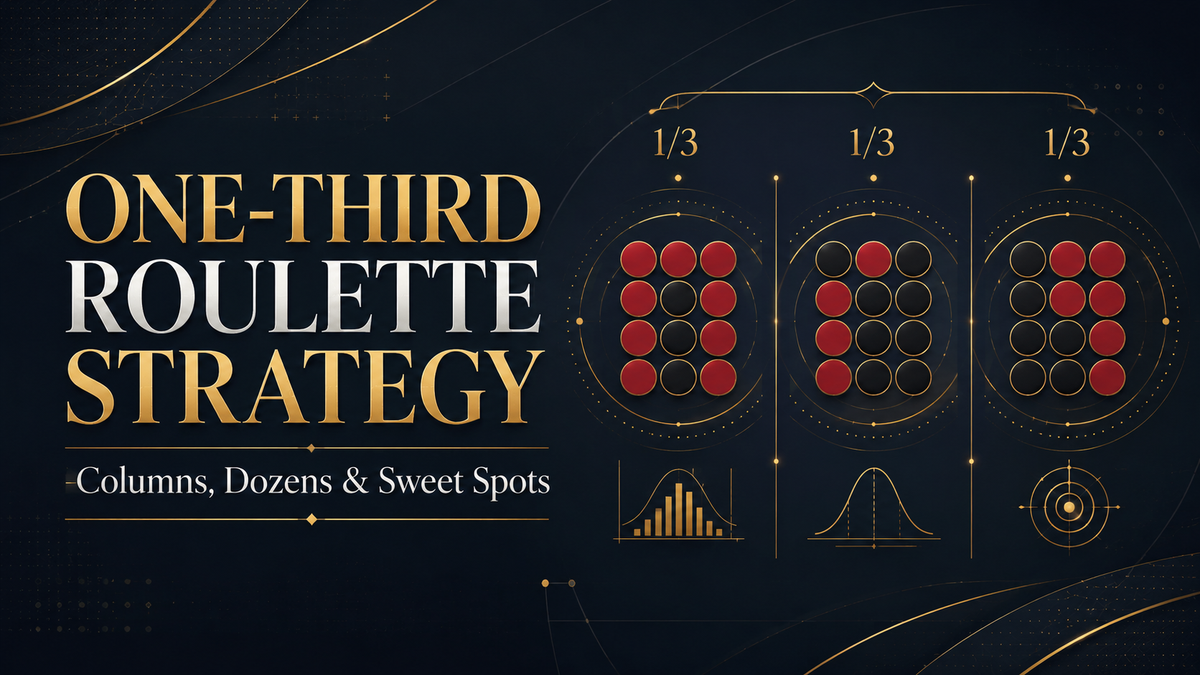
One-Third Roulette Strategy: Columns, Dozens and the Sweet Spot
Stephen Tabone explains why roulette columns and dozens deserve deeper study, and why one-third betting is about timing, discipline and bankroll control.

Written by Stephen Tabone for Global Casino Games. Last reviewed: 16 June 2026.
Roulette players often talk about red or black, odd or even, and the single numbers that flash across a casino table like sparks. Yet one of the most interesting areas of roulette strategy is often pushed to the side: the one-third bets.
I am talking about roulette columns and dozens.
These are the 2 to 1 options that cover twelve numbers at a time. They sit between the narrow excitement of straight-up number betting and the broader comfort of even-money bets. For that reason, I have always believed they deserve more serious attention than they usually receive.
That is one reason I wrote Sweet Spot One-Third Roulette Strategy (OTRS): An Extensive Exploration into Roulette Column or Dozen Betting. It is not my most obvious roulette book for casual readers. Baccarat and blackjack often attract more attention because players are used to hearing about systems, decisions and table flow in those games. But for anyone interested in roulette columns, dozens, one-third betting, 2 to 1 roulette options and bankroll control, this is one of the deeper studies I have produced.
This article does not reveal the system. That belongs in the book. What I want to do here is explain why this area matters, why I think many roulette players overlook it, and why the “sweet spot” idea is not just about chasing a number. It is about timing, structure and knowing when not to play.
Why Roulette Columns and Dozens Are Different
A roulette column or dozen bet covers twelve numbers. On a European wheel, that means twelve of the thirty-seven pockets, with zero sitting outside the main 1–36 number structure. On an American wheel, the extra double zero makes the maths harder still.
The attraction is clear. If your selected column or dozen hits, the payout is 2 to 1. You are not covering half the table. You are not taking the lower-return even-money route. You are accepting a harder hit rate in exchange for a stronger return when the bet wins.
That creates a different kind of mental pressure.
With red or black, a player can feel close to the result on nearly every spin. With a single number, the bet feels like a long shot. Columns and dozens sit in the middle. They feel close enough to be playable, but selective enough to punish bad timing.
That is why one-third roulette strategy requires more thought than many players give it.
The Problem With Random Number Picking
A lot of roulette play is emotional. Players change numbers because the last spin hurt them. They move chips because a number “looks due”. They chase hot numbers, avoid cold ones, or build a pattern in their mind that may have no real structure behind it.
I understand that instinct. I have studied casino games for years, and I know how easy it is to create meaning from short runs of results. Roulette especially invites that kind of thinking because every spin leaves a visible mark. The numbers appear to be speaking.
But without a plan, changing numbers constantly can make the whole session unstable.
If the player changes the bet selection from spin to spin, it becomes much harder to judge whether the method is working. The player is not testing one idea. He is drifting between several ideas, often without noticing.
That is one of the reasons I became interested in fixed one-third options. A column or dozen can remove some of the mental noise. The player is no longer asking, “Which twelve numbers shall I invent next?” The better question becomes, “When should I bet, how much should I risk, and when should I stand aside?”
That shift is important.
The Value of Static Chips
In my roulette thinking, I use the idea of “static chips”. By that I mean chips placed on the same fixed area rather than constantly moving around the layout.
This is not about pretending that roulette can be controlled. It cannot. A properly run roulette wheel is still a game of chance. The casino still has the mathematical edge. No column, dozen, system or staking plan removes that fact.
But fixed selection changes the way a player can observe the game.
If I am watching one column or one dozen over a run of outcomes, I can think more clearly about the rhythm of that selection. I can see whether it is appearing regularly, disappearing for stretches, or returning after a weak phase. That does not give certainty, but it does give structure.
And structure matters.
The worst roulette sessions often happen when a player has no entry point, no exit point, no stop-loss thinking and no way of knowing whether he is reacting or following a plan. The table takes over. Emotion takes over. The player starts playing from spin to spin rather than session to session.
A one-third framework can slow that down.
Why the “Sweet Spot” Matters
The phrase “sweet spot” is important because roulette is not only about what you bet on. It is about where you enter the sequence.
Many players enter too late. They see a column or dozen hitting, jump in after the visible run, then discover that the run has already done most of its work. They are buying into the high point rather than waiting for a better moment.
That idea is not limited to casino games. Traders, investors and sports bettors all understand the danger of entering after the obvious move has already happened. In roulette, the same basic problem appears in a faster and more compressed form.
The sweet spot idea is about looking for a more disciplined entry point. It is about not treating every spin as an invitation. Sometimes the best move is not to bet. Sometimes the best move is to watch, record, wait and let the table show more information before risking chips.
That is the part many casual roulette guides do not spend enough time on.
They explain the bets. They explain the payouts. They may even say columns and dozens pay 2 to 1. But they often stop before the real question: what does the player actually do with that information during a live session?
Why One-Third Betting Is Often Overlooked
In my view, columns and dozens are overlooked because they are not as dramatic as single numbers and not as comfortable as even-money bets.
A straight-up number has glamour. A single chip on one number looks bold. The payout catches the imagination. Red or black, meanwhile, feels simple and familiar. It is easy to understand, easy to explain and easy to play.
Columns and dozens require more patience.
They ask the player to think in groups. They ask the player to accept losing stretches. They also ask the player to respect the fact that a 2 to 1 payout does not mean the game has suddenly become easy.
That is why I think this area suits a more serious roulette player. Not necessarily a high-stakes player. Serious does not have to mean reckless. I mean a player who wants to understand the relationship between coverage, payout, timing and bankroll exposure.
For that type of reader, Sweet Spot One-Third Roulette Strategy has value because it focuses on a part of the game that is not usually studied deeply enough.
Bankroll Pressure Is the Real Test
A roulette system is not really tested when everything is going well. It is tested when the chosen section of the table goes quiet.
That is where many players fail.
They increase stakes too quickly. They chase the missing column. They decide the next spin must rescue the last few losses. They forget that roulette does not owe them a correction on demand.
This is why bankroll management has to sit at the centre of any serious roulette strategy discussion. A player cannot simply talk about wins. He has to talk about what happens during losing phases, what happens after a missed entry, and what happens when the table refuses to behave.
That is also why I do not like roulette advice that sounds too easy.
If someone says, “Just pick a dozen and follow it,” that is not a strategy. It is only a bet selection. A full strategy needs rules, limits, session thinking and an understanding of when the method is under pressure.
The deeper question is not “Can a column win?” Of course it can. The deeper question is whether the player can survive the wrong phases long enough to benefit from the right ones, without giving back the session through poor discipline.
The Difference Between a Bet and a Strategy
A column is a bet. A dozen is a bet. A strategy is something more complete.
A strategy answers uncomfortable questions.
When do I start?
When do I stop?
What happens after a losing run?
What happens after a winning run?
Do I keep betting every spin?
Do I stand aside?
What does a sensible target look like?
What loss level ends the session?
These questions matter because roulette punishes vague thinking.
In Sweet Spot One-Third Roulette Strategy, I explored these questions through a one-third lens. The point was not merely to say that columns and dozens are interesting. The point was to study how a player might create more order around them.
I am not going to give away the full OTRS method here. But the heart of the thinking is simple enough to discuss: reduce unnecessary decision-making, focus on one defined area, respect the 2 to 1 risk-reward structure, and treat timing as seriously as selection.
That is a much more useful conversation than simply asking which number will land next.
Why I Still Think the Book Is Important
Some of my baccarat work naturally attracts attention because baccarat players are already used to looking at shoes, streaks, chops, Player, Banker and the way outcomes form. Blackjack also attracts attention because people associate it with decision-making and skill.
Roulette is different. Many players assume it is either pure luck or pure number chasing.
That is too shallow.
Roulette is still a chance game, and the house edge remains. But the player’s behaviour is not random unless he allows it to be. Bankroll choices, entry points, exit points, bet size and session discipline are all human decisions. Those decisions do not remove the house edge, but they can change how exposed the player becomes during a session.
That is why I see OTRS as an important book in my wider casino strategy work.
It looks at a very specific part of roulette: the one-third options, especially columns and dozens. It asks how those 2 to 1 options can be studied with more structure. It also asks what a player can do to avoid the common trap of betting too often, changing direction too quickly and staying too long after the useful part of a session has passed.
That is not a small subject. It is one of the most practical questions in roulette.
My Editorial View at Global Casino Games
At Global Casino Games, I do not want roulette strategy content to sound like recycled casino filler. I want it to feel as though someone has actually sat with the game, watched the patterns, felt the temptation to jump in too early, and understood the damage caused by weak bankroll discipline.
That is the difference between a page written to fill a keyword and an article written from real experience.
When I write about roulette systems, I am not trying to promise that a player can defeat randomness. I am trying to explain how a player can think more clearly inside randomness.
That distinction matters.
A responsible roulette strategy article should not sell certainty. It should explain uncertainty better.
Why One-Third Roulette Strategy Still Matters
One-third roulette betting is not the loudest part of the roulette table, but it may be one of the most interesting. Columns and dozens force the player to think about coverage, payout, timing and discipline in a different way.
For players who only want instant excitement, that may sound too slow. For players who want to study roulette more seriously, it is exactly where the conversation becomes useful.
That is why I still think Sweet Spot One-Third Roulette Strategy deserves attention. It is an overlooked book compared with more obvious baccarat or blackjack subjects, but it goes deep into a part of roulette that many players see without properly studying.
If you are interested in roulette columns, roulette dozens, 2 to 1 roulette bets, one-third roulette strategy, bankroll management and the psychology of timing, this is an area worth understanding before you risk real money.
No strategy can guarantee profit. No system can remove the house edge. But a structured approach can help a bettor avoid some of the worst mistakes: betting without a plan, chasing after losses, entering too late, and failing to leave when the session has already done enough. I make a similar point in my article on betting systems, timing and bankroll discipline, because the real issue is often not just what a bettor chooses to bet on, but how well the session is controlled.
That, for me, is where the real value of one-third roulette strategy begins.
One-Third Roulette
Sweet Spot Strategy (OTRS) Summary
Bet Types
Covers fixed blocks of 12 numbers on the layout.
Payout Ratio
Higher return than even-money; tighter than straight-up.
The Sweet Spot
Waiting for optimal entry rather than chasing late runs.
House Edge
Maths remain absolute. Strategy controls behavior, not randomness.
Core Pillars of OTRS
Questions and Answers
What is a one-third roulette strategy?
A one-third roulette strategy focuses on bets that cover twelve numbers, usually a column or a dozen. These bets pay 2 to 1 and sit between even-money bets and single-number betting. The key issue is not only which section is chosen, but how the player manages timing, staking and session risk.
Are roulette columns and dozens the same type of bet?
They are different areas of the layout, but both cover twelve numbers and both pay 2 to 1. A column follows the vertical number structure on the table layout, while a dozen covers 1–12, 13–24 or 25–36.
Does a column or dozen strategy beat roulette?
No roulette strategy can guarantee profit or remove the house edge. A column or dozen strategy is better understood as a structured way to manage decisions, timing and risk rather than a method that changes the underlying maths of the game.
Why are roulette columns and dozens often overlooked?
They are less dramatic than straight-up number bets and less simple than red or black. Many players understand the payout but do not study the timing, bankroll pressure and losing phases that come with one-third betting.
Why does Stephen Tabone call it a sweet spot?
The “sweet spot” idea refers to timing and entry-point thinking. Instead of betting blindly into every spin, the player studies when a chosen section may offer a more disciplined point of entry, while still accepting that roulette remains uncertain.
Should beginners use roulette betting systems?
Beginners should first understand the rules, payouts, house edge and bankroll risk before using any system. A betting system should never be treated as a guarantee. It should be tested carefully, ideally with fun money first.
Where can I read more about this approach?
You can read more in Stephen Tabone’s book Sweet Spot One-Third Roulette Strategy (OTRS): An Extensive Exploration into Roulette Column or Dozen Betting, which explores roulette columns, dozens, one-third betting, bankroll discipline and session timing in more depth.
About Stephen Tabone
Stephen Tabone is a casino strategy author, researcher and founder of Global Casino Games. His published work covers baccarat, roulette, blackjack, bankroll management, house edge, RTP, player risk and betting systems, with wider editorial interest in gambling behaviour and the iGaming industry.
Read his full Global Casino Games author profile, or browse his published casino strategy books on Amazon.