
Should You Split 6s in Blackjack? Why DAS and the Dealer Upcard Matter
Should you split 6s in blackjack? This guide explains the 6-6 strategy, why DAS matters, and when the dealer upcard changes the correct play.

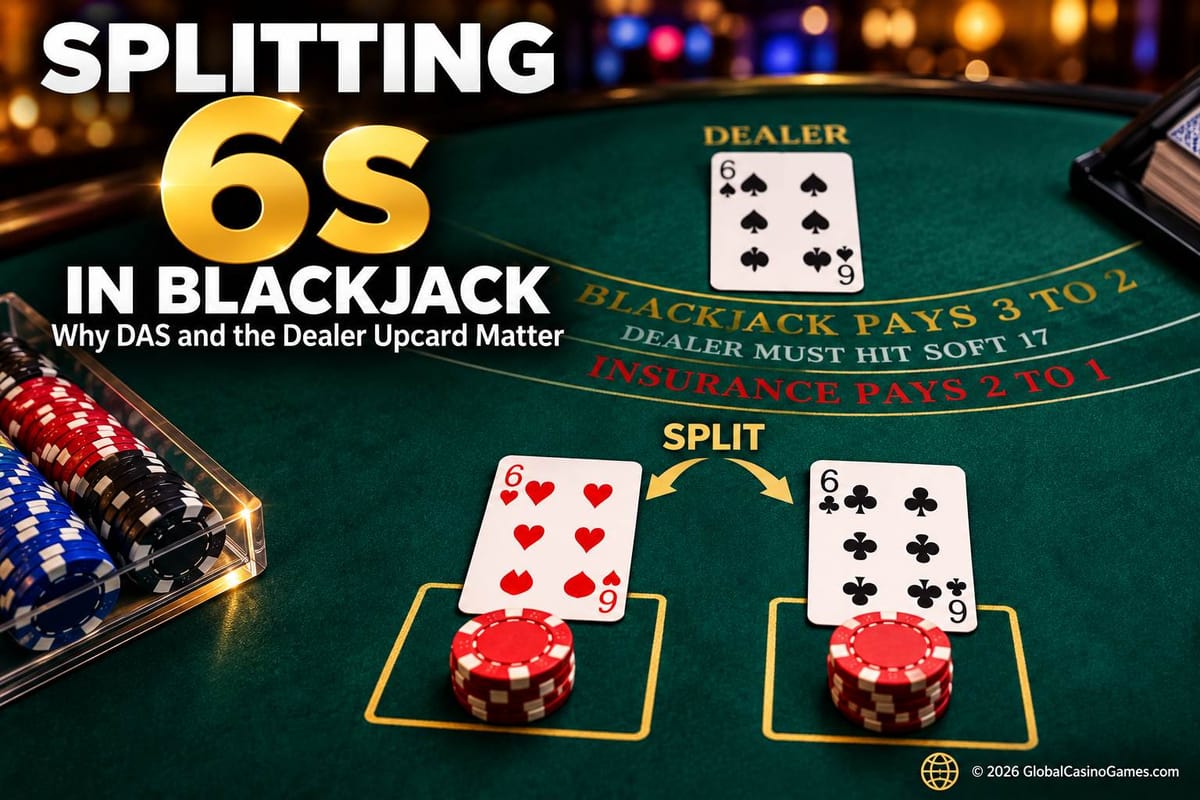
Two 6s make hard 12 — an awkward blackjack total. But whether you should keep the 12 or break it into two hands depends heavily on the dealer’s upcard and whether doubling after split is allowed.
Written by Stephen Tabone for GlobalCasinoGames.com | Based on my own analysis and research, and fact-checked against established blackjack mathematics, basic-strategy research and published rules on pair splitting and doubling after split | Last reviewed: 1 October 2026
In a common multi-deck blackjack game, you normally split 6s against dealer 2–6 when Double After Split (DAS) is allowed; without DAS, you normally split against 3–6 and hit against dealer 2.
That sounds simple.
But the interesting part is what happens when you stop looking at the cards as a pair and start looking at their total:
6 + 6 = hard 12
Hard 12 is already one of blackjack’s uncomfortable hands.
So why would you put another wager on the table and deliberately turn one difficult hand into two hands beginning with a 6?
Because against the right dealer cards, two starting 6s can be worth more than preserving the original 12.
Pair 6s demonstrate how DAS and the dealer’s vulnerability can change the correct splitting range. With pair 7s, the boundary becomes easier to recognise because the dealer’s 7 is normally the cut-off between splitting and hitting. Continue with my guide to splitting 7s in blackjack.
Should You Split 6s in Blackjack?
For a common multi-deck game, the basic pattern is:
| Dealer Upcard | DAS Allowed | No DAS |
|---|---|---|
| 2 | Split | Hit |
| 3–6 | Split | Split |
| 7–Ace | Hit | Hit |
DAS means Double After Split.
The dealer 2 is therefore the important borderline decision.
With DAS:
6-6 vs 2 = Split
Without DAS:
6-6 vs 2 = Hit
For the wider mathematics behind pair splitting, dealer upcards and doubling decisions, see my Blackjack Basic Strategy and Mathematics Guide.
Why Split 6s Against a Weak Dealer?
Suppose you have:
6 + 6
and the dealer shows 6.
If you keep the cards together, you have hard 12.
But splitting creates:
6
and
6
with an equal wager on each hand.
Now consider what could arrive next:
6 + 3 = 9
6 + 4 = 10
6 + 5 = 11
Those are much more attractive starting totals, and where DAS is available, some can become valuable double-down opportunities against the dealer’s weak card.
Even when you do not immediately produce a doubling hand, the dealer’s 3, 4, 5 or 6 gives you another advantage: the dealer must continue drawing under fixed rules and has a meaningful chance of busting.
You are therefore breaking up an awkward 12 while forcing the dealer to play from a vulnerable position.
The Hard-12 Puzzle: Why Not Just Play the Total?
This is where 6s become interesting.
Ordinary hard 12 basic strategy commonly tells you to stand against dealer 4, 5 or 6.
But:
6 + 6 against those same dealer cards is normally split.
Why?
Because pairs give you an option that an ordinary 10+2 or 7+5 does not have.
You are no longer comparing only Hit versus Stand.
You can create two new hands.
That additional option changes the expected value of the decision.
This is a useful reminder that blackjack strategy is not based solely on the numerical total. How the total is composed can matter.
Why Does DAS Change 6-6 Against Dealer 2?
Dealer 2 is weaker than a 7, 8, 9 or 10, but it is not as vulnerable as dealer 5 or 6.
That makes 6-6 versus 2 a much closer decision.
When DAS is available, splitting gives each new 6 the chance to receive a 3, 4 or 5 and become a 9, 10 or 11 that may subsequently be doubled.
That extra option can push the split ahead.
Remove DAS and some of that potential disappears.
So without DAS, the better common multi-deck play becomes:
Keep the 6s together as hard 12 and hit.
This is similar to the rule-sensitive decision I examine in my Splitting 4s in Blackjack guide, although DAS affects the two pairs differently.
With 4s, DAS creates the main reason to split against 5 and 6.
With 6s, splitting is already valuable against 3–6; DAS mainly adds dealer 2 to the range.
Why Not Split 6s Against Dealer 7?
This is another useful boundary.
Dealer 7 is not an Ace or a 10, so it can be tempting to extend the splitting range one card further.
But dealer 7 is substantially stronger than dealer 6.
Starting two separate hands with 6 against that upcard means placing twice the original money into two hands that may still develop into weak totals such as 14, 15 or 16.
Instead:
6 + 6 vs dealer 7 = Hit
You keep one wager in action and try to improve the hard 12.
The same general principle applies against dealer 8, 9, 10 and Ace.
What If Another 6 Appears After the Split?
If the table permits resplitting and another 6 arrives, you may be able to split again.
That can create three or more separate hands, each requiring another wager.
This is why seemingly small table rules matter.
Before playing, check:
- Is DAS allowed?
- Can pairs be resplit?
- How many hands can be created after splitting?
Those rules change both strategy and the amount of money you may have exposed during a single round.
The 6s Rule to Remember
The easiest way to remember 6s is:
With DAS: split against 2–6.
Without DAS: split against 3–6.
Against 7 through Ace: hit.
But the more useful lesson goes beyond memorising the chart.
Two 6s are not simply a hard 12.
They are a hard 12 with another option attached.
Against a weak dealer, splitting can turn one awkward hand into two opportunities.
And against dealer 2, one apparently minor table rule — Double After Split — can be enough to change the decision.
To compare 6s with every other matching pair, explore my complete casino blackjack pair-splitting guide, covering Aces and every pair from 2s through 10s.