
Splitting Aces in Blackjack: Why Two Aces Should Become Two Hands
Should you split Aces in blackjack? This guide explains why A-A is usually split, the one-card rule, resplitting Aces and how split 21s are paid.

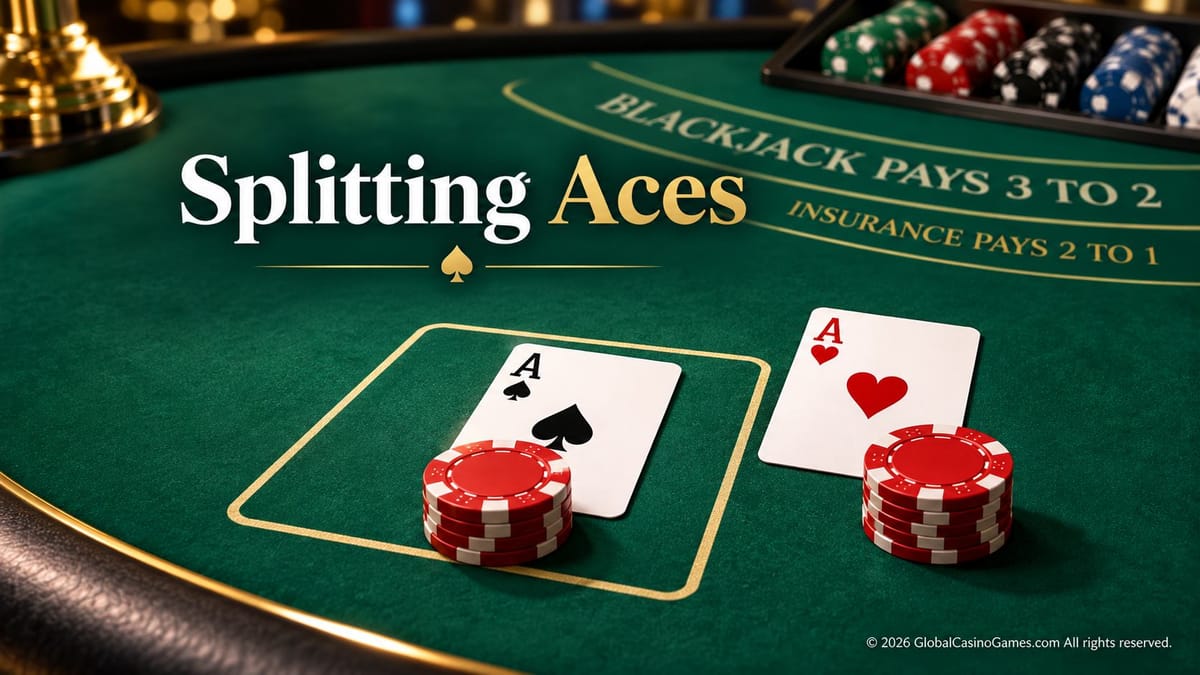
Should you split Aces in blackjack? Usually, yes. Two Aces make soft 12, but separating them gives you two powerful starting hands — and two chances to build 21.
Written by Stephen Tabone for GlobalCasinoGames.com | Based on my own analysis and research, and fact-checked against established blackjack mathematics, recognised basic-strategy sources and published rules on splitting Aces | Last reviewed: 13 September 2026
You look down and see:
A + A
At first glance, that is soft 12.
You could hit it. One additional card cannot immediately bust the hand. But blackjack gives you a much stronger option:
Split the Aces.
Under common blackjack basic strategy, Aces are one of the easiest pairs to remember. If the rules allow you to split them, you normally do.
The reason is simple. One awkward hand containing two Aces becomes two separate hands, each beginning with the most flexible card in blackjack.
That is an opportunity I would rarely want to waste.
Aces represent one of blackjack’s clearest splitting decisions, but not every valuable pair should be divided. Two 5s form a strong hard 10 that is normally kept together for a possible double down. Read my guide to splitting 5s in blackjack to understand this important contrast.
Should You Split Aces in Blackjack?
For a standard multi-deck blackjack game using conventional hole-card or dealer-peek rules, the usual basic-strategy decision is straightforward:
Aces Strategy Matrix
| Dealer Upcard | Optimal Action |
|---|---|
| 2 through 6 | SPLIT |
| 7 through 9 | SPLIT |
| 10, J, Q, K | SPLIT |
| Ace | SPLIT * |
Interactive Split Ace Sandbox
See what happens when you split your pair of Aces and draw one card per hand:
| Dealer Upcard | Usual Basic Strategy |
|---|---|
| 2–6 | Split |
| 7–9 | Split |
| 10 | Split |
| Ace | Split* |
*Some unusual rule structures, particularly certain no-hole-card games, can change strategy against strong dealer cards. Always match your play to the rules at the table.
For the wider mathematics behind pair splitting, soft hands and dealer upcards, see my Blackjack Basic Strategy and Mathematics Guide.
Why Split Aces Instead of Playing Soft 12?
A pair of Aces has an unusual problem.
Together, they are normally counted as:
11 + 1 = 12
That is not a strong completed blackjack hand.
Separate them and suddenly each new hand begins with an Ace.
Outcome Probabilities per Split Ace
Separating your Aces primes your hands for strong totals. A single card addition yields the following card distribution values:
Mathematical Fact: You have a massive 61.6% chance of landing a highly competitive pat hand (18 through 21) on every single Ace you isolate.
One additional card could produce:
- 10, Jack, Queen or King = 21
- 9 = 20
- 8 = 19
- 7 = 18
- 6 = 17
Even lower cards leave you with an Ace-based hand that may still have useful flexibility, depending on the table rules.
This is why splitting Aces is fundamentally different from simply looking at a total of 12.
You are not trying to improve one mediocre hand.
You are creating two potentially strong hands from one weak starting total.
The Catch: Split Aces Often Receive Only One More Card
This is one of the most important rules to understand.
At many blackjack tables, once you split Aces, the dealer gives one additional card to each Ace and the hand is then complete.
You normally cannot keep hitting.
For example:
Ace + 6 = 17
If the 6 arrives after splitting Aces under a one-card-only rule, you may be required to stand on 17.
Official regulated blackjack rules commonly include this restriction. Nevada-approved blackjack rules, for example, include games in which split Aces receive only one additional card.
That limitation itself shows how valuable an Ace can be as the starting point of a separate hand.
Ace Plus 10 After a Split Is Usually Not a Natural Blackjack
This catches many players.
Suppose you split:
A + A
and one Ace receives a King.
You now have:
A + K = 21
It looks exactly like blackjack.
But at most standard tables it is not treated as a natural blackjack, because the hand was created after a split.
It is simply a two-card 21.
That normally means a winning hand is paid 1:1, rather than receiving the traditional 3:2 blackjack payout.
So splitting Aces gives you two excellent chances to reach 21 — but not necessarily two chances to receive a blackjack payout.
That distinction is important.
Three Split-Ace Rules to Check
Before you play, I would check these three rules:
Can Aces be resplit?
If another Ace lands after the original split, some tables allow you to split again while others do not.
Can you hit split Aces?
Many tables allow only one additional card on each Ace.
How is 21 after splitting paid?
An Ace plus a 10-value card after a split is usually treated as ordinary 21 rather than a natural blackjack.
These rules do not normally change the basic attraction of splitting Aces, but they can affect how valuable the split becomes.
Aces and 10s: The Perfect Opposites
Pair splitting becomes easier to understand when you compare Aces with 10s.
With:
A + A = soft 12
you normally break the hand apart because two hands beginning with an Ace are worth more than keeping the 12 together.
With:
10 + 10 = 20
you normally do the opposite.
You already have one of blackjack's strongest completed totals, so destroying it in pursuit of two speculative hands usually makes little mathematical sense.
I explore that opposite side of the decision in my Splitting 10s in Blackjack guide.
Same option.
Completely different mathematics.
What About European No-Hole-Card Blackjack?
This is where I would add one warning to the familiar phrase “always split Aces.”
In traditional European no-hole-card blackjack, the dealer may not take a second card until after players have completed their decisions.
Depending on the rules, additional money committed through a split can therefore be exposed if the dealer later reveals blackjack.
That can change some basic-strategy decisions against a dealer Ace or 10.
So the more accurate rule is not:
Always split Aces under every conceivable blackjack format.
It is:
Under ordinary blackjack basic strategy, split Aces — but check whether the table uses unusual no-hole-card or split-Ace rules.
The Ace Rule to Remember
Two Aces look valuable because they are Aces.
Together, however, they are only soft 12.
Their real strength appears when you separate them.
One Ace becomes two starting Aces.
One mediocre hand becomes two opportunities.
And although the casino may restrict what you can do after the split, the basic mathematical logic remains powerful.
Do not protect the 12. Give each Ace its own hand.
To compare Aces with every other matching pair, explore my complete casino blackjack pair-splitting guide, covering Aces and every pair from 2s through 10s.