
Baccarat Losing Streaks and Variance: Why Short Losses Add Up
A detailed guide to Baccarat losing streaks and variance, including Banker and Player patterns, chops, short losing bursts, blended house edge, skipped hands and progression risk.

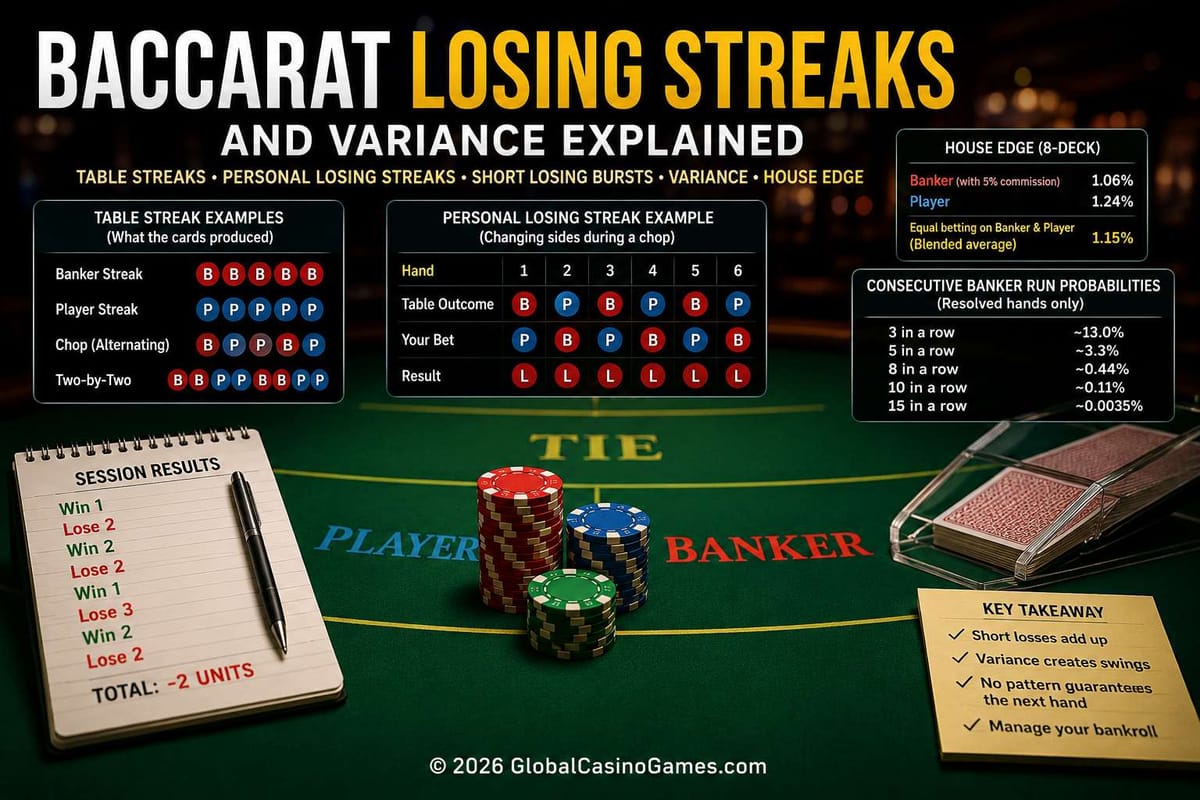
How Banker and Player streaks, chops, changing selections and repeated two- or three-unit losses can steadily reduce a Baccarat bankroll.
Written by Stephen Tabone for Global Casino Games. Last reviewed: 23 July 2026.
Quick Answer
A table streak describes the sequence of Baccarat outcomes. A personal losing streak describes the results of the bets you actually placed. You can lose repeatedly during Banker streaks, Player streaks, chops, pairs or irregular sequences. More often, a bankroll is worn down by repeated short bursts of two or three losses rather than one extraordinary run of 20 or 30 identical outcomes.
Core Baccarat Mathematics
A statistical overview of base house edge advantages across standard eight-deck Punto Banco play.
When players hear the words Baccarat losing streak, they often imagine one extreme sequence.
Perhaps Banker appears ten times in a row while someone continually bets Player. Perhaps Player dominates a large part of the shoe. Perhaps a Martingale reaches the stage where the next required wager is larger than the remaining bankroll.
Those situations can happen.
The more common danger is less dramatic.
A player might lose two bets, skip three hands, win one, lose another two, sit out again and then return for three more losing selections. There may never be an obvious ten-hand streak on the table, yet the player can still finish six or seven units behind.
Three related ideas must therefore be separated:
- Table-outcome streak: What Banker, Player and Tie produced.
- Personal losing streak: What happened to the bets the player placed.
- Short negative bursts: Several small groups of losses accumulating across a session.
The third type can be particularly damaging because it may not feel like a losing streak while it is happening.
For the basic probabilities, card values and main wagers, begin with my guide explaining how to play Baccarat.
What Is Variance in Baccarat?
Baccarat variance is the short-term movement of actual results above or below the game’s long-term mathematical expectation.
The Banker house edge of approximately 1.06% does not mean a player loses £1.06 during every £100 session.
A short session might finish:
- Ten units ahead.
- Ten units behind.
- Slightly above or below break-even.
- Far outside what the player considers normal.
Variance can produce large movements across a limited number of outcomes. Those movements do not have to complete a full circle during the same session.
A bankroll might rise sharply and remain ahead when the player stops. It might fall sharply and remain behind. It might move above and below break-even several times, or spend most of the session on only one side of it.
Over a much larger wagering sample, the negative expected value becomes increasingly important. That does not mean the bankroll must decline smoothly or that every temporary profit must immediately disappear. The path can remain uneven for a long time.
The house edge describes the long-term average casino advantage.
Variance describes how rough, one-sided and unpredictable the journey towards that average can be.
A low house edge means a comparatively low theoretical cost.
It does not mean low short-term losses, even when the player is flat betting.
What House Edge Applies When You Bet Both Banker and Player?
If someone alternates between Banker and Player throughout a shoe, the applicable average house edge depends on how much money was placed on each side.
Using the common approximate figures:
- Banker house edge: 1.06%.
- Player house edge: 1.24%.
If equal amounts are wagered on Banker and Player, the simple average house edge is approximately:
1.15%
If more money is placed on Banker, the weighted average moves closer to 1.06%.
If more money is placed on Player, it moves closer to 1.24%.
That theoretical average does not determine the session result. The actual profit or loss depends on:
- Which hands were selected.
- Which selected wagers won.
- How much was placed on each hand.
- Banker commission.
- Ties and pushes.
- Any stake increases or progressions.
The house edge describes the expected cost of the wagers.
The player’s net win-and-loss ratio describes what actually happened during that session.
Baccarat Table Streaks vs Personal Losing Streaks
These are different concepts.
What Is a Baccarat Table Streak?
A table streak is a sequence visible in the completed outcomes.
Examples include:
- Banker, Banker, Banker, Banker.
- Player, Player, Player, Player.
- Banker, Player, Banker, Player.
- Banker, Banker, Player, Player, Banker, Banker.
- Tie, Banker, Tie, Player.
A continuous Banker or Player sequence is often called either a run or a streak. To keep the wording clear, this guide uses the term streak.
Chops and two-by-two patterns are also outcome sequences, even though neither side produces one uninterrupted streak.
What Is a Personal Baccarat Losing Streak?
A personal losing streak records whether the player’s own selections won or lost.
Consider this six-hand chop:
| Hand | Table outcome | Player’s selection | Result |
|---|---|---|---|
| 1 | Banker | Player | Loss |
| 2 | Player | Banker | Loss |
| 3 | Banker | Player | Loss |
| 4 | Player | Banker | Loss |
| 5 | Banker | Player | Loss |
| 6 | Player | Banker | Loss |
The table produced a perfect Banker–Player chop.
The player suffered six consecutive losses by selecting the opposite side every time.
There was no Banker streak and no Player streak. The personal losing streak came from the relationship between the changing selections and the outcomes that followed.
This is why looking only for long Banker or Player streaks on the Big Road can underestimate the real risk.
What If You Flat Bet One Side Throughout a Chop?
Consider 12 resolved outcomes containing six Banker wins and six Player wins.
A player flat betting one unit on Player every hand would have:
- Six one-unit wins.
- Six one-unit losses.
- A break-even result before any unusual rules or side bets.
A player flat betting one unit on Banker every hand at a standard 5% commission table would have:
- Six winning Banker bets returning 0.95 units profit each: +5.70 units.
- Six losing Banker bets: −6 units.
- Net result: −0.30 units.
The outcome sequence is evenly divided, but the Banker commission produces a small loss.
This also shows why table history and personal results cannot be treated as the same thing.
Can You Lose More Times Than the Longest Visible Table Streak?
Yes.
A personal losing sequence does not have to match one uninterrupted Banker or Player streak.
Someone changing sides can lose against:
- A chop.
- A two-by-two pattern.
- An irregular sequence.
- A streak that ends immediately after they join it.
- A reversal that occurs immediately after they bet against it.
For example:
| Table outcome | Player’s bet | Result |
|---|---|---|
| Banker | Player | Loss |
| Banker | Player | Loss |
| Player | Banker | Loss |
| Player | Banker | Loss |
| Banker | Player | Loss |
| Player | Banker | Loss |
The table has not produced six identical outcomes.
The player has still lost six consecutive decisions.
There is no fixed maximum number of personal losses that Baccarat must stop at. Extremely long losing sequences become increasingly improbable, but they remain mathematically possible.
What Does Roulette Show About Extreme Losing Streaks?
The famous Monte Carlo roulette event of 1913 is widely reported as a sequence of 26 consecutive black results. Players continued betting on red because they believed black had already appeared too many times and red must therefore be due.
The wheel had no obligation to produce the outcome they wanted.
The 1913 Monte Carlo Variance Anomaly
"The wheel had no obligation to produce the outcome they wanted."
This illustrates two dangers that also appear in Baccarat:
- Outcomes a player does not want can continue much longer than expected.
- Continually betting on the opposite outcome because it feels due can extend a personal losing streak.
A Baccarat streak of 25 or 30 consecutive Banker or Player outcomes would be extraordinary.
However, a player does not need an extraordinary sequence to suffer serious financial damage.
Six, eight or ten wrong selections may be enough—especially when the stake increases after each loss.
Why Short Baccarat Losing Bursts Matter More Than Extreme Records
Most bankrolls are not destroyed by a record-setting streak.
They are worn down by repeated small deficits.
Consider this flat-betting session:
| Betting block | Results | Net position |
|---|---|---|
| Block 1 | Win 1, lose 2 | −1 unit |
| Block 2 | Win 2, lose 3 | −1 unit |
| Block 3 | Win 1, lose 3 | −2 units |
| Block 4 | Win 2, lose 3 | −1 unit |
| Session total | 6 wins, 11 losses | −5 units |
The player never loses 11 consecutive bets.
The largest uninterrupted burst may be only three losses.
The session still finishes five units down.
Several hands may have been skipped between those betting blocks. The skipped hands cannot be treated as missed wins because nobody can know in advance what the player would have selected.
Those hypothetical wagers could have:
- Improved the result.
- Made the result worse.
- Made no overall difference.
An unknown hypothetical cannot be used to rewrite the real session.
Only the bets actually placed form the player’s financial result.
I call this in-game betting variance: the uneven results experienced across the particular hands on which the player chooses to wager.
The full shoe may contain a reasonably balanced mixture of Banker and Player outcomes. The player can still enter at the wrong moments and finish well behind.
Does Skipping Baccarat Hands Stop a Losing Streak?
Skipping hands reduces turnover.
It does not guarantee that the next selected wager will win.
Suppose a player:
- Loses two wagers.
- Sits out three hands.
- Returns and loses another two.
- Skips one hand.
- Returns and loses three.
The player may regard these as separate episodes because several table outcomes occurred between them.
Financially, the bankroll has suffered seven losses across seven selected wagers.
The skipped hands changed the timing.
They did not change the outcome of the wagers actually placed.
Selective betting can be useful because it places less total money into action. It should not be confused with protection from variance.
How Can Chops Cause a Baccarat Losing Streak?
A chop alternates between Banker and Player:
Banker–Player–Banker–Player
A player might expect the chop to continue and bet the opposite of the previous outcome.
That works only while the alternation continues.
If the pattern changes when the player enters, the wager loses. The player may then switch interpretation, only for the chop to resume.
| Previous result | Player’s reasoning | Next outcome | Result |
|---|---|---|---|
| Banker | “The chop should continue—bet Player” | Banker | Loss |
| Banker | “Now it is a Banker streak—stay Banker” | Player | Loss |
| Player | “The chop is back—bet Banker” | Player | Loss |
| Player | “Two Players means a streak—stay Player” | Banker | Loss |
No long table streak occurred.
The player lost four consecutive wagers by changing their interpretation after every result.
The Baccarat roadmaps and pattern strategy guide explains what the roads record and why they cannot determine the next outcome.
How Likely Are Consecutive Banker or Player Outcomes?
Under standard eight-deck Punto Banco:
- Banker wins approximately 45.86% of all rounds.
- Player wins approximately 44.62%.
- Tie occurs approximately 9.52%.
When Ties are excluded, Banker wins slightly more than half of resolved Banker-versus-Player outcomes.
Using a simplified resolved-hand model, the probability of one specified Banker streak beginning at one specified point is approximately:
| Consecutive Banker outcomes | Approximate probability |
|---|---|
| 3 | 13.0% |
| 5 | 3.3% |
| 8 | 0.44% |
| 10 | 0.11% |
| 15 | 0.0035% |
These figures must be interpreted carefully.
They describe one specified sequence beginning from one specified position.
A complete shoe contains many possible starting positions. The chance of seeing a notable streak somewhere in a long shoe is therefore higher than the chance of it beginning on one preselected hand.
Does a Banker Streak Make Player Due?
No.
A long Banker streak does not create a future rule requiring Player to appear next.
Likewise:
- A Player streak does not guarantee Banker.
- A chop does not guarantee another switch.
- Two-by-two outcomes do not guarantee another pair.
- A broken pattern does not guarantee an immediate correction.
In a physical shoe, card removal means the hands are not perfectly independent in the strict mathematical sense.
However, the visible outcome pattern does not reveal enough about the precise remaining card composition to make the opposite side due.
A 2025 study by Hiroyuki Muto, Ryusuke Nakai, Toshiya Murai, Sakiko Yoshikawa and Nobuhito Abe analysed 17,970,830 Baccarat games played by 6,625 casino customers. It found that players tended to follow recent outcome trends, with betting amounts increasing slightly when following them.
Some players follow a streak.
Others continually oppose it.
Neither reaction forces the cards.
How Losing Streaks Affect Flat Betting
With flat betting, the financial damage increases in a straight line.
| Consecutive losses | £5 unit | £10 unit | £25 unit |
|---|---|---|---|
| 3 | £15 | £30 | £75 |
| 5 | £25 | £50 | £125 |
| 8 | £40 | £80 | £200 |
| 10 | £50 | £100 | £250 |
The next stake remains unchanged.
Flat betting cannot prevent losing streaks or large losses. It prevents the wager itself from multiplying because of the previous result.
How Losing Streaks Affect Martingale
A Martingale doubles the stake after each loss.
The Martingale Trajectory
A compounding look at how rapidly exponential stakes grow and accumulate losses from a standard £5 base unit.
| Loss No. | Next Wager | Total Loss |
|---|---|---|
| 1 | £5 | £5 |
| 2 | £10 | £15 |
| 3 | £20 | £35 |
| 4 | £40 | £75 |
| 5 | £80 | £155 |
| 6 | £160 | £315 |
| 7 | £320 | £635 |
The player does not need 20 or 30 consecutive losses to be wiped out.
Six or seven can be enough.
Extreme historical streaks can therefore distract from the practical danger. A progression usually reaches the bankroll or table limit long before a record-setting sequence appears.
The Baccarat bankroll management guide explains unit size, stop-loss rules and progression exposure in more detail.
Why a Low Baccarat House Edge Does Not Prevent a Bad Session
The Banker house edge is approximately 1.06%, while Player is approximately 1.24%.
These comparatively low percentages describe long-term expected cost.
They do not place a ceiling on short-term losses.
A player can use the lowest-edge main wager and still suffer:
- Five consecutive losses.
- Several separate two- or three-loss bursts.
- A poor selection rate across the session.
- A sharp bankroll fall caused by oversized stakes.
- A progression failure.
- Excessive turnover at a fast table.
The house edge and variance answer different questions.
Statistical Concept Matrix
Can a Stop-Loss Prevent Baccarat Losing Streaks?
A stop-loss cannot prevent a losing sequence.
It can stop the player from continuing to finance it.
Suppose a player uses:
- £200 session bankroll.
- £10 flat unit.
- Six-unit stop-loss.
Once the session reaches minus £60, play ends.
The next selected wager might have won.
It might also have produced another loss.
The purpose of the stop-loss is not to predict which outcome comes next. It is to prevent an open-ended session from consuming unlimited funds.
Baccarat Losing-Streak Checklist
Before reacting to a streak or short burst of losses, ask:
Baccarat Losing-Streak Checklist
Baccarat Losing Streaks: What Matters Most?
A long Banker or Player streak can produce a personal losing streak when someone continually backs the opposite side.
The table does not need to produce an extreme streak.
A player can lose against chops, pairs, irregular sequences and constantly changing patterns. A player can also finish substantially behind through repeated two- or three-unit deficits spread across several betting blocks.
That is the practical danger.
The spectacular streak attracts attention.
The smaller repeated losses quietly consume the bankroll.
Flat betting limits how quickly the wager grows. Progressions magnify the damage. Skipping hands reduces turnover but does not guarantee that the next selected wager will win.
The house edge explains the casino’s long-term advantage.
Variance explains why the route towards that advantage can be rough, uneven and psychologically difficult.
The strongest response is not to predict every wave.
It is to control how much of the bankroll enters the water—and keep the ship floating.