Best Online Casino? Start With the Games, Rules and House Edge First
The best online casino starts before the deposit. Stephen Tabone explains how house edge, RTP, probability, blackjack rules, baccarat side bets, roulette zeros and bankroll risk should shape the games you choose before you trust any casino brand.

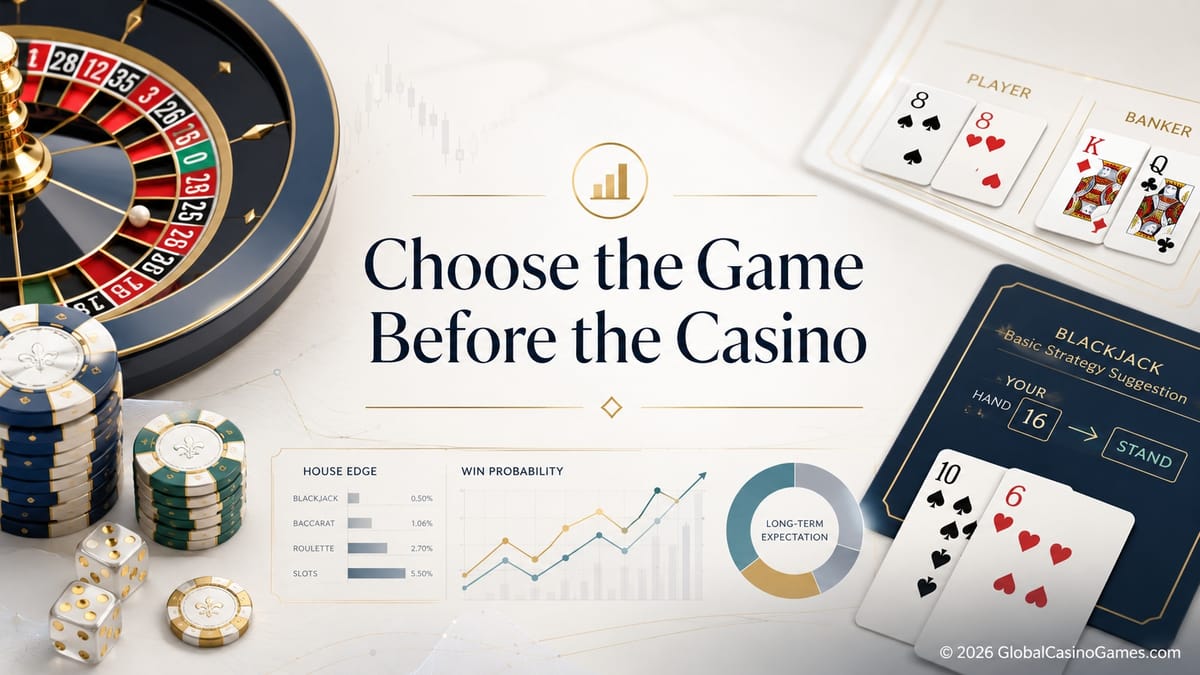
Written by Stephen Tabone for Global Casino Games. Last reviewed: 04 July 2026.
Most people searching for the best online casino are shown a list of brands, bonuses and sign-up offers.
That is not where I would start.
At Global Casino Games, my view is simple: the best online casino starts with education. Before you ask which casino is best, you should ask which games you understand, which rules you are playing under, what the house edge is, what the probability of winning is, what the RTP means, and how quickly the game can pressure your bankroll.
I am Stephen Tabone, and I am not writing this guide to discourage you from playing online casino games. I am also not writing it to push you towards gambling, promote a casino brand or tell you that one game is automatically the best game for every player.
This article has a simpler purpose.
I want to strip away the flashing lights, welcome bonuses, live-dealer drama, spinning reels, roulette wheels, baccarat scoreboards, blackjack side bets, dice rolls, jackpot banners and casino theatre, then look at the mechanics underneath.
When I compare online casino games, my first instinct is not to look at the bonus banner. I look at the rules, the payout, the house edge, the probability, the RTP, the speed of play and how quickly the game allows repeated bets. That is where the real cost begins to show.
House Edge Comparison
Typical long-term casino advantage by game variant
In this guide, I am going to cover 12 main online casino game areas:
- Blackjack
- Baccarat
- Roulette
- Online slots
- Video poker
- Craps
- Three Card Poker
- Ultimate Texas Hold’em
- Casino War
- Caribbean Stud Poker
- Pai Gow Poker
- Keno and wheel-style games
I will also cover important side bets and special bets, including blackjack even money, blackjack insurance, Perfect Pairs, 21+3, baccarat Tie, baccarat side bets, baccarat pairs, Dragon Bonus, Panda 8, Super 6, roulette even-money bets, craps proposition bets and other high-payout wagers that can look attractive before the maths is understood.
Do not assume the lowest house edge is automatically the best choice for every player. Read the whole article first. A game can have a low house edge but still be wrong for your bankroll, your patience, your knowledge level or your reason for playing.
If you are comparing online casinos, weighing up the odds, looking at bonuses, checking game rules or trying to understand your chances before playing, save this page and come back to it. This is designed to be a reference guide, not a quick casino advert.
What Makes the Best Online Casino for an Educated Player?
The best online casino is not just the one with the biggest bonus.
A bonus may look generous. A mobile app may look polished. A live casino studio may look professional. A slot lobby may look exciting. None of that changes the mathematics underneath the games.
From where I sit, the biggest mistake many players make is assuming that the best online casino is the one with the largest welcome offer. To my eyes, that puts the decision in the wrong order. The casino brand matters, but the game mechanics matter first.
For an educated player, the best online casino starts with these questions:
- Are the games licensed and regulated?
- Are the rules clear?
- Is the RTP shown where relevant?
- Are the blackjack rules fair or weakened?
- Is roulette single-zero, double-zero, triple-zero or worse?
- Does baccarat use commission, no commission or altered Banker rules?
- Are side bets clearly priced?
- Are withdrawal terms fair?
- Are responsible gambling tools easy to use?
- Does the casino give the player enough information before real money is risked?
That is the Global Casino Games angle. The brand matters, but the game matters first.
A player who does not understand the game is not really choosing the best online casino. They are choosing a website and hoping the maths forgives them.
Is the Best Online Casino the One With the Best Bonus?
No, not automatically.
A casino bonus can be useful, but it can also distract the player from the real cost of play. Wagering requirements, maximum bet rules, game contribution rates, withdrawal limits and excluded games can turn a headline bonus into something much less attractive.
The mistake is thinking a bonus changes the house edge.
It does not.
If a player uses bonus money on a high-edge game, fast slots, bad roulette rules or expensive side bets, the bonus may simply increase exposure to bad decisions. The casino knows that many players focus on the offer before they understand the game.
I felt a strong sense of scepticism the first time I started comparing bonus language with actual game maths. The offer can look generous, but if the player is pushed towards fast, volatile or high-edge games, the bonus may only extend the time spent playing at a disadvantage.
That is why I would rather start with the games.
Before looking at the bonus, ask this:
What am I actually playing?
If the answer is unclear, the bonus should not be the deciding factor.
What Are You Actually Trying to Do Before You Play?
The best online casino game is not the same for every player.
A player who wants a slow session, low volatility and clear rules may choose differently from someone chasing a progressive jackpot. A player with a small bankroll should think differently from someone treating gambling as entertainment money for the evening. A player looking for even money bets should think differently from someone choosing baccarat side bets, roulette number groups, online slots or live blackjack.
That is why I would not start with the casino logo.
I would start with the player’s objective.
Are you playing for entertainment?
Are you trying to make a bankroll last longer?
Are you trying to understand casino games before risking money?
Are you chasing a rare jackpot?
Are you attracted to blackjack even money, baccarat side bets, roulette progressions or online slots without fully understanding what those bets cost?
Are you thinking of gambling as a way to make money?
That last one matters. I do not encourage anyone to treat casino gambling as income. The house edge exists for a reason. Some players win in short sessions. Some players win large amounts. Some players may even leave ahead over a longer period. But the games are not designed around the ordinary player making consistent profit.
They are designed around mathematical advantage, speed, repetition, variance and player emotion.
It feels completely effortless to press spin, place another chip or take another card online. That is exactly why the maths matters. The easier the next bet feels, the more important it becomes to understand what that bet costs.
You do not need to become a mathematician before playing, but you do need to know what kind of game you are entering, what the casino edge is, and whether your motivation matches the risk.
Why a Lost Casino Bet Is Not Like a Falling Stock Price
A lost casino bet is not the same as a falling stock price.
If you buy shares and the price falls, the value of the position has moved against you, but the position still exists. It may recover. It may fall further. You may sell at a loss, sell at a profit or continue holding. The price movement is a fluctuation until the position is closed.
The same can apply to property, gold or other assets. They can rise, fall, stagnate, recover or crash. There is risk, but the asset still exists until sold or written off.
A settled casino bet is different.
If you stake £10 on a blackjack hand, baccarat hand, roulette spin, craps roll, online slot spin or side bet and that bet loses, that £10 is gone. The next bet may win. The next spin may pay. You may even hit a jackpot later. But the previous losing bet has still been lost and settled.
That earlier loss has not recovered. It has not floated back up in value. It has not become an unrealised loss waiting for a market rebound. It has been transferred out of the bankroll.
This is one of the most important Global Casino Games principles:
Do not let a later win rewrite the cost of earlier losing decisions.
A player can recover their balance. A player can increase their balance. A player can finish the session in profit. But every losing bet still removed money from the bankroll at the moment it lost.
I have found that players often focus on the next chance to win, not the last amount already lost. You need to separate those two things. A future win may improve your balance, but it does not undo the fact that the previous losing bet was already settled.
That is why house edge, probability, volatility and game speed matter.
What Does House Edge Mean at an Online Casino?
House edge is the casino’s long-term mathematical advantage on a bet.
If a game has a 2.70% house edge, that does not mean you will lose exactly 2.70% in one session. You may win. You may lose. You may break even. You may have a wild session that looks nothing like the long-term number.
But over a very large number of bets, a 2.70% house edge means the game is designed to keep around £2.70 for every £100 wagered.
RTP is the other side of the same idea.
If a game has 97.30% RTP, the house edge is 2.70%.
If a slot has 96% RTP, the house edge is 4%.
If a slot has 94% RTP, the house edge is 6%.
The key point is that house edge applies to total money wagered, not just the starting bankroll.
If a player deposits £100 but makes £1,000 worth of bets over a session, the mathematical exposure is linked to the £1,000 wagered, not only the £100 deposit.
That is how casino games can quietly tax a bankroll over time.
When I mapped the games in this guide from lowest house edge to highest house edge, I noticed a clear pattern. The best-value areas are usually the clean main bets: strong-rule blackjack with basic strategy, Baccarat Banker and Player, proper craps line bets, full-pay video poker and single-zero roulette. The danger usually appears around weak rules, fast repetition, high volatility and side bets that offer bigger payouts but carry a heavier long-term price.
My takeaway when weighing the pros and cons is that the lowest house edge is not always the whole story. A low-edge game can still be wrong for a player who does not understand the rules, plays too quickly or chooses the wrong side bets.
I am always careful to distinguish between a low house edge and a low-risk experience. They are not the same thing. A game can have a reasonable house edge and still produce brutal short-term swings.
Online Casino House Edge and Probability Chart: Games Ranked From Lowest to Highest
The figures below are typical or commonly cited figures. Rules, paytables, providers and jurisdictions can change the numbers. Always check the specific game rules before playing.
|
Rank |
Game or bet |
Typical house edge |
Win probability / key probability |
Global Casino Games view |
|
1 |
Blackjack, favourable rules with correct basic strategy |
Around 0.28% to under 1% |
Rule-dependent; pushes and player decisions affect
outcomes |
One of the best online casino games only if the rules are
fair and the player uses basic strategy. |
|
2 |
Full-pay Jacks or Better video poker |
Around 0.46% |
Depends on correct strategy and full-pay table |
Excellent on paper, but only when the paytable is strong
and the player knows the correct holds. |
|
3 |
Baccarat Banker |
1.06% |
Banker wins about 45.86% of all hands, or about 50.68%
excluding ties |
Low house edge, but the 5% commission and shoe movement
still matter. |
|
4 |
Baccarat Player |
1.24% |
Player wins about 44.62% of all hands, or about 49.32%
excluding ties |
Slightly higher edge than Banker, but no commission on
standard tables. |
|
5 |
Craps Don’t Pass / Don’t Come |
1.36% |
Low-edge dice bet, but not always comfortable for casual
players |
Strong mathematically, but the game has many worse bets
around it. |
|
6 |
Craps Pass Line / Come |
1.41% |
Simple core craps bet |
One of the better craps options if the player avoids
proposition bets. |
|
7 |
Pai Gow Poker |
Around 1.46% |
High push frequency |
Slower and lower pressure, but rules and commission
matter. |
|
8 |
Craps Place 6 or 8 |
1.52% |
More hits than Place 5/9 or 4/10 |
Decent for craps players, but not as clean as Pass/Don’t
Pass. |
|
9 |
Ultimate Texas Hold’em Ante |
Around 2.19% |
Strategy matters; extra wagers complicate risk |
Better than many carnival games, but not simple low-risk
poker. |
|
10 |
French roulette even-money bets with La Partage |
Around 1.35% on even-money bets |
Red/black, odd/even, high/low win 18 out of 37 spins; zero
triggers half-loss rule |
Excellent roulette version for even-money bets if
available. |
|
11 |
European roulette |
2.70% |
Even-money bets win 18 out of 37 spins, or 48.65% |
Simple and transparent, but the zero is the house edge. |
|
12 |
Casino War, go to war on ties |
Around 2.88% |
Simple one-card comparison game |
Easy to understand, but easy does not mean best value. |
|
13 |
Three Card Poker Ante & Play |
Around 3.37% on the Ante |
Strategy matters slightly |
Social and simple, but more expensive than baccarat or
strong blackjack. |
|
14 |
Common online slots |
Often around 3% to 6%, depending on RTP |
A 96% RTP slot equals 4% house edge |
Popular, but volatility can punish the bankroll even when
RTP looks fair. |
|
15 |
Caribbean Stud Poker |
Around 5.22% |
Strategy and jackpot side bets matter |
Similar headline cost to double-zero roulette, but with a
different risk profile. |
|
16 |
Double-zero roulette |
5.26% |
Even-money bets win 18 out of 38 spins, or 47.37% |
The extra zero nearly doubles the cost compared with
European roulette. |
|
17 |
Three Card Poker Pair Plus |
Around 7.28% |
Paytable-dependent |
A classic example of a tempting side bet with a higher
price. |
|
18 |
Triple-zero roulette |
7.69% |
Even-money bets win 18 out of 39 spins, or 46.15% |
A much worse roulette structure. Avoid if single-zero is
available. |
|
19 |
Four-zero or equivalent roulette-style games |
Around 10% on even-money-style bets |
Even-money bets may win about 18 out of 40 outcomes |
Very expensive roulette-style structure. |
|
20 |
Baccarat Tie, pays 8 to 1 |
14.36% |
Tie occurs about 9.52% of hands |
Big payout illusion. Not a core baccarat strategy bet. |
|
21 |
Casino War Tie bet |
Around 18.65% with six decks |
Pays if player and dealer tie on first card |
Very high house edge for a simple-looking side bet. |
|
22 |
Keno |
Often 25% to 29% or more |
Depends on numbers selected and paytable |
Usually one of the most expensive casino games. |
This table does not tell every player what to play.
It tells the player what the games are likely to cost over time.
That is different.
A player who wants slow entertainment may prefer one game. A player who wants simple rules may prefer another. A jackpot hunter may accept a higher house edge for the chance of a large payout. But the decision should be conscious.
If you ask me, the real trade-off you are making here is between entertainment, control, volatility and cost. A slot may offer excitement and jackpot potential, but baccarat or good-rules blackjack may offer a lower long-term price.
Is Blackjack the Best Online Casino Game If You Use Basic Strategy?
Blackjack can be one of the best online casino games, but only under the right conditions.
The rules matter.
The player’s decisions matter.
The payout matters.
In my experience with blackjack analysis, the first thing to check is not whether the table looks exciting. It is whether blackjack pays 3 to 2, whether the dealer hits or stands on soft 17, whether doubling and splitting rules are fair, and whether the player is actually using basic strategy.
The most important blackjack rule to check is whether blackjack pays 3 to 2 or 6 to 5. A 3 to 2 blackjack payout is much better for the player. A 6 to 5 payout damages the return and should usually be avoided if better games are available.
I also look for rules such as:
- dealer stands on soft 17 rather than hits soft 17;
- player can double after splitting;
- player can double on any first two cards;
- late surrender if available;
- fewer decks where possible;
- re-splitting aces if allowed;
- clear rules on soft hands and split hands.
Blackjack basic strategy is the minimum standard. It does not guarantee profit, but it reduces the casino’s advantage by telling the player when to hit, stand, double, split or surrender under the rules being used.
Without basic strategy, the low house-edge claim becomes misleading.
A player who ignores basic strategy, plays 6 to 5 blackjack, takes poor side bets and guesses under pressure is not really playing the low-edge version of blackjack. They are giving the casino extra edge through rule choice and decision mistakes.
I often debate whether the lower edge is worth the added complexity. Blackjack can be mathematically stronger than baccarat under good rules, but baccarat is much easier for a casual player to understand without making decision errors.
That is the trade-off.
Good blackjack can be excellent.
Bad blackjack can be expensive.
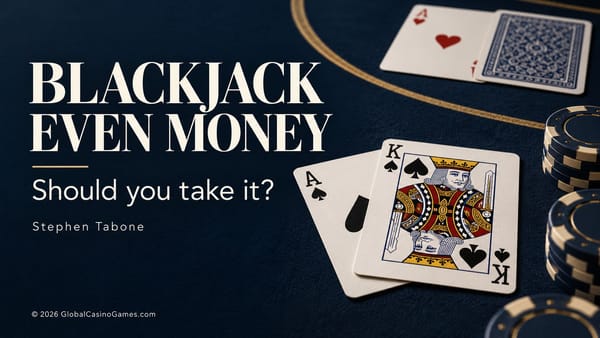
Is Blackjack Even Money a Smart Bet or a Trap?
Blackjack even money is usually offered when the player has a natural blackjack and the dealer shows an Ace.
It can feel safe.
Instead of waiting to see whether the dealer also has blackjack, the player accepts an even money payout. In simple terms, the player locks in a 1 to 1 win instead of risking a push if the dealer also has blackjack.
I can understand why blackjack even money feels comforting. You have a strong hand, the dealer shows an Ace, and the casino offers you a clean 1 to 1 win. But that feeling of safety is exactly why you need to understand that even money is tied closely to insurance.
Insurance is a side bet on whether the dealer has blackjack. For most ordinary players, it is usually not the best long-term decision. The exception is when a skilled card counter has enough information about the remaining shoe to know the deck is rich in tens. That is not the position of most online players.
In normal RNG online blackjack, the game is commonly reshuffled every hand or uses virtual dealing conditions that make card counting irrelevant. In live online blackjack, counting may sound more realistic, but practical value is often limited by deck penetration, shuffle procedure, table speed, bet limits, account monitoring and rule conditions.
So my Global Casino Games view is this:
Do not treat blackjack even money as a magic safety button.
If you want to play blackjack properly, the stronger route is good rules, 3 to 2 blackjack, correct basic strategy, sensible doubling, correct splitting and avoiding weak side bets.
Which Blackjack Side Bets Should Players Understand First?
Blackjack side bets can make the table look more exciting.
They can also make a strong game much more expensive.
Common blackjack side bets include:
- Insurance
- Even money
- Perfect Pairs
- 21+3
- Lucky Ladies
- Buster Blackjack
- Royal Match
- Match the Dealer
- Hot 3
- Lucky Lucky
- Blazing 7s
- progressive jackpot side bets
The exact house edge depends on the paytable, number of decks and game rules. That means players should not assume all versions of a side bet are the same.
Perfect Pairs may pay for a mixed pair, coloured pair or perfect suited pair. 21+3 usually combines the player’s first two cards with the dealer’s upcard to form poker-style hands. Lucky Ladies may reward queen-of-hearts combinations or twenty-point hands. Buster Blackjack usually pays when the dealer busts, with higher payouts for more dealer cards.
These bets can be fun, but they should not be confused with the main blackjack game.
The main blackjack game can be low edge when the rules are good and the player uses basic strategy. The side bets are usually where the casino adds excitement, volatility and extra margin.
What I always warn people to be wary of is the side bet that looks harmless because the stake is small, but becomes expensive because the house edge is high.
My first recommendation for this specific list is to understand the main blackjack game before touching the side bets. Learn the main hand first. Learn the rules. Learn basic strategy. Then, if you still choose a side bet, treat it as entertainment, not as the serious mathematical core of the table.
Play blackjack for blackjack.
Treat side bets as side roads.
Does Card Counting Work in Online Blackjack?
Card counting only matters when cards are dealt from a finite shoe and not fully reset every hand.
That means card counting does not work against ordinary RNG blackjack that reshuffles every round.
In live online blackjack, the idea is more complicated. If real cards are dealt from a shoe, then in theory removed cards change the composition of the remaining shoe. But the practical value depends on deck penetration, shuffle timing, number of decks, table speed, bet limits, game rules and whether the operator restricts or monitors unusual betting behaviour.
That is why I would not build an online blackjack plan around card counting.
For most players, the realistic blackjack edge is not card counting. It is:
- choose 3 to 2 blackjack;
- avoid 6 to 5 blackjack;
- learn basic strategy;
- understand doubling;
- understand splitting;
- avoid unnecessary side bets;
- manage bankroll exposure;
- stop treating every hand as a recovery mission.
Online blackjack can feel frustrating because you are making decisions inside a game that moves quickly, often without the same table atmosphere you would get in a land-based casino. That is why basic strategy helps: it gives you a decision map before emotion starts pushing you around.
That is the real cheat code for normal players.
Not a guarantee.
A discipline framework.
Is Baccarat Banker Really the Best Low-House-Edge Bet?
Baccarat is one of the easiest online casino games to understand because the player does not decide whether to hit, stand, split or double.
The dealer or software handles the drawing rules.
The player usually chooses from three main bets:
- Banker
- Player
- Tie
The Banker bet has the lowest standard house edge at around 1.06% with the usual 5% commission.
The Player bet has a house edge around 1.24%.
The Tie bet, when paid at 8 to 1, has a much higher house edge of around 14.36%.
That makes Banker the strongest main baccarat bet in theory.
For the complete mathematical comparison, my Baccarat Banker bet guide explains the standard 5% commission, Banker and Player house edges, and the altered payouts used by no-commission tables.
But this is where players need to slow down.
Banker being the better long-term bet does not mean Banker must win the next hand. It does not mean Banker must dominate every shoe. It does not mean a player can blindly bet Banker forever and avoid damage.
Baccarat hands still move through randomness, streaks, chops, ties, reversals and shoe personality.
To my eyes, baccarat is one of the cleanest examples of a game that looks simple but still punishes lazy thinking. Banker has the better house edge, but that does not mean Banker must dominate the next shoe.
If you ask me, the real highlight of baccarat is not the Tie bet or the flashy side bets. It is understanding the difference between the low-cost main road of Banker and Player, and the higher-risk side roads that can drain a bankroll much faster.
Banker is the lower-cost main road.
It is not a guaranteed route.
Player is slightly more expensive but still a low-edge main bet.
Tie is where the payout illusion begins.
The Anatomy of a Casino Bet
What your eyes focus on versus what actually drains your bankroll
Are Baccarat Side Bets Worth Playing at the Best Online Casino?
Baccarat side bets are dangerous because they look exciting.
The main Banker and Player bets are simple, low-edge and easy to understand. The side bets add bigger payouts, extra outcomes and more emotional hooks.
Common baccarat side bets include:
- Tie
- Banker Pair
- Player Pair
- Either Pair
- Perfect Pair
- Big
- Small
- Dragon Bonus
- Panda 8
- Dragon 7
- Super 6
- Lucky 6
- Bonus Banker or Bonus Player bets
- natural-based bets
- high/low total bets depending on provider
- commission-free baccarat side bets
The Tie is the most famous. It may pay 8 to 1 on many tables. Some versions pay 9 to 1. That difference matters. At 8 to 1, the Tie bet is very expensive. At 9 to 1, it is less bad, but still not something I would treat as a core baccarat plan without understanding the rules.
Pairs are also common. A Banker Pair or Player Pair wins when the first two cards on that side form a pair. Either Pair covers a pair on either side. Perfect Pair usually requires a suited pair and can pay much more.
Big and Small bets focus on how many total cards are used in the hand. Small usually wins when only four cards are dealt. Big usually wins when five or six cards are dealt. These can be found in some online baccarat versions.
Dragon Bonus pays according to natural wins or winning margins. Panda 8 and Dragon 7 are common in EZ Baccarat-style games. Super 6 usually relates to Banker winning with a total of six on no-commission baccarat tables.
These wagers also appear under different baccarat formats and payout structures. My baccarat variants comparison explains EZ Baccarat, Super 6, standard commission, no-commission and other versions that change the rules, payouts or presentation.
My analysis shows a stark contrast between Baccarat Banker and Player on one side, and baccarat side bets on the other.
The main bets are relatively clean. Banker has the lower house edge, Player is slightly higher, and both are easy to understand. The side bets are different. Tie, pairs, Dragon Bonus, Panda 8, Super 6 and other baccarat side bets may look exciting because the payouts are larger, but that is exactly why you need to check the probability and house edge before treating them as part of a serious plan.
I felt sceptical about baccarat side bets the moment I compared the payouts with the probabilities. They look exciting because the payout is bigger, but you need to ask why the casino is willing to offer that payout in the first place.
A player can understand baccarat as a low-house-edge game and still damage the bankroll by chasing baccarat side bets.
For the detailed probabilities, payouts and house edges, read my baccarat side-bet guide, covering Tie, Égalité, pairs and other optional wagers alongside the lower-edge Banker and Player bets.
That is why I would keep the main game and the side bets mentally separate.
Main game: Banker and Player.
High-risk extras: Tie, pairs, bonus bets and progressive-style baccarat options.
Are Even Money Bets Better for Online Casino Players?
Even money bets are attractive because they look simple.
Bet £10. Win £10 profit. Lose £10. No complicated payout. No huge table of odds.
Examples include:
- roulette red or black;
- roulette odd or even;
- roulette high or low;
- baccarat Player;
- baccarat Banker after commission adjustment is considered;
- blackjack main-hand outcomes in many resolved hands;
- some craps even-money bets such as Pass Line and Don’t Pass;
- Casino War main bet.
But even money does not mean fair money.
That is the mistake.
A roulette red/black bet pays even money, but on a European wheel it wins only 18 out of 37 spins because zero exists. On an American wheel, it wins only 18 out of 38 outcomes because 0 and 00 exist.
That missing outcome is the casino’s edge.
In blackjack, the main hand can be part of a low-edge game, but only when the rules are good and the player makes correct decisions. Blackjack even money, as a specific offer when the dealer shows an Ace, is not the same as saying blackjack is a fair 50/50 game.
In baccarat, Player pays 1 to 1, while Banker normally pays 0.95 to 1 after commission. Banker is still mathematically stronger because it wins slightly more often, but the commission affects chip flow.
To my eye, even money is one of the most misunderstood phrases in casino gambling.
An even money bet sounds balanced. It sounds clean. It sounds close to fair. But when I break down the numbers, the hidden catch is usually the missing outcome: the zero in roulette, the commission in baccarat, the dealer Ace in blackjack even money, or the rule structure behind the table.
Even money does not mean equal chance.
It only describes the payout.
So the Global Casino Games rule is this:
Even money bets are easier to understand, but they are not automatically better.
They reduce confusion.
They do not remove the house edge.
Is Roulette a Good Online Casino Game or a House-Edge Trap?
Roulette is one of the clearest examples of why rules matter.
On the surface, roulette looks simple. Pick a number, colour, section or characteristic. Watch the wheel spin. Wait for the result.
But the wheel structure changes the cost.
European roulette has one zero and 37 total pockets. Its standard house edge is 2.70%.
American roulette has 0 and 00, giving 38 total pockets. Its house edge is 5.26%.
Triple-zero roulette has 39 pockets. Its house edge is 7.69%.
Four-zero or equivalent roulette-style games push the cost even higher.
This matters most for even money bets.
On European roulette, red or black wins 18 out of 37 spins. That is not 50/50. It is 48.65%.
On American double-zero roulette, red or black wins 18 out of 38 spins. That is 47.37%.
On triple-zero roulette, the chance is 18 out of 39, or 46.15%.
The payout stays 1 to 1, but the winning probability falls as more zeros are added.
French roulette can be better when La Partage or En Prison applies to even-money bets. With La Partage, if zero lands, the player loses only half the even-money stake. That can reduce the house edge on those bets to around 1.35%.
When I map roulette by house edge, the lesson is immediate. The same red-or-black decision can become much more expensive simply because the wheel has more zeros.
From where I see it, the hidden catch in roulette is that the bet looks the same while the price changes underneath. Red on French roulette with La Partage is not the same long-term decision as red on double-zero, triple-zero or four-zero roulette.
Roulette gives you peace of mind because the rules look obvious: red or black, odd or even, high or low. But that simplicity can hide the most important detail, which is the number of zeros on the wheel.
That is why I treat roulette like this:
- French roulette with La Partage on even-money bets is the best roulette structure.
- European single-zero roulette is the clean standard version.
- American double-zero roulette is much more expensive.
- Triple-zero and four-zero versions are poor value if better roulette exists.
Roulette can be enjoyable. It can be simple. It can be slower than slots.
But the zero is the toll road.
Where Do Online Slots Fit in the House-Edge Table?
Slots deserve a place in any serious online casino house-edge guide because they are one of the most common games players see when they enter an online casino lobby.
But slots need to be understood differently from blackjack, baccarat or roulette. With table games, the player is usually looking at rules, payouts, decisions and fixed bet types. With slots, the starting point is usually RTP, volatility, game speed and whether the player is chasing entertainment, frequent small wins or a rare jackpot-style payout.
Online slots are different from table games because players usually think in RTP rather than house edge.
A slot with 97% RTP has a 3% house edge.
A slot with 96% RTP has a 4% house edge.
A slot with 94% RTP has a 6% house edge.
A slot with 92% RTP has an 8% house edge.
That looks simple, but volatility changes the player experience. A high-volatility slot may have a reasonable RTP and still punish a bankroll quickly because wins can arrive unevenly. A low-volatility slot may pay smaller amounts more often but still grind the bankroll over time.
When I look at online slots, I do not start with the theme, music or animation. I start with RTP, volatility and speed.
To my eye, the low-edge illusion in slots appears when a player sees a reasonable RTP but ignores volatility. A 96% RTP slot still has a 4% house edge, and high volatility can make that game feel much harsher on a real bankroll than the headline number suggests.
It can feel effortless to keep spinning because the game gives you constant movement, sound and near-miss drama. That is why you need to know the RTP before the session starts, not after the bankroll is already under pressure.
Progressive jackpot slots add another layer. The jackpot may be attractive, but the player may be accepting higher volatility or a lower base-game return in exchange for the dream of a rare major win.
That is fine if the player understands the trade-off.
It is dangerous if the player thinks the slot is “due” because it has not paid.
Slots should be treated as entertainment-first games. The spin that loses is lost. The next spin may win, but the previous stake has already gone.
Can Online Casinos Change the RTP of Slots?
Players often ask whether online casinos can change the RTP of slots.
The careful answer is this: some game providers offer different approved RTP versions of the same slot. A casino may choose one approved version depending on market, provider agreement and platform settings.
That is different from secretly changing one individual player’s next spin because the player is winning or losing.
A regulated slot game should use approved maths, approved RTP settings and random number generation. The player should check the in-game help file, paytable or information screen where the RTP is usually displayed.
The practical player question is:
Which RTP version am I actually playing?
Not:
Is the casino changing my next spin because I just won?
That distinction matters.
At Global Casino Games, I am more interested in the declared RTP, volatility, bet size, game speed and bankroll exposure than slot myths about hot and cold machines.
Are Craps Bets Better Than Slots and Roulette Online?
Craps can be a good game or a terrible game depending on the bets chosen.
That is the whole story.
The Pass Line has a low house edge of around 1.41%.
Don’t Pass is slightly lower at around 1.36%.
Come and Don’t Come are similar structures once the point system is understood.
Odds bets are unusual because they can pay true odds with no house edge, but they normally sit behind a Pass, Come, Don’t Pass or Don’t Come bet. That means the total combined position still starts from a line bet with an edge.
Place 6 and Place 8 are reasonable compared with many craps bets, at around 1.52%.
But craps also has dangerous bets:
- Any Seven
- Any Craps
- Hardways
- Field bets depending on payout
- proposition bets
- hop bets
- Big 6 and Big 8
Some of these have house edges far higher than the main line bets.
In my experience, comparing craps to roulette comes down to choice quality. Roulette gives you fewer decisions, but the price is fixed by the wheel. Craps gives you more decisions, but some of those decisions are excellent and others are terrible.
So the answer is not “craps is good” or “craps is bad”.
The answer is:
Certain craps bets are good.
Many craps bets are not.
A player who sticks to Pass, Don’t Pass, Come, Don’t Come and sensible odds is playing a very different game from a player firing chips at the centre of the table.
Online craps can be mathematically strong, but only if the player knows which bets to avoid.
Are Three Card Poker, Casino War and Other Simple Games Worth Playing?
Simple games can be enjoyable, but simple does not always mean cheap.
Three Card Poker is popular because the rules are easy to follow. The player makes an Ante, receives three cards, then decides whether to fold or make the Play bet. The Ante & Play structure has a house edge around 3.37% on the Ante, assuming correct strategy.
That is not terrible, but it is not as low as Baccarat Banker, Baccarat Player or strong blackjack.
The Pair Plus side bet is different. It pays based on the player’s three-card poker hand, regardless of the dealer. It can be fun, but the house edge is usually higher than the main game and depends on the paytable.
Casino War is even simpler. The player and dealer each receive one card. Higher card wins. Ties create the decision point: surrender half or go to war. The main game can sit around 2.88% if the player goes to war on ties, but the Tie side bet can be much worse.
Caribbean Stud Poker is another casino poker-style game. It has a headline house edge around 5.22%, though risk can be measured in more than one way because the player may raise after seeing their cards. The progressive jackpot side bet can change the attraction of the game but also changes the risk profile.
Ultimate Texas Hold’em is more strategic and often has a better headline house edge than many casino poker games, but it involves multiple decision points and extra wagers. Players should not judge it by one number without understanding the total money exposed.
My takeaway when weighing the pros and cons is this: casino poker games can be entertaining, but they need to be separated from true poker. You may see familiar cards, familiar hands and familiar poker language, but you are still usually playing a casino paytable with a built-in edge.
The Global Casino Games view is simple:
If a game looks easy, check the price.
Casinos do not need a game to be complicated for it to be profitable.
Is Online Poker Different Because You Play Other Players?
Online poker is different from casino table games.
In blackjack, baccarat, roulette, craps, slots, Casino War and most casino poker variants, the player is playing against the house or against a house-controlled paytable.
In poker, the player usually plays against other players.
The house usually earns money through rake, tournament fees or other charges. That means poker is not judged in exactly the same way as a fixed house-edge casino game.
A skilled poker player can have an edge over weaker opponents, but that does not mean poker is easy. Rake matters. Table selection matters. Discipline matters. Bankroll management matters. Tilt matters. Volume matters.
A weak poker player may face a bigger real-world disadvantage than someone playing a lower-edge casino game correctly.
So I would not tell a beginner that poker is automatically better because the player is not directly playing against the house.
Poker replaces house-edge simplicity with skill, psychology, variance and rake.
That can be better for the right player.
It can be worse for the wrong one.
Can Online Casinos Detect Your Strategy or Change Your Results?
Players often worry that online casinos detect their strategy and change the results.
This is where we need to separate two things.
A regulated casino should not be secretly changing an individual player’s blackjack hand, baccarat outcome, roulette spin or slot result because the player is using a strategy or has recently won.
But online casinos can collect data.
They may track game choice, session length, deposit behaviour, bonus use, withdrawal activity, game preference, bet size, churn risk and responsible gambling indicators. That data can affect marketing, offers, limits, account reviews, risk checks or bonus eligibility.
That is not the same as changing the next random result.
A player should understand both points.
The game result should be governed by the approved rules and random process.
The player experience around the game may still be shaped by data, promotions, personalisation and risk systems.
Whenever I look at online casino game rules, my priority is not the design of the table. It is the payout, the probability, the house edge, the speed of play and whether the rules quietly move the player into a worse position.
That is why I focus on what the player can control:
- choose better rules;
- understand the house edge;
- avoid weak side bets;
- check RTP;
- manage bankroll;
- avoid chasing losses;
- stop when the session plan is broken.
You cannot control the next card, spin, roll or slot result.
You can control whether you understand the game before you enter it.
The House Edge Tax
Volatility creates short-term ups, but edge dictates the long-term floor
What Is the Best Online Casino Game for Your Own Motivation?
The best online casino game depends on what the player is trying to do.
If the goal is low house edge, good-rules blackjack with correct basic strategy can be one of the strongest choices.
If the goal is simple low-edge play without complex decisions, baccarat Banker and Player are easier to understand.
If the goal is even money bets with clean rules, French roulette with La Partage is much better than double-zero or triple-zero roulette, but availability matters.
If the goal is dice with low-edge core bets, craps can work if the player sticks to Pass, Don’t Pass, Come, Don’t Come and sensible odds.
If the goal is entertainment and jackpot hunting, online slots may fit the motivation, but the player should understand RTP, volatility and the fact that every losing spin is settled immediately.
If the goal is skill against other players, online poker is different, but rake and player ability matter.
If the goal is simple fun, Casino War or Three Card Poker may appeal, but the player should not confuse simplicity with value.
If the goal is to make money from casino gambling, I would be very cautious. That is not the way I would frame casino play for ordinary readers. The house edge exists, and most players underestimate how quickly repeated betting creates exposure.
In my mathematical teardown of casino games, the real contrast is not just between high-edge and low-edge bets. It is between games that give the player control, games that give the player simplicity, and games that only give the player the feeling of control.
That is an important difference.
The better question is not:
What game can make me money?
The better question is:
What game do I understand well enough to play without fooling myself?
That is a much stronger starting point.
Global Casino Games Takeaway: Learn the Game Before You Choose the Casino
The best online casino starts before the deposit.
It starts before the bonus.
It starts before the app.
It starts before the first spin, first hand, first roll or first side bet.
At Global Casino Games, my view is that the educated player should choose the game before choosing the casino. Check the rules before trusting the lobby. Know the house edge before chasing the payout. Read the probability before believing the pattern. Be honest about your own motivation before risking the bankroll.
I am not here to tell you that gambling is good or bad for every person.
I am here to show the mechanics.
Blackjack can be strong when the rules are fair and the player uses basic strategy. Baccarat Banker and Player are low-edge bets, but baccarat side bets can become expensive. Even money bets are simple, but not automatically fair. Roulette changes dramatically depending on the number of zeros and whether La Partage applies. Slots depend on RTP, volatility and entertainment value. Craps has excellent core bets and terrible proposition bets. Casino poker games can be fun but often cost more than players realise. Poker is different because you play other players, but rake and skill decide the real challenge.
My takeaway after years of writing about casino games is simple: the player who understands the rules, house edge, probability and bankroll pressure is in a stronger position than the player who only understands the bonus.
This does not mean the lowest house edge is automatically the best game for every person.
It means you should know the cost before you choose the game.
This is exactly why I structure my guides at Global Casino Games around rules, house edge, probability and bankroll pressure. The player should understand the game before judging the casino.
The casino floor is designed to make games feel exciting.
This article is designed to slow the player down.
Strip away the lights. Strip away the music. Strip away the live-dealer smile, the bonus banner, the spinning wheel, the jackpot animation and the side-bet temptation.
Then ask the real questions.
What is the house edge?
What is the probability?
What are the rules?
What is the payout?
How fast does the game play?
What happens to the bankroll when the losing bets arrive?
What am I trying to get from this session?
If you are still weighing up the odds, save this page and come back to it. Read it before choosing a game. Read it before chasing a side bet. Read it before assuming a bonus makes a bad game good.
The Stephen Tabone / Global Casino Games view is simple:
Learn the game before you choose the casino.
Understand the cost before you chase the reward.
And never forget that a lost casino bet is not waiting to recover.
It has already gone.
For a deeper breakdown of how different casino games compare mathematically, read my Casino House Edge Comparison, where I rank popular games by house edge, RTP and player risk.