UK £5 Slot Cap: Will Players Switch to Roulette, Blackjack or Baccarat?
The UK £5 online slot cap may make some players compare slots with roulette terminals, blackjack, baccarat and side-bet table games, but slot players do not always move easily from reels to tables.

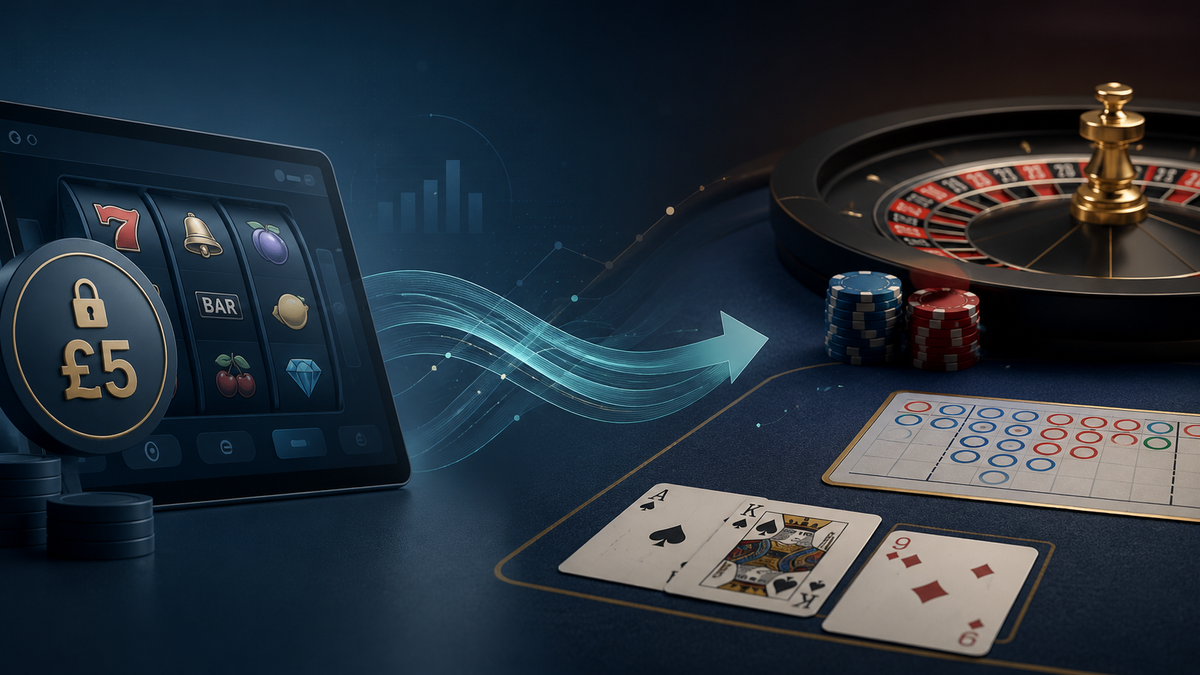
UK £5 Slot Cap: Will Players Switch to Roulette, Blackjack or Baccarat?
Written by Stephen Tabone for Global Casino Games. Last reviewed: 14 June 2026.
The UK online slots market has changed. Under the UK Gambling Commission’s two-tier online slot stake rules, adults aged 25 and over are limited to £5 per spin, while players aged 18 to 24 face a stricter £2 limit. These online casino limits apply to online slots, not in the same way to blackjack, roulette, baccarat or other table games.
That creates an obvious question. If some players feel restricted by capped online slot stakes, will they start looking at table games instead? My view is that some will, but many will not. The shift is not a simple move from reels to felt, because slot players often like slots for very specific reasons: the reels, the bonus round, the jackpot meter, the near miss, the feature trigger and the hope that a small stake can suddenly produce a much bigger return.
That feeling is difficult to replace. A blackjack hand does not feel like a slot bonus. A roulette spin does not feel like free spins. Baccarat has tension, especially when the cards are revealed slowly, but it is a different kind of tension. Slots give quick repetition. Table games make each decision, each wait and each loss feel more visible.
Key Takeaways
- The UK £5 slot cap applies to online slots for adults aged 25 and over, with a £2 limit for players aged 18 to 24.
- These UKGC slot stake rules do not apply to table games in the same way.
- Slot players may compare roulette, blackjack and baccarat, but many still prefer reels, bonus rounds and jackpots.
- Terminal roulette may be the closest crossover because it is screen-based and can allow smaller chip units.
- Baccarat, blackjack and Three Card Poker may attract volatility seekers through side bets.
- The cap changes player behaviour, but it does not remove slot demand.
Why Slot Players Do Not Always Switch to Table Games
The mistake is assuming that a slot player is simply looking for any casino game. Many are not. They are looking for the slot experience: fast rounds, bright features, bonus sounds, jackpot symbols and the possibility of a sudden payout spike.
A table game asks for a different mindset. Blackjack gives the player decisions. Roulette gives placement. Baccarat gives a reveal. Three Card Poker gives the rare-hand chase. Those things can be interesting, but they are not the same as pressing spin and waiting for a bonus round to explode onto the screen.
That is why the £5 slot cap may create more curiosity around table games, but it will not automatically convert slot players into table-game players. Some players will test blackjack or roulette once and go straight back to slots. Others may split their play. The crossover depends on the type of player.
Many Slot Players Try Table Games, But Stick to Slots
In land-based casinos, this divide is easy to see. Some players may visit roulette, sit at Three Card Poker, or try a live-dealer table game for a while. But their default game is still slots. They move around the floor, test a table game, follow a hunch, then sooner or later drift back to the machines.
I remember one elderly lady who showed this perfectly. She sometimes sat at roulette, but roulette was never really her main game. She had a system where she wrote the roulette results down vertically from top to bottom, then started another column, then another column. She was trying to make connections between numbers. If one number seemed to connect with another number, the system expanded.
The problem was that the system never really settled. Another rule would appear. Then another exception. Then the pattern would be extended again. I could see what she was trying to do, but it became very confusing because the rules were always moving. She could never quite form the strategy into something fixed.
That is something I have seen often in casinos. A player sees a pattern, then stretches the pattern. Then they add a new rule when the first rule almost works. Before long, the method becomes bigger than the game itself. But the important point is this: she was not really a roulette player. Most of the time, she was on slots. That was her game. Roulette was something she visited.
The £16,500 Slot Ticket Moment
There was another moment with the same player that explains the slot mentality better than any theory. It was about 4 p.m. in a land-based casino. The slot area was quiet. There were not many players around, and she was playing around 50p per spin. She would leave the machine, walk around, get a drink, come back, sometimes to the same machine and sometimes to a different one.
She was chatting to me as well. Nothing looked dramatic. It was not one of those nights where every machine was full and everyone was watching a jackpot meter. Then she went away for a while. About 20 minutes later, she came back with a ticket in her hand and two slot staff beside her. They were the people who deal with tickets, machine issues and slot-floor payouts.
She had won about £16,500. She was over the moon.
That is what slots can do to the imagination. A quiet afternoon. A modest stake. Hardly anyone playing. Then suddenly, a huge ticket. It does not mean jackpots are predictable. It does not mean a player should chase them. It does not mean a machine is due. But it does show why slot players remain attached to slots.
The dream is simple: small stake, big return. A normal table game struggles to compete with that feeling.
Jackpot Hunting Is a Different Mindset
I have also seen the other side of slot jackpot behaviour. Sometimes a jackpot meter gets close to a point where regular players believe it is likely to drop soon. The slot area changes. Machines fill up. Players start watching the meter. In those situations, players staking higher per spin may believe they have a better chance because they are playing more lines, using higher stakes, or qualifying for a fuller prize structure.
That still does not guarantee anything. I have seen lower-stake players win jackpots as well. The £16,500 example above was not a packed-machine situation. Every machine has its own rules. Some jackpots require a qualifying stake. Some require all lines to be active. Some can still hit at lower stake levels. Some progressive or must-hit-style jackpots behave differently from others.
The important point is the psychology. Slot players often like the jackpot hunt. They like the idea that the machine can suddenly produce something much bigger than the stake. Most standard table games do not offer that feeling unless side bets or progressive features are involved.
Online Slots vs Table Games
The comparison between online slots and table games is not only about the £5 stake cap. It is about what the player wants from the session.
| Feature | Online Slots | Table Games |
|---|---|---|
| Main appeal | Reels, bonuses, features, jackpots | Rules, decisions, rhythm |
| Pace | Fast and repetitive | Slower, hand by hand |
| Player role | Choose stake, press spin | Choose bets, wait, react |
| Big-win route | Bonus rounds, multipliers, jackpots | Side bets, rare hands, progressives |
| Feel | High volatility and feature-driven | More deliberate, more exposed |
A slot player may be curious about table games because slots are capped, but curiosity is not the same as conversion. A player can try a table game and still prefer the pace, sound and feature-chase of slots.
Terminal Roulette Can Feel Closer to Slots
Roulette is interesting because there are two very different roulette experiences. There is the live table, where players use physical chips, deal with table minimums, and stand or sit with other players around them. Then there is terminal roulette, where the player taps the layout on a screen, often connected to a live roulette table or automated wheel.
For a slot player, the terminal can feel much more familiar. A player with £10, £15 or £20 may not want to stand at a real roulette table where the minimum chip is £2, £2.50 or £5. There may be some £1 tables, but they are not always available, and sometimes the cheaper roulette options may be double-zero, which many experienced roulette players avoid because single-zero roulette gives a better mathematical position.
On a terminal, the chip values can be lower depending on the casino, terminal and table feed. A player may find 10p, 20p, 25p or 50p units. Some premium terminals, especially those positioned in certain parts of the casino or linked to certain live tables, may require more. But the screen-based action and smaller chip values can make terminal roulette feel closer to slots than a real table does.
Playing the Roulette Layout Like a Piano
There is a style of roulette terminal play where players tap around the layout almost instinctively. I call it playing the layout like a piano. A straight-up number here. A split there. Maybe 11 and 12. Maybe 35 and 36. Maybe number 17 or 21 as straight-up numbers. A street like 1, 2 and 3. A six line like 1, 2, 3, 4, 5 and 6. Maybe a corner, such as 23, 24, 26 and 27.
This is not a reliable system. It is not a hidden roulette edge. It is still random. But it gives the player something slots do not give: a sense of placement. With a slot, the player presses spin and waits. They may play 50p a go, go through 20 spins, lose £10, and hardly see any meaningful return.
Roulette can be just as brutal. A player can put £10 across the layout and miss the number completely. But emotionally, terminal roulette feels different because the player chose where the money went. They placed it. They spread it. They built the position themselves.
That is why roulette terminals can attract some slot players. Not because roulette is safer. It is not. But because it feels more active. The player is not merely pressing spin. They are building a layout, even if the wheel still decides the result.
Inside Bets, Outside Bets and the Cost of Coverage
There is also a practical detail that matters. On some roulette terminals, inside bets and outside bets may have different minimums. A player might be able to place 50p inside chips on straight-ups, splits, corners, streets and six lines, but red or black, odd or even, high or low, dozens or columns may require a higher minimum such as £2.50, £5 or another amount.
That can make inside bets feel more flexible for a player working with a smaller bankroll. Straight-up numbers cover one number. Splits cover two. Streets cover three. Corners cover four. Six lines cover six. A player can build a spread in smaller pieces instead of placing one larger outside bet.
But coverage can quietly eat the bankroll. A few straight-ups become a few splits. Then comes a corner. Then a street. Then a six line. Before long, the layout looks nicely covered, but the stake has grown. Sometimes the player catches a return. Sometimes they get back most of the stake. Sometimes they make 20% or 50% on a spin. Sometimes they miss and lose the whole layout.
That is roulette. Short-term luck can make almost anything look clever, but the house edge is still there.
House Edge, Jackpots and What Players Actually Feel
This is where the £5 slot limit becomes relevant. If a player wants to put more than £5 into action on one casino decision, online slots no longer offer that in the same way under UK rules. But roulette terminals, blackjack, baccarat and other table games can still appear to offer more staking flexibility.
That does not mean they are better games. It means the comparison changes. A player who feels restricted by £5 online spins may look at roulette and think they can still put £10 or £20 across the layout if they want to. A player who likes faster games may look at online blackjack or live casino variants because the settlement is automated and the game can still move quickly.
There is also the house-edge question. Single-zero roulette has a house edge of about 2.70%, while double-zero roulette is about 5.26%. Slot RTP varies from game to game, and some high-volatility slots can feel much harsher in short sessions. But that is not always how players think in the moment. If a slot jackpot drops for thousands of pounds, the winner is not usually standing there thinking about the house edge. They are thinking about the ticket.
That does not make slots the better game. The house edge still matters. For a deeper look at why headline RTP can still mislead players in real sessions, read my article on the RTP illusion. RTP still matters. Bankroll still matters. But if a player is not trying to grind an even-money style game, and instead wants a shot at a bigger win in one evening, slots may still feel more attractive than roulette or blackjack.
That is the honest player psychology. The maths matters, but the feeling matters too.
| Player Profile | Core Casino Drive | Target Table Alternative | Migration Likelihood |
|---|---|---|---|
| The Slot Purist | Cascading features, free spin mechanics, and audio-visual dopamine drops. | None (Stays on slots by lowering spin value) | Extremely Low |
| The Volatility Hunter | Enduring prolonged mathematical dry spells to trigger steep win multipliers. | Baccarat Égalité / Blackjack Side Bets | Moderate |
| The Screen Interface Fan | Rapid tactile pacing, physical privacy, and low friction asset management. | Electronic Roulette Terminals (Familiar UI) | High Conversion |
| The Jackpot Tracker | Community anticipation and tracking "must-hit-by" progressive pools. | Three Card Poker Progressive Networks | Low to Moderate |
| The Analytical Player | Pattern mapping, structural roadmaps, and active statistical control. | Baccarat Roads & Live Dealer Strategy | High Conversion |
© 2026 GlobalCasinoGames.com. All rights reserved.
Side Bets Are the Bridge Between Slots and Table Games
If a slot player does move toward table games, the most natural bridge is often the side bet. The main game may feel too flat. A Banker bet in baccarat, a standard blackjack hand, or an outside bet on roulette may not give the same rush as a slot bonus or jackpot meter.
Side bets change that. They add the larger-payout possibility. They create the rare-event moment. They can make a table game feel more like high-volatility slots.
But they also come with a warning. Side bets usually carry more risk and can have a higher house edge than the main game. They may give the player a bigger target, but they can also drain the bankroll faster if used without discipline.
Blackjack Side Bets and the Pressure of Player Decisions
Blackjack may appeal to players who want more control than slots. It gives decisions: hit, stand, double or split. Those decisions make blackjack feel more active. But they also create pressure because if the player makes the wrong decision, they may blame themselves.
That is different from slots. With slots, the machine simply produces the result. The player may feel unlucky, but they do not usually feel they made the wrong tactical move. In blackjack, they might. That makes blackjack more engaging for some players and more stressful for others.
For jackpot-minded slot players, the main blackjack game may still feel too flat. The side bets add the spark. Perfect Pairs is based on whether the player’s first two cards form a pair. The 21+3 side bet usually uses the player’s first two cards and the dealer’s up-card to form a three-card poker-style hand. Progressive-style blackjack side bets may also appear in some versions.
Those extras can create higher-payout moments. They make blackjack feel less like a slow grind and more like a hybrid game: main hand plus side action. But side bets can cost a lot over time. They add excitement, not safety.
That decision pressure is exactly why blackjack should not be treated like a slot substitute. A slot player can press spin and wait for the result, but blackjack asks the player to make tactical choices on almost every hand. I explain those choices in my blackjack basic strategy guide, including hard hands, soft hands, pairs, dealer upcards, doubles, splits and surrender.
Baccarat Side Bets Explained: Tie, Égalité and Roadmaps
Baccarat may be the table game that best fits this discussion. The main game is simple: Banker, Player or Tie. There is no complicated strategy and no decision about hitting or standing. The player backs an outcome and waits for the reveal.
The reveal matters. In a live baccarat game, the table can go quiet when the cards come out. One card can change the final total. It is not the same as a slot bonus, but it has its own tension.
Then come the side bets. The standard Tie bet often pays 8/1 or 9/1, depending on the casino. Some baccarat games also offer Pair bets and numbered Tie bets, often called Égalité bets. These are bets on exact tied totals from 0-0 through to 9-9, including every exact Tie total in between.
Égalité payouts vary by casino and paytable. Some rare numbered Tie outcomes can pay far more than the standard Tie bet, sometimes reaching the 150/1 to 225/1 range depending on the rules. That is why baccarat can catch the eye of a slot player. The main game may look too steady, but the side bets carry the higher-payout shape.
This is also one reason I wrote The Baccarat Tie Hunter Strategy. My interest in baccarat Tie betting has never been about pretending that the next hand can be known with certainty. It is about studying Tie activity, main-road behaviour, clusters, patience and bankroll protection. A baccarat side bet can look attractive, but without discipline it can become expensive very quickly.
Baccarat also has roadmaps: Big Road, Bead Plate, Tie marks, clusters and pattern watching. No roadmap guarantees the next hand. But baccarat gives analytical players something to study between bets, and that is part of its appeal.
Three Card Poker and the Rare-Hand Chase
Poker-style table games can also feel closer to slots than traditional even-money games. Three Card Poker is a good example because it is simple enough for casual players, but it can include side bets such as Pair Plus. Some versions may also include progressive jackpot side bets.
That matters because slot players understand rare-event thinking. They know dead rounds. They know waiting. They know the idea that one unusual result can change the whole session. Three Card Poker is not slots, but with side bets and progressives, it can appeal to the same part of the brain that likes bonus rounds and jackpot meters.
The attraction is not only the game itself. It is the possibility of a rare hand. That is the table-game version of the jackpot chase.
Roulette Is Not Really a Side-Bet Game
Roulette is different because classic roulette does not really have side bets in the same way as baccarat or blackjack. The whole layout is already the betting menu: straight-ups, splits, streets, corners, six lines, dozens, columns, red or black, odd or even, high or low.
That means roulette may appeal less to jackpot hunters and more to players who want screen-based placement, flexible chip values and the feeling of building coverage. This is why terminal roulette matters more in this discussion than live-table roulette. It feels closer to the slot-machine environment.
A live roulette table can feel formal. A terminal feels more private, quicker and easier to experiment with. For a slot player, that difference can matter more than the game rules themselves.
UK Remote Gaming Trends in 2026
The slot cap is not the only pressure in the UK remote gaming market. Remote Gaming Duty has risen from 21% to 40% from 1 April 2026. Operators are also dealing with safer gambling rules, affordability expectations, product restrictions and tighter player-value calculations.
Players may not think in tax terms. They just notice the experience changing. Online slots are capped. Promotions may feel different. Live casino products remain visible. Table games still sit there with their own pace, limits, side bets and variants.
Players will not all react in the same way:
- The slot purist may stay with reels because that is the part of the casino they enjoy.
- The hybrid player may split the bankroll between slots and tables.
- The terminal player may test roulette because the screen and small-unit chips feel familiar.
- The side-bet player may look toward baccarat Tie bets, blackjack extras or Three Card Poker progressives.
This is not a mass migration. It is more like a casino floor after someone moves the furniture. Everyone looks around. Some stay where they are. Some try a new seat. Some walk around for a while, then go back to the machine they know.
Mathematical Payout Architecture: Side Bets vs Main Wagers
Why slot volatility hunters bypass the even-money grind to seek high-multiplier alternatives on table felts.
© 2026 GlobalCasinoGames.com. All rights reserved.
FAQ: UK Slot Limits, Table Games and Player Behaviour
Does the £5 slot limit apply to table games?
No. The UK online slot stake cap applies to online slots. It does not apply in the same way to blackjack, roulette, baccarat or other table games. That is why some players may compare slots with table games more closely.
Why do some slot players prefer slots over roulette or blackjack?
Many slot players like the pace, feature rounds, bonus triggers, sounds, jackpot meters and the possibility of a large return from a small stake. Table games offer a different experience, with more visible decisions and slower outcomes.
Are roulette terminals cheaper than live roulette tables?
They can be, depending on the casino and terminal. Some roulette terminals may offer smaller chip units than a live table, although minimums vary. Outside bets, columns and dozens may also have different minimums from inside bets.
Do side bets increase risk?
Yes. Side bets can create larger-payout possibilities, but they are usually more volatile than the main game. A baccarat Tie bet, blackjack side bet or Three Card Poker progressive can look attractive, but these bets can become expensive without discipline.
Will UK slot limits make players abandon slots?
Probably not. The £5 slot cap may make some players compare other games, but slots still offer a fast, familiar and feature-driven experience. Many slot players may simply adjust their stake size or split some play between slots and table games.
What the £5 Slot Limit Means for UK Casino Players
The £5 online slot limit has not killed slots. Slots are too familiar, too fast and too feature-driven. The bonus hunt still matters. The jackpot dream still matters.
But the cap changes how some players look at the rest of the casino. A roulette terminal may feel natural to a slot player because it is screen-based and flexible. Blackjack offers decisions, but those decisions can also create pressure. Baccarat has simple rules, a dramatic reveal and volatile side bets. Three Card Poker brings in the rare-hand chase.
Some slot players will try these games once and go straight back to the machines. Some will split their play. Some will discover they were never slot-only players in the first place.
The £5 slot limit changes behaviour, but it does not eliminate slot demand. It simply makes some UK players compare slots with roulette, blackjack, baccarat and other table games more closely.
About Stephen Tabone
Stephen Tabone is a casino strategy author, researcher and founder of Global Casino Games. His published work covers baccarat, roulette, blackjack, bankroll management, house edge, RTP, player risk and betting systems, with wider editorial interest in gambling behaviour and the iGaming industry.
Read his full Global Casino Games author profile, or browse his published casino strategy books on Amazon.