Baccarat Third Card Rules: Master the Official Tableau and Spot Dealer Mistakes
A detailed guide exploring baccarat third card rules, the official tableau, naturals, Banker and Player probabilities, Tie pushes, house edge, and dealer mistakes.

Written by Stephen Tabone for Global Casino Games. Last reviewed: 14 July 2026.
A detailed Global Casino Games guide to baccarat drawing rules, naturals, Banker and Player probabilities, Tie pushes, house edge, dealer mistakes and how to spot third-card errors in live play.
Baccarat is usually sold as simple.
Bet on Banker.
Bet on Player.
Or take the long-shot Tie.
Then the cards come out and the hand closest to 9 wins.
That is the polished casino-floor version. Smooth, easy, almost effortless.
But the real game sits underneath that surface. Baccarat is controlled by a strict set of drawing rules known as the tableau. This is the rule table that decides when Player gets a third card, when Banker gets a third card, when the hand stops immediately, and why a strong-looking hand can suddenly fall apart.
That is where baccarat gets interesting.
A dead-looking bet can be rescued.
A good position can collapse.
A likely loss can turn into a Tie push, where the stake comes back instead of being lost.
This guide explains the baccarat third card rule in detail. I will cover how the tableau works, why 8 and 9 are naturals, why 10 is not close to 9, how Banker gets its small mathematical advantage, how the house edge is formed, and what to look for if a dealer or live-casino system appears to make a mistake.
For the wider maths behind the main Banker wager, I cover commission, no-commission rules and Banker-only play in my Baccarat Banker bet guide.
Quick Baccarat Terms Before We Start
Before getting into the third card rule, these terms need to be clear.
Tableau
The tableau is the official baccarat drawing-rule table. It tells the dealer when Player or Banker must draw a third card.
Punto Banco
Punto banco is the common casino version of baccarat where the casino banks the game and both hands follow fixed rules. The player does not decide whether Player or Banker draws.
Player
Player is one of the two baccarat hands. It does not mean you personally are playing that hand. You can bet on Player, Banker or Tie.
Banker
Banker is the other baccarat hand. In punto banco, it does not mean the casino’s private hand. It is simply the Banker betting position.
Natural
A natural is a two-card total of 8 or 9. If either side has a natural, the hand normally ends immediately.
Push
A push means the bet is returned. If you bet Banker or Player and the hand finishes as a Tie, the usual result is a push.
EZ Baccarat
EZ Baccarat is a no-commission baccarat variant. It usually keeps the standard drawing rules but changes how certain Banker wins are paid.
EZ Baccarat is one of several formats that retain the core tableau while changing the payouts, pace or presentation. My baccarat variants comparison compares standard Punto Banco, no-commission baccarat, EZ Baccarat, Super 6, Speed Baccarat and Squeeze Baccarat.
Baccarat Third Card Blueprint
Baccarat is completely automated. Neither the player nor the dealer makes choices. Card delivery follows this strict, three-step engine:
What Are Baccarat Drawing Rules?
Baccarat drawing rules are the fixed instructions that decide whether Player or Banker receives a third card.
In punto banco baccarat, the card decisions are not personal choices. Player does not decide to hit. Banker does not decide to stand. The dealer is following the table procedure, not Drawing Rules?
Baccarat drawing rules are the fixed instructions that decide whether Player or Banker receives a third card.
In punto banco playing a hunch.
The hand follows a strict, sequential order:
- The Natural Check: The dealer verifies if either side holds a natural 8 or 9 on the initial two cards. If a natural lands, play stops immediately.
- Player's Action: If no natural is present, the Player acts first, standing or drawing based on their total.
- Banker's Action: The Banker acts last, drawing or standing according to the tableau.
This sequence forms the foundation of the game.
The betting choice is yours.
The card delivery is rule-based.
The Baccarat Tableau in Plain English
The baccarat tableau is easier to understand when you think of it as a flow.
First, two cards go to Player and two cards go to Banker.
Then the game checks for a natural.
If Player or Banker has 8 or 9 from the first two cards, the hand normally stops.
If there is no natural, Player goes first.
Player has the simpler rule. Player draws on 0 to 5 and stands on 6 or 7.
Banker is the more detailed side. If Player stands, Banker follows the same simple 0-to-5 draw rule. If Player draws, Banker’s move depends on the value of Player’s third card.
That is why the Banker side sometimes looks strange.
For example, Banker can have a total of 4 and still stand if Player’s third card is 8 or 9. But Banker with 4 will draw if Player’s third card is 2, 3, 4, 5, 6 or 7.
That is not the dealer guessing.
That is the tableau doing its job.
Why Is 9 the Highest Score in Baccarat?
Baccarat scores run from 0 to 9.
Nine is the top.
Eight is next.
Zero is the bottom.
This is not normal high-card scoring. Baccarat uses modulo-10 mathematics, which means only the final digit of the total counts.
So if the cards add up to 13, the score is 3.
If they add up to 16, the score is 6.
If they add up to 10, the score is 0.
That last one catches new players.
A score of 10 is not close to 9.
It does not sit one away.
It becomes zero.
The dreaded baccarat zero.
The card values are also part of this. Tens, Jacks, Queens and Kings are all worth 0. Aces are worth 1. Cards 2 to 9 keep their face value.
So a hand of 10 and King is not strong.
It is 0.
A hand of Ace and 8 is 9.
That is the whole personality of baccarat. Big-looking cards can be worthless, and small cards can be perfect.
Baccarat Card Values
The card values are simple once you understand the scoring scale.
Aces count as 1.
Cards 2 to 9 count as face value.
Tens, Jacks, Queens and Kings count as 0.
Suits do not matter.
Only the final digit of the total matters.
Examples:
4 + 5 = 9.
Queen + 6 = 6.
8 + 7 = 15, which scores as 5.
9 + King = 9.
King + Queen = 0.
This is why baccarat feels different from games such as blackjack or poker. A King may look powerful, but in baccarat it can be dead weight. A small 4 can be exactly the card you need if your hand is sitting on 5.
The value of the card depends on where it lands.
What Is a Natural in Baccarat?
A natural is a two-card total of 8 or 9.
The word natural is used because the hand is already strong enough from the first two cards. It does not need help from the third-card rule.
A natural normally stops the hand immediately. If either side has a natural 8 or 9, no third cards are drawn. The higher natural wins. If both sides have the same natural total, the result is a Tie.
Look at how these common natural outcomes resolve instantly:
- Player Wins (No Draw): Player has 9 vs. Banker 6. The round ends automatically in a Player win.
- Banker Wins (No Draw): Player has 8 vs. Banker 9. The Banker's superior natural ends the play.
- The Natural Tie: Player has 8 vs. Banker 8. The hands match perfectly, resulting in an immediate Tie.
A natural 9 is the best two-card start.
A natural 8 is also powerful because it is only one point below the maximum. That is why 8 stops the hand just like 9 does.
A 7 is different. It is a strong standing hand, but it is not a natural. A 7 can still be beaten if the other side is allowed to draw and improves. An 8 or 9 is treated as special because those totals sit at the top of the baccarat scale.
How Many Cards Can Be Dealt in Baccarat?
Each side starts with two cards.
Player can receive one extra card.
Banker can receive one extra card.
That means a baccarat hand can use a maximum of six cards:
Three cards for Player.
Three cards for Banker.
No side receives a fourth card.
This limit is important because baccarat does not drag on. There is no repeated hitting. No long decision tree. No player deciding to take another card after another card.
The whole hand turns on a small number of cards.
That is why the third card matters so much.
How the Player Third Card Rule Works
Player acts first when there is no natural.
The Player rule is the easy one.
Player draws on 0, 1, 2, 3, 4 or 5.
Player stands on 6 or 7.
That is the complete Player drawing rule.
If Player has 5 or less, Player takes one card.
If Player has 6 or 7, Player stands.
Most beginners can understand that part quickly. The confusion usually starts when Banker has to react.
How the Banker Third Card Rule Works
Banker acts second.
That is the key point.
If Player stands on 6 or 7, Banker follows the simple rule.
Banker draws on 0, 1, 2, 3, 4 or 5.
Banker stands on 6 or 7.
But when Player draws a third card, Banker switches to the conditional table.
Now Banker’s decision depends on two things:
Banker’s two-card total.
Player’s third card.
This is why Banker can stand on a low-looking score in one hand and draw with the same score in another. The missing piece is usually Player’s third card.
Banker Third Card Rule Table
If Player draws a third card, Banker follows this table:
|
Banker two-card total |
Banker draws when Player’s third card is |
Banker stands when Player’s third card is |
|
0, 1 or 2 |
Always draws |
Never stands |
|
3 |
0, 1, 2, 3, 4, 5, 6, 7 or 9 |
8 |
|
4 |
2, 3, 4, 5, 6 or 7 |
0, 1, 8 or 9 |
|
5 |
4, 5, 6 or 7 |
0, 1, 2, 3, 8 or 9 |
|
6 |
6 or 7 |
0, 1, 2, 3, 4, 5, 8 or 9 |
|
7 |
Never draws |
Always stands |
This is the part of baccarat that looks complicated on first reading.
In practice, the casino table follows it automatically. The important thing for the player is to understand that Banker’s decision is not random. It is not a choice. It is a fixed response to the Player hand and the Player third card.
Why Banker Has the More Complicated Rule
Banker has the more complicated rule because Banker acts after Player.
That second position gives Banker a small structural advantage.
If Player draws, Banker gets to respond to the value of Player’s third card under the fixed tableau. The casino is not choosing for Banker. The rule is automatic. But the automatic rule still gives Banker the better mathematical position.
That is why Banker wins slightly more often.
Across standard eight-deck baccarat, Banker wins about 45.86% of all hands. Player wins about 44.62%. Tie lands about 9.52%.
Those figures include Tie hands.
If Ties are removed and only resolved Banker-versus-Player decisions are counted, Banker wins about 50.68% of resolved hands.
That resolved-hand figure is the number I like to look at because it explains the 5% Banker commission.
Banker wins more resolved decisions, so the casino charges commission on winning Banker bets to pull the payout back in the house’s favour.
In standard commission baccarat, Banker still has the lower house edge compared with Player after the 5% commission.
That is why experienced baccarat players pay attention to Banker.
Not because Banker is safe.
Because Banker is the lower-cost main bet.
Baccarat Probabilities and House Edge
Here is the basic eight-deck probability picture.
|
Outcome |
Approximate probability |
|
Banker wins |
45.86% |
|
Player wins |
44.62% |
|
Tie |
9.52% |
The usual house edges are roughly:
|
Bet |
Approximate house edge |
|
Banker after 5% commission |
1.06% |
|
Player |
1.24% |
|
Tie at 8 to 1 |
14.36% |
Those numbers matter because drawing rules are not just a technical detail. They help create the shape of the game.
Banker acts second.
Banker wins more resolved hands.
The 5% commission brings the bet back into the casino’s favour.
The Tie bet sits in a very different risk category. Tie results happen, but not often enough to make the standard Tie bet attractive as a regular play. The payout looks tempting. The house edge tells the real story.
For deeper Banker-bet analysis, including commission and no-commission rules, read my Banker bet guide.
Tie Push vs Tie Bet: Do Not Confuse Them
This is one area I always want readers to separate clearly.
A Tie result is not the same thing as a Tie bet.
If you bet on Banker and the hand finishes as a Tie, your Banker bet usually pushes. That means the stake is returned.
If you bet on Player and the hand finishes as a Tie, the Player bet usually pushes as well.
But if you specifically bet on Tie, then you need the hand to finish tied. If it does, the Tie bet pays according to the table rules, commonly 8 to 1 or sometimes 9 to 1 depending on the casino or variant.
So there are two separate ideas.
Tie as a result.
Tie as a bet.
For Banker and Player bettors, a Tie can feel like an escape hatch.
For Tie bettors, it is the actual winning outcome.
That distinction matters.
Are Ties Guaranteed in a Baccarat Shoe?
No.
Ties occur at about 9.52% over the long run, which is roughly once every 10.5 hands on average.
But baccarat does not hand them out evenly.
One shoe can have several Ties.
Another shoe can run light.
A shoe with no Ties is possible, although it should not be treated as normal or expected. The long-term average is not a promise for one shoe.
That is baccarat variance.
The maths gives the broad shape.
The shoe gives the actual ride.
For the specialist side of this subject, my baccarat side-bet guide explains Égalité payouts, numbered Tie bets, Tie clusters and why Tie hunting is different from emotional chasing.
I also go deeper into selective Tie betting in Baccarat Tie Hunter Strategy, which is listed through my official author page.
The 8-Deck Shoe and the Burn Card
Standard casino baccarat is often dealt from an eight-deck shoe.
Eight decks means 416 cards before cuts and burns.
At the start of a shoe, casinos may burn cards before the first hand is played. In many punto banco procedures, the first card is exposed, and its value can determine how many additional cards are burned face down. House rules vary, so this is not something every player should assume works identically everywhere.
For the complete physical procedure, my baccarat shoe guide explains six-deck and eight-deck games, opening burn cards, cut-card placement, average cards per round and why the number of hands varies between shoes.
Why does this matter?
Because it reminds you that the shoe is a physical sequence.
Cards are not floating around in theory once the shoe is set. They are sitting in an order. Burns, cuts, dealing errors and third-card decisions affect which physical cards are used in each hand.
That does not let the player predict the game.
It does show why card order matters.
In baccarat, one card out of place can change a hand. It can also change what appears later in that shoe.
Why the Drawing Rules Create the House Edge
The house edge in baccarat does not come from players making poor hit-or-stand decisions.
In punto banco, the card decisions are fixed. Player and Banker follow the tableau.
The edge comes from the rules, the payouts, the probabilities and the commission structure.
Banker acts second.
Banker’s drawing rule is conditional.
Banker wins more resolved hands.
The casino charges commission on Banker wins.
That is the structure.
The tableau does not just make baccarat more interesting. It shapes the maths. The third-card rule helps create the familiar Banker, Player and Tie probability split.
Why Baccarat Is Not Just Casino War
Without the drawing rules, baccarat would be closer to a simple high-card comparison.
Two sides.
Cards come out.
Higher total wins.
That would be much flatter.
Baccarat becomes baccarat because of the tableau.
The game uses:
Modulo-10 scoring.
A 0 to 9 value scale.
Naturals.
Player’s fixed rule.
Banker’s conditional rule.
Tie pushes for Banker and Player bets.
A maximum of three cards per side.
That mix creates a second layer of randomness beyond the first card reveal.
The first two cards create the position.
The third-card rule decides whether that position survives.
That is where the drama sits.
If you want to see how players then try to read that movement after the cards have landed, my baccarat roadmaps guide explains the Big Road, Bead Plate, Tie marks, streaks, chops and pattern-reading traps.
Banker's Conditional Hit Matrix
When the Player hand takes a third card, the Banker's strategy switches completely. The decision depends entirely on the Banker's two-card total versus the exact value of Player's third card:
| Banker Total | Draws if Player's 3rd Card is: | Stands if Player's 3rd Card is: |
|---|---|---|
| 0, 1, 2 | Always Draws | Never Stands |
| 3 | 0, 1, 2, 3, 4, 5, 6, 7, 9 (All except 8) | 8 |
| 4 | 2, 3, 4, 5, 6, 7 | 0, 1, 8, 9 |
| 5 | 4, 5, 6, 7 | 0, 1, 2, 3, 8, 9 |
| 6 | 6, 7 | 0, 1, 2, 3, 4, 5, 8, 9 |
| 7 | Never Draws | Always Stands |
How a Good Baccarat Hand Turns Bad
Player has:
7 + King = 7.
Banker has:
King + 3 = 3.
Player stands on 7.
That looks strong.
Banker has 3. Because Player stood, Banker draws.
The next card is a 5.
Banker moves from 3 to 8.
The hand flips.
Player’s 7 was good. But it was not locked.
That final Banker card turned the whole result.
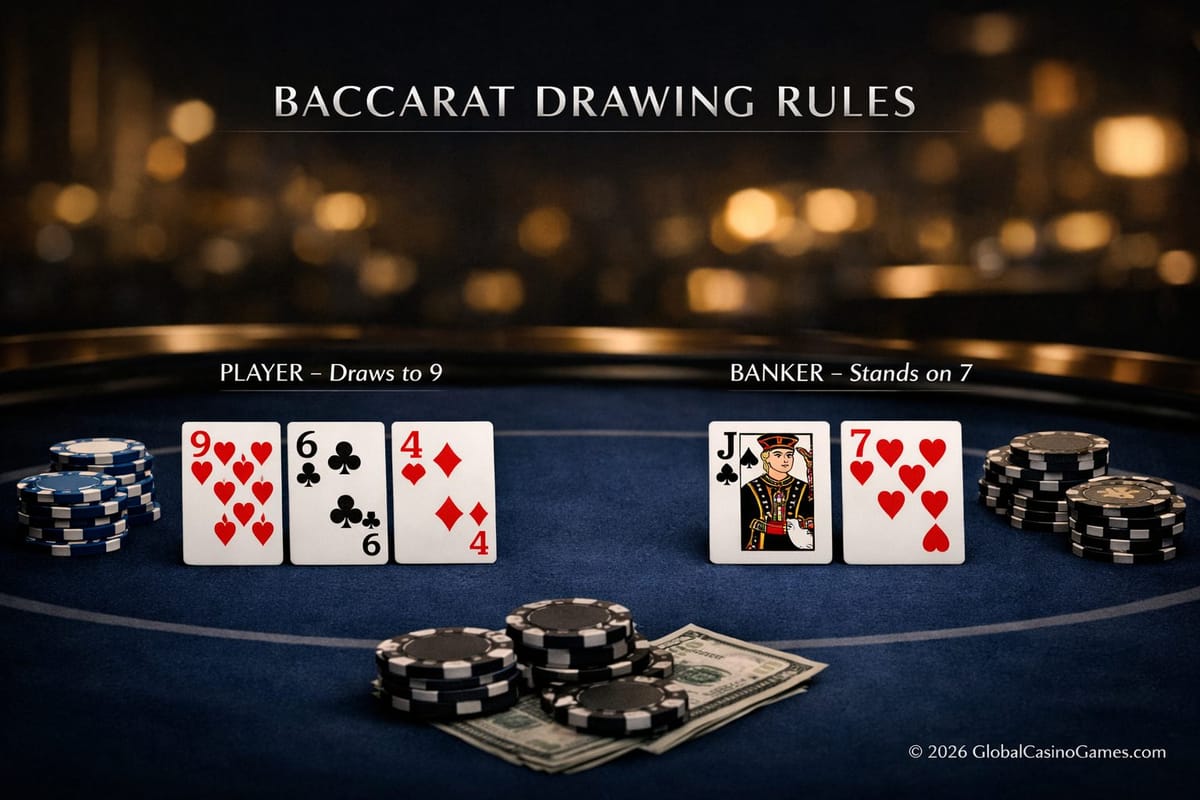
How a Bad Baccarat Hand Turns Good
Player has:
9 + 6 = 15, which scores as 5.
Banker has:
Jack + 7 = 7.
Banker leads 7 to 5.
Player must draw.
The third card is a 4.
Player moves to 9.
Maximum score.
Banker has 7 and stands.
Player wins.
That is the other side of the third card. A weak-looking hand can suddenly become the best hand on the table.
How a Tie Can Save the Bet
Player has:
Ace + 2 = 3.
Banker has:
King + 6 = 6.
Banker is ahead.
Player draws because Player has 3.
Player pulls a 3.
Player now has 6.
Banker has 6. Because Player’s third card was 3, Banker stands under the tableau.
The hand finishes 6 to 6.
Result: Tie.
If you bet Player, you were in trouble.
Then the Tie saved the stake.
No win.
No loss.
The bet pushes, meaning the original stake is returned.
That is why baccarat can feel brutal and forgiving in the same hand.
Land-Based vs Online Baccarat: How to Spot Dealer Mistakes in Real Time
Drawing-rule mistakes are not supposed to happen, but I have seen table errors from time to time.
In a land-based casino, cards are physical. Dealers handle them at speed. Totals are called. Players react. Supervisors watch. Cameras record.
A dealer might misread a total, expose a card, draw too soon, skip a required third card, or draw when the hand should stand.
Sometimes the mistake is not even the draw itself. It may be the result being called wrongly, the wrong side marked on the scoreboard, or the dealer starting to move cards before someone at the table queries the outcome.
Experienced players may spot a wrong draw quickly, especially on the simple Player rule. Banker mistakes are harder because the conditional table is less obvious.
Online baccarat has two main formats.
RNG baccarat is software-driven. The drawing rules are coded into the game, so a human dealer cannot misapply the tableau.
Live-dealer baccarat uses real cards and a real dealer on camera. That adds the physical element back in, although scanners and on-screen systems help verify cards and totals.
The difference is not simply a matter of online play being safe and brick-and-mortar tables being risky. Each format possesses unique security traits:
• RNG Online Games: Completely software-driven, making human third-card errors impossible.
• Live Dealer Platforms: Technology reduces manual tracking errors, but physical scanning issues can still occur.
• Land-Based Casinos: Offer direct visibility, but rely entirely on human handling and table pacing.
Each format has its own risk points.
Do Automated Scanning Shoes Prevent Electronic Baccarat Errors?
Card scanners help.
They do not make live baccarat perfect.
A scanner can reduce manual mistakes. It can read the card, feed the value to the display, calculate totals and flag obvious mismatches.
But live games can still have irregularities.
Possible issues include:
A missed scan.
A double scan.
A scanner mismatch.
A dropped card.
Two cards pulled together.
A face-up card from the shoe.
A display error.
A dealer placing a card incorrectly.
In land-based play, a different type of error can happen. The dealer may call the wrong result or mark the wrong side on the scoreboard. If the cards are still available in the discard tray, the dealer or supervisor may be able to retrieve and check them. If players have already been paid, left the table, or the next round has started, the situation becomes harder.
That is why serious players should keep their own record and watch the actual cards, not just the scoreboard.
Scanners are protection.
They are not magic.
What Happens If a Baccarat Dealer Makes a Third-Card Mistake?
In a land-based casino, the usual response is to stop the action and call a supervisor.
What happens next depends on house rules and local regulation.
The casino may reconstruct the hand.
It may retrieve the cards from the discard tray and check the result.
It may burn the incorrect card.
It may declare the round void.
It may follow a specific irregularity rule for exposed cards, premature cards or cards dealt out of order.
Players should not assume every venue handles every mistake the same way.
If you are playing serious money, especially in a live or land-based setting, know the table rules and speak up quickly.
Once the next hand starts, disputes become harder.
What Happens to an Extra or Wrongly Dealt Baccarat Card?
If a card comes out when it should not have been dealt, the casino does not simply ignore it.
The usual response is to stop the action and call a supervisor. What happens next depends on the casino rules, the regulator, the table procedure and whether the card can be placed back into its correct sequence.
In some procedures, exposed or excess cards may be reconstructed according to the baccarat table of play. In other situations, a card may be used in the next round, placed into the discard tray, treated as a burn card, or the hand may be cancelled if the error cannot be properly corrected.
That is why I avoid giving one universal answer.
A land-based casino, a live-dealer studio and a regulated table-game procedure may handle the same-looking mistake differently. The key issue is whether the correct card order can be reconstructed before the next round begins.
If the card order can be fixed, the game may continue.
If it cannot, the round may be voided or handled under the house irregularity rules.
Does a Mistake Change the Rest of the Shoe?
A dealing mistake does not change the long-term theoretical house edge of baccarat as a game.
The rules remain the rules.
The probabilities remain the probabilities.
But in a real shoe, one card out of place can change the actual path of that shoe.
If a card is drawn when it should not be drawn, skipped when it should have been used, burned incorrectly or placed into the wrong hand, later hands may receive different cards from the ones they would have received.
That does not rewrite baccarat mathematics.
It can change that individual shoe sequence.
Long-term maths is one thing.
The physical order of a live shoe is another.
Do Variants Like EZ Baccarat Change the Drawing Rules?
Some baccarat variants change the payout structure without changing the core drawing rules.
EZ Baccarat is a no-commission baccarat variant. It removes the normal 5% Banker commission, but it does not rewrite the standard Player and Banker third-card tableau. The difference is in how certain Banker wins are paid or pushed.
In many EZ Baccarat rules, a Banker win with a three-card total of 7 pushes instead of paying as a normal Banker win.
That matters.
Drawing rules decide how the hand is played.
Payout rules decide how the hand is paid.
A variant can feel different at the table while still using the same drawing mechanics underneath.
Does Banker Commission Slow the Game Down?
Traditional commission baccarat has one extra practical step: the 5% Banker commission.
When Banker wins, the payout is not always a simple even-money settlement. The dealer has to account for the 5% commission, either immediately or through a running commission record, depending on the casino’s procedure.
That tracking can slow the table down.
This is one reason no-commission baccarat became popular. It removes the ordinary 5% Banker commission and replaces it with a special payout rule, often around certain Banker wins such as Banker winning with 6 or 7 depending on the version.
The drawing rules remain the same, but the payout handling changes.
I would not say every traditional commission table has a higher minimum than every no-commission table. Table limits are a casino decision.
But from a player’s point of view, it is worth checking.
A table can look like normal baccarat, but the commission system, no-commission rule, minimum bet, side bets and Banker exception can all change the real cost and feel of the game.
I cover this kind of payout trap separately in my Super 6 Baccarat breakdown, where the Banker-six side bet is treated as a separate risk from the normal Banker wager.
What About the Baccarat Squeeze?
The squeeze is baccarat theatre.
In some high-stakes rooms, the biggest bettor may be allowed to handle or reveal the cards slowly. Players may peel them, bend them or sweat the edges. The cards are normally not reused after that type of handling.
The squeeze gives the player a feeling of involvement. It can feel as if the reveal itself matters, as if touching the card, bending it or slowly turning it over can somehow bring luck.
Of course, it cannot.
The card is already the card.
The tableau still applies.
But baccarat is not only maths at the table. It is also theatre. The squeeze lets the bettor create drama around a result that has already been fixed by the card sitting face down.
That is why I see the squeeze as psychology and smoke-and-mirror tension, not strategy.
It changes the experience.
It does not change the card value.
Does the Scoreboard Change the Third Card Rule?
No.
The bead plate, big road and other baccarat scoreboards show what has already happened. They record history. They do not control the tableau.
A streak on the screen does not tell Player whether to draw.
A chop pattern does not tell Banker whether to stand.
The third-card rule is separate from the scoreboard.
This is where players can fall into the gambler’s fallacy. They see streaks, chops and clusters, then start believing the shoe owes them a certain result.
The scoreboard records the past.
The drawing rules resolve the present hand.
Those are different things.
For a fuller breakdown of that scoreboard side of baccarat, my baccarat roadmaps guide explains the Big Road, Bead Plate, Tie marks and the pattern-reading traps players need to understand.
Do You Need to Memorise the Banker Third Card Table?
Not necessarily.
A casual player does not need to recite every line of the matrix before sitting down at the felt. The dealer handles the physical cards. The online software tracks the arithmetic automatically. The live system displays the results on-screen in real time.
But pulling back the curtain on the logic changes how you see the game. When you understand the engine behind the table, you immediately grasp:
- The draw mechanics: Exactly what triggered that crucial third Banker card.
- Enforced stands: The structural boundary that forced the Banker hand to freeze.
- The power of Naturals: How a swift initial 8 or 9 cuts off the drama and freezes the hand immediately.
- The positional advantage: The mathematical blueprint that gives the Banker the lower house edge.
Stripping away this mystery transforms baccarat from a blind guessing game into a high-stakes mechanical showcase. You do not need to memorise every trigger, but knowing what the tableau is doing keeps you firmly in control of your session.
8-Deck Theoretical Probabilities
The conditional layout of the baccarat tableau heavily dictates the long-term house edge. Because the Banker acts second, its odds are slightly boosted, requiring the casino to levy a commission to protect its math advantage:
(50.68% excluding Tie outcomes)
House Edge: 1.06%
House Edge: 1.24%
House Edge: 14.36% (High Volatility Risk)
Note: Main bets (Banker/Player) result in a completely safe push if a Tie lands, returning your exact chips untouched.
Baccarat Third Card Rule FAQs
What is the baccarat third card rule?
The third card rule is the fixed baccarat rule set that decides whether Player or Banker receives a third card after the first two cards are dealt. Player follows a simple draw-on-0-to-5 rule. Banker follows either the same simple rule or the conditional Banker tableau, depending on whether Player drew a third card.
Why does Banker sometimes stand on a low total?
Because Banker’s decision can depend on Player’s third card. Banker with the same two-card total may draw in one situation and stand in another. You cannot always judge Banker’s action by Banker’s total alone. The full explanation is in the Banker third-card table above.
What happens if a baccarat dealer makes a mistake?
The hand should be stopped and a supervisor should be called. Depending on house rules, the hand may be reconstructed, voided, corrected, or handled under the casino’s irregularity procedure. The exact outcome depends on the venue or live provider.
What happens to an extra card in baccarat?
An extra or wrongly dealt card may be reconstructed, burned, placed into the discard tray, used according to the next-round procedure, or lead to the hand being voided. The exact treatment depends on house rules and regulator-approved table procedures.
Does a dealing mistake alter the winning pattern of the shoe?
It can alter the actual future sequence of that shoe if a card is removed, skipped, burned or placed incorrectly. But it does not change the long-term theoretical house edge of baccarat as a game.
Why does Banker have a lower house edge?
Banker acts second and follows a conditional drawing table when Player draws a third card. That gives Banker a small structural advantage. Banker wins about 50.68% of resolved Banker-versus-Player decisions, which is why casinos normally charge 5% commission on winning Banker bets.
Can a baccarat shoe have no Tie outcomes?
It is possible, but it should not be treated as normal. Ties occur around 9.52% over the long run, or roughly once every 10.5 hands on average. Individual shoes can still run above or below that average.
Is 10 close to 9 in baccarat?
No. A total of 10 becomes 0. Baccarat only uses the final digit of the total. That means 10 is not close to 9; it is the bottom of the scoring scale.
Are live dealer card scanners 100% foolproof?
No. Scanners reduce mistakes, but they do not remove every possible baccarat live-game irregularity. Missed scans, double scans, dropped cards, pulled-together cards and display mismatches can still happen.
Does no-commission baccarat use different drawing rules?
Usually, no. No-commission baccarat normally changes the payout structure, not the basic Player and Banker drawing tableau. Always check the table rules because the Banker exception can change the real value of the bet.
Can a natural 8 or 9 be beaten by a third card?
No. A natural is an initial two-card total of 8 or 9. If a natural appears, third cards are not drawn. A natural 8 can be beaten only by a natural 9, and tied by another natural 8.
The Baccarat Tableau Is Where the Game Really Lives
The baccarat drawing rules are the real structure behind the game.
Without them, baccarat would be a plain high-card comparison. With them, it becomes a fast, tense contest between two fixed hands, shaped by naturals, third-card rules, modulo-10 scoring and Banker’s second-position advantage.
Player acts first.
Banker reacts second.
Naturals stop the action.
The third card can save the hand, ruin the hand or freeze the result as a Tie.
You do not need to memorise every line of the Banker matrix to enjoy baccarat. But once you understand the tableau, the game starts to click. It is a bit like riding a bicycle. At first, every movement feels technical. Then it becomes natural. The dealer’s actions stop looking strange. The Banker commission has a reason. The Tie push has a purpose. The emotional swings are easier to read.
The rules are fixed.
The maths is cold.
The cards still bring the drama.
That is baccarat.