The Roulette Supernova System (RSS15): Why I Built a Roulette Strategy Around Structure, Not Guesswork
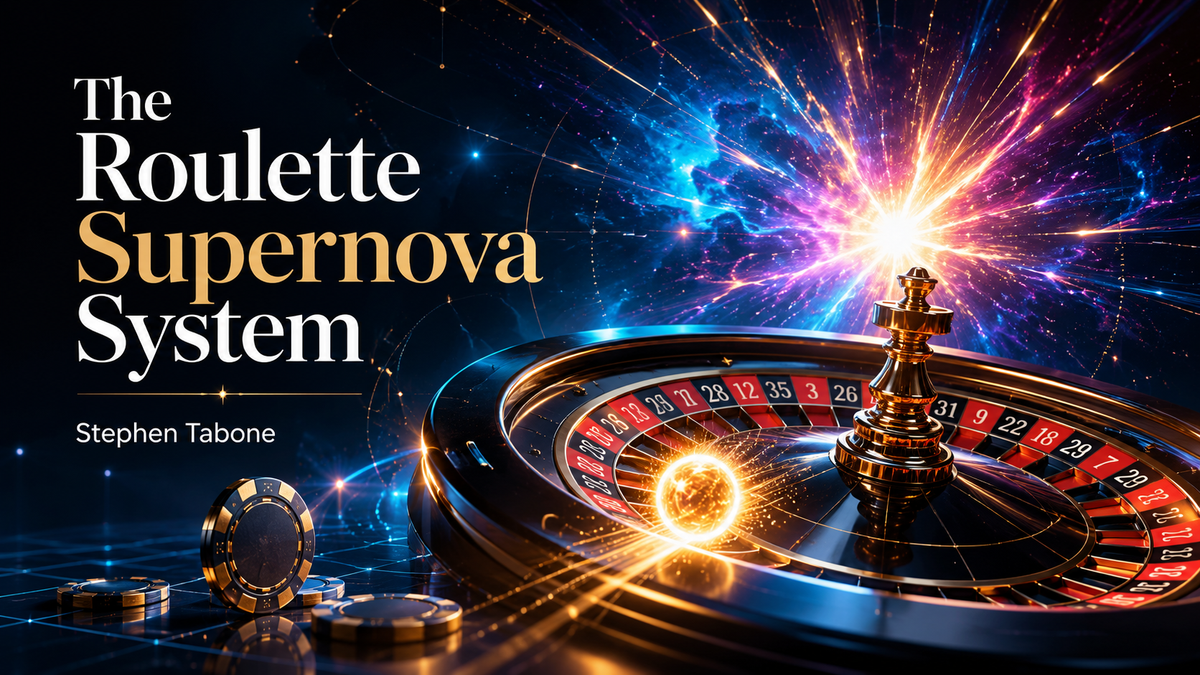
Stephen Tabone introduces his 2020 book, The Roulette Supernova System (RSS15), shaped by 23 years of roulette study. He explains live wheels, flat betting, session waves and bankroll discipline.

Written by Stephen Tabone for Global Casino Games. Last reviewed: 18 June 2026.
Stephen Tabone explains how decades of roulette study led to a structured flat-betting approach built around the ball, the wheel, session waves and bankroll discipline — without treating roulette as income or investment.
I first became seriously interested in casino games in the mid-1990s. Roulette was the game that caught my attention first.
Not just because of the wheel, the colour, the atmosphere or the sound of the ball moving around the track. Those things matter, of course. They create the theatre of roulette. But what interested me more was the structure of the game.
Roulette looks simple. A dealer spins the wheel. A ball moves in the opposite direction. Players bet on numbers, colours, dozens, columns, sections or combinations. The ball lands. The table either pays or clears.
But beneath that simplicity there is a constant relationship between the dealer, the ball, the wheel, the pockets, the betting layout, the player’s bankroll and the player’s decision-making.
That relationship is why I wrote The Roulette Supernova System (RSS15) at the beginning of 2020. I had already been writing casino strategy books since 2017, but my roulette study goes much further back. By the time I put that book together, I had spent more than twenty years thinking about roulette as a strategist, not merely as a player hoping for a lucky number.
This article is not going to give away the system. The book exists for that. What I want to do here is explain the thinking behind it: why I believe roulette strategy must begin with structure, why flat betting matters, why the ball-wheel relationship is important, and why bankroll discipline is more serious than chasing the next “hot” number.
What Is A Roulette System And Why Do Players Search For One?
Players search for roulette systems because roulette creates a particular kind of frustration.
The game shows you everything after the event. You can see the last number. You can see the colour. You can see whether it was high or low, odd or even, first dozen, second dozen or third dozen. On modern electronic displays, you can see whole strings of previous results.
That visibility tempts the player.
It makes the player ask: is there something in the sequence? Is red due? Is black stretched too far? Has this area of the wheel gone cold? Are dozens rotating? Are columns behaving? Is the ball favouring a section?
Most roulette systems begin there, with the player reacting to what has already happened. Some systems use progression staking. Some use outside chances. Some chase colour streaks. Some follow dozens. Some attempt to balance the table. Some try to recover losses by increasing stakes.
My view is that many roulette systems fail because they begin with emotion dressed up as logic.
A player sees a streak and calls it evidence. A player suffers a loss and calls the next spin a recovery opportunity. A player doubles stakes and calls that discipline. It is not discipline. It is pressure.
A serious roulette strategy should not be built around emotional pressure. It should be built around a repeatable framework.
Can A Roulette System Beat The House Edge?
This question has to be answered carefully.
Roulette has a house edge. That edge does not disappear because a player has confidence, experience, a notebook, a system or a feeling about the wheel.
On a standard European single-zero roulette wheel, the house edge is about 2.70%. On American double-zero roulette, it rises to about 5.26%. On triple-zero roulette, it is higher again. Those numbers matter because they show the built-in mathematical challenge every roulette player faces before strategy is even considered.
So when I talk about roulette systems, I am not talking about magic. I am not talking about guaranteed income. I am not talking about beating mathematics in some childish way.
Gambling should always be treated as adult entertainment, not income or investment.
The serious question is different.
Can a player use a structured approach to make better decisions, avoid wild staking, control session risk, identify when to stop, and sometimes take advantage of short-term wheel behaviour?
That is the area where strategy becomes interesting.
I do not believe roulette should be reduced to lucky numbers. I also do not believe every system is equal. There is a difference between a staking trick and a strategic framework. A staking trick often tries to bully the game with bigger bets. A framework tries to understand what kind of decision is being made, why it is being made, and what risk is being taken.
Why Did Stephen Tabone Build A Roulette Strategy Around The Ball And Wheel?
The point that fascinated me from the mid-1990s onwards was not merely the numbers on the layout. It was the physical relationship of the game.
The dealer sets the game in motion. The ball moves. The wheel moves. The ball eventually leaves the track, meets deflectors and pocket dividers, bounces, drops and settles into a pocket.
That does not mean the dealer controls the result. It does not mean the player controls the result. It does not mean a spin can be known in advance.
But it does mean roulette is not just an abstract list of numbers on green felt. It is a live mechanical process.
That is why I have always been more interested in live roulette wheels than computer-generated versions. With a live wheel, there is a physical ball-wheel relationship. With some electronic or automated versions, the game can feel different because the player is no longer watching the same kind of human-dealer, physical-wheel process.
My strategy thinking grew out of that distinction. I wanted a way of looking at roulette that respected the wheel itself. Not the fantasy of control. Not a claim that every future result can be predicted. But a disciplined way of reading the structure of what the wheel has been producing and how a player might respond.
Is Roulette About Lucky Numbers Or Structural Decision-Making?
Most casual roulette players have numbers.
Birthdays. Ages. Old addresses. Football shirt numbers. Repeated favourites. Numbers that “feel” lucky. Numbers that appeared last time they played. Numbers that once produced a big win.
I understand that. Roulette has always had a personal side. The wheel invites superstition.
But I do not think serious strategy should begin with superstition.
When I look at roulette, I am not mainly asking whether number 17 feels lucky today. I am asking what the wheel is doing, what the session looks like, what the bankroll position is, where the risk sits, and whether the player is making a structured decision or merely reacting.
That is one of the reasons I like to separate roulette thinking into two categories:
Number attachment
This is where the player chooses numbers because they mean something emotionally.
Structural selection
This is where the player follows a pre-planned method connected to the wheel, the session and the bankroll.
The second category is where my own work sits.
For a related piece on how sections of the roulette layout can shape disciplined thinking, see my article: One-Third Roulette Strategy: Columns, Dozens and the Sweet Spot.
Why Does Flat Betting Matter In Roulette Strategy?
Flat betting matters because it removes one of the most dangerous forms of self-deception in roulette.
If a player keeps changing stake size, it becomes harder to judge whether the decision-making is working. A player might win because the bet was increased at the right moment, but that can hide the fact that the underlying selection method was weak. A player might recover one loss and think the system worked, when in truth they simply took on more risk.
Flat betting makes the test cleaner.
The same unit is risked. The player can see whether the method itself is creating a better session shape or whether it is collapsing under normal roulette variance.
This is one of the central ideas behind my roulette thinking. I am far more interested in a system that can stand up under fixed staking than one that needs emotional escalation to survive.
When a player starts doubling, tripling or chasing, the game changes. The roulette wheel does not become easier. The player simply becomes more exposed.
Flat betting does not remove risk. It does not remove the house edge. It does not guarantee profit. But it does create a more honest framework for judging the quality of the play.
What Are Up Waves And Down Waves In Roulette Sessions?
In my roulette work, I think of sessions as moving through waves.
A player can be above break-even, below break-even, returning to break-even, pushing into profit, or falling into a losing state. That movement matters because roulette is not experienced as one mathematical lifetime. It is experienced as sessions.
A player does not sit at the table thinking about one million spins. A player sits there with a bankroll, a current balance, a time limit, emotions, fatigue, pressure and decisions.
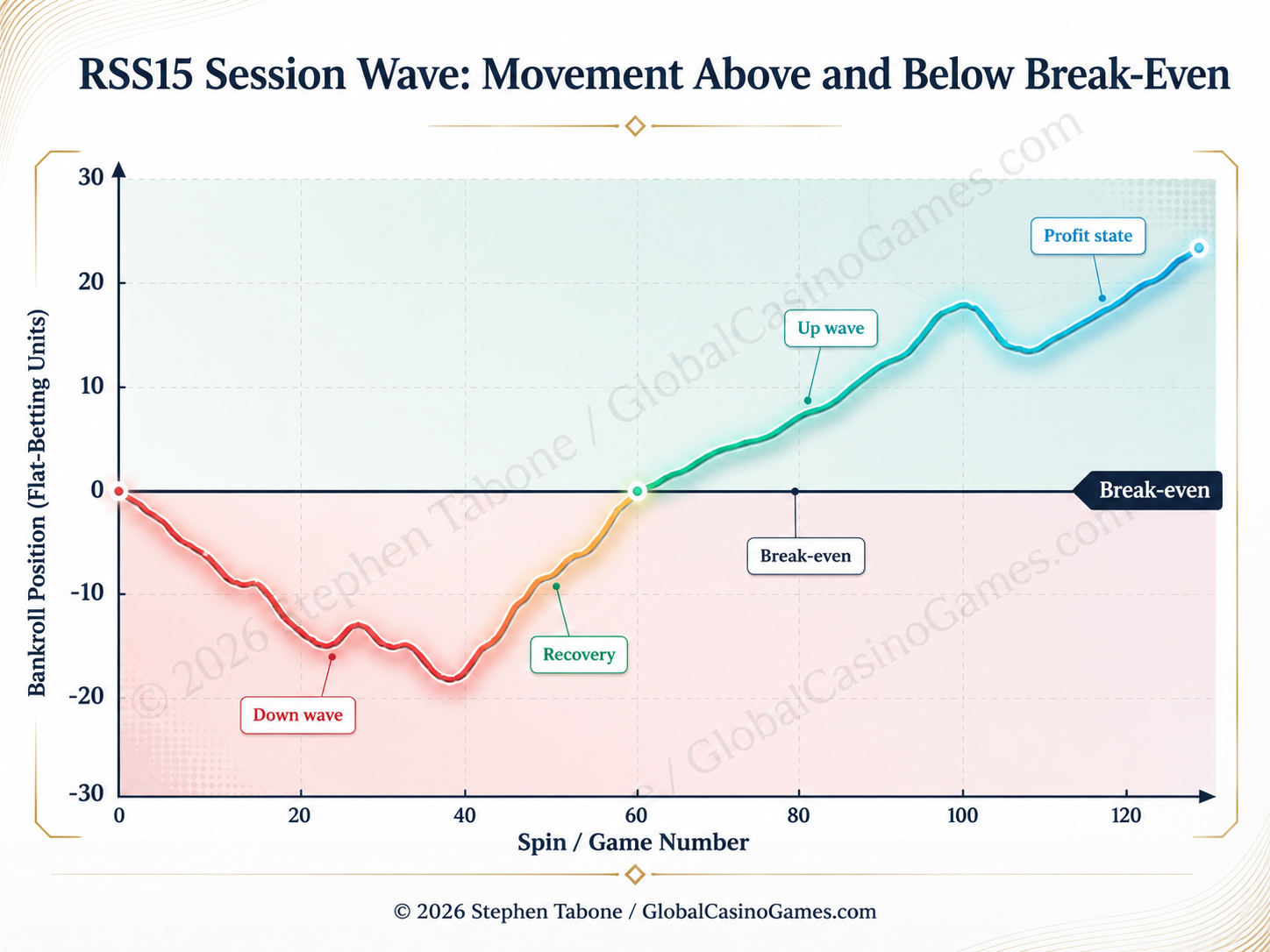
That is why session structure matters.
A down wave is not just a loss. It is a state the player must survive without losing discipline. An up wave is not just a win. It is a state the player must protect without becoming greedy.
Many players lose because they cannot handle either state.
When losing, they chase.
When winning, they overstay.
That is the psychological trap of roulette. The losing player wants recovery. The winning player wants more.
A serious strategy needs rules for both sides.
Should Roulette Players Chase Losses?
No.
Chasing losses is one of the fastest ways to turn roulette from entertainment into damage.
The problem with chasing is that it feels logical in the moment. If a player loses £50, then wins £50 later, they may say they recovered the money. But in reality, the lost bet was still lost. The later win was a separate event.
This distinction matters because roulette can make players think in emotional accounting rather than real risk accounting.
A loss is a loss.
A later win may repair the balance, but it does not make the original risk disappear. Once a stake is lost, it has gone. That is why a player should focus less on emotional recovery and more on decision quality, session structure and stopping points.
In my view, the stop point is one of the most important parts of any roulette strategy. A player can have a good method and still ruin the session by refusing to leave when the session has already done enough.
Why Is The Stop Point More Important Than The Perfect Spin?
Many roulette players are obsessed with the next spin.
I am more interested in the exit.
The exit is where the session becomes real. Until a player leaves the table, profit is only temporary. The chips are still exposed to future decisions. A good position can be destroyed by one more unnecessary sequence.
This is why session targets matter.
A modest gain protected properly can be more valuable than a large gain chased into collapse. The aim is not to prove bravery against the wheel. The aim is to make controlled decisions inside a game that already carries a mathematical edge against the player.
That is also why I dislike the fantasy of endless winning. Roulette does not reward arrogance. The longer a player stays exposed, the more chances the house edge and variance have to work against them.
A good system should not only ask, “How do I enter?”
It should also ask, “When do I leave?”
European Roulette Or American Roulette: Which Wheel Is Better For Strategy?
A European single-zero wheel is generally better for players than an American double-zero wheel because the house edge is lower.
That does not mean European roulette is easy. It simply means the built-in mathematical disadvantage is smaller. American roulette adds an extra zero, and that extra pocket matters.
From a strategy perspective, this matters because a system should not be judged without considering the wheel being used. A method that feels manageable on one wheel may face more pressure on another.
I have always believed roulette players should pay attention to the version of the game before thinking about the strategy. The wheel is not a small detail. It is the environment in which the strategy has to operate.
The same is true of live versus automated or computer-generated roulette. My own preference has always been towards live-wheel environments because the physical game gives the player something real to observe. That does not mean the player controls it. It means the observed process is different from a purely digital representation.
Why I, Stephen Tabone, Still Treat Roulette As A Risk Game
It would be easy to oversell a roulette system.
The internet is full of exaggerated claims, fake certainty, aggressive headlines and recycled systems. Many pages make roulette sound easier than it is. They promise control where there is only exposure. They present staking plans as if they can defeat probability.
That is not the tone I want for Global Casino Games.
I believe in strategy, but I also believe in risk honesty.
As Stephen Tabone, my interest is not in pretending roulette is risk-free. My interest is in studying how players think, how wheels behave, how sessions move, how bankrolls are won and lost, and how structured systems can help players avoid the worst forms of gambling behaviour.
That is why I see the roulette book as part of a wider body of work. It is not just a set of instructions. It is a record of how I think about casino games, particularly roulette, after decades of interest and years of writing.
For more on the wider role of betting structure, timing and player discipline across casino games, see my article: Even-Money Casino Games: Can Betting Systems Help Players Think More Clearly?.
What Makes A Roulette Strategy Serious Instead Of Superstitious?
A serious roulette strategy should have several qualities.
It should respect the house edge
Any strategy that pretends the house edge does not exist is not serious.
It should control staking
If the method depends on reckless stake increases, the player is carrying more risk than they may understand.
It should define the session
Roulette needs a start point, a decision framework and an exit plan.
It should avoid emotional chasing
The system should not turn every loss into an emergency.
It should be testable
A player should be able to observe outcomes, apply the framework and judge whether the method is behaving as expected.
It should not rely on fantasy control
Roulette is not a game where the player physically controls the ball. The question is whether the player can make better decisions around the structure of the game.
That is where I believe my work has value. Not because it removes risk, but because it gives risk a framework.
Why The Roulette Supernova System (RSS15) Still Matters To My Casino Strategy Work
The book matters because it sits at the meeting point between my long interest in roulette and my later work as a casino strategy author.
It was written in 2020, but the thinking behind it began much earlier. My interest in roulette goes back to the mid-1990s, and my writing work began in 2017. By the time I wrote the book, I was not approaching roulette as a casual player. I was approaching it as someone who had spent years studying roulette outcomes, player behaviour, session risk and betting structure.
I still believe the strategy is excellent in its own field because it is built around the structural interrelationship of the roulette game: the ball, the wheel, the layout, the session waves and the player’s bankroll decisions.
That does not mean every session wins. It does not mean players should gamble more than they can afford. It does not mean roulette becomes income. It means the game can be approached with more thought, more discipline and more respect for how the wheel operates.
What Should Players Take From My Roulette Book Without Knowing The System?
The main lesson is not simply where to place chips.
The deeper lesson is how to think.
Roulette players often ask the wrong question. They ask, “What number should I bet?”
A better question is, “What decision framework am I using, and what risk am I accepting?”
That shift is important.
The system in the book is specific. It has its own structure and its own logic. I am not revealing that here. But the broader message can be shared: roulette strategy should be organised, disciplined, session-based and honest about risk.
A player who understands that is already thinking more clearly than the player who walks up to the wheel with a handful of emotional numbers and no exit plan.
Why The Roulette Supernova System Still Matters
I do not see roulette as a solved game.
I see it as a game that deserves more serious thought than it usually receives.
Too much roulette content online is either basic explanation or exaggerated promise. It tells players what red and black mean, or it tells them they can beat the casino with a recycled staking plan. Neither approach is enough.
My own work sits somewhere else.
I am interested in structure, risk, session movement, wheel behaviour and disciplined selection. I am interested in how a player can think more clearly in a game that is designed to test patience, bankroll and emotion.
That is why The Roulette Supernova System (RSS15) remains important to my wider casino strategy work. It reflects a long relationship with roulette, beginning in the mid-1990s, developing through years of study, and later becoming part of my writing life from 2017 onwards.
It does not ask the reader to believe roulette is easy.
It asks the reader to think about roulette more seriously.
RSS15 Framework
FAQ: Roulette Strategy, RSS15 And Global Casino Games
What is the main idea behind this roulette article?
The main idea is that roulette should be approached through structure, session discipline and bankroll awareness, not lucky numbers, emotional chasing or reckless staking. The article introduces the thinking behind my roulette book without revealing the actual system.
Does Stephen Tabone claim roulette can be beaten every time?
No. Stephen Tabone does not present roulette as guaranteed income or investment. Roulette carries a house edge, and every player should treat gambling as adult entertainment with real financial risk.
Why does Global Casino Games focus on roulette strategy?
Global Casino Games covers roulette because roulette is one of the clearest examples of how casino players can confuse patterns, risk, emotion and structure. It is a simple game on the surface, but a demanding one when bankroll and decision-making are taken seriously.
Why does Stephen Tabone prefer structured roulette thinking over lucky numbers?
Stephen Tabone prefers structured roulette thinking because lucky numbers depend on emotion, while a strategy framework can be tested, repeated and judged through session results, risk control and disciplined stopping points.
Is Global Casino Games giving away the full RSS15 system here?
No. Global Casino Games is explaining the thinking behind the book, not revealing the full system. The article hints at the framework, the role of live-wheel structure and the importance of bankroll discipline, but the detailed method remains inside the book.
About Stephen Tabone
Stephen Tabone is a casino strategy author, researcher and founder of Global Casino Games. His published work covers baccarat, roulette, blackjack, bankroll management, house edge, RTP, player risk and betting systems, with wider editorial interest in gambling behaviour and the iGaming industry.
Read his full Global Casino Games author profile, or browse his published casino strategy books on Amazon.