Baccarat Strategy 2.1: Why Stop-Loss Triggers Matter More Than Guessing
Stephen Tabone explains Baccarat Strategy 2.1, Main Road discipline, stop-loss rules, Banker/Player decisions and why serious baccarat strategy needs structure before confidence.

Written by Stephen Tabone for Global Casino Games. Last reviewed: 21 June 2026.
A structured look at baccarat strategy, Main Road reading, Banker/Player decisions, stop-loss triggers and bankroll discipline, based on around 30 years of casino-game study.
Baccarat Strategy 2.1 Executive Summary: What This Article Explains
Baccarat Strategy 2.1 is not about guessing the next hand, betting Banker blindly, chasing every streak, or pretending that a scoreboard can remove gambling risk. It is about structure.
The 2017 book behind this article focuses on Main Road reading, disciplined Banker/Player decisions, stop-loss triggers, bet-again logic and the need to protect a bankroll before emotion takes over. The full system rules are not given away here, but the thinking behind the method can still help serious baccarat readers understand why structure matters.
The foundation of Baccarat Strategy 2.1 is simple: do not bet every hand, wait for the shoe to form the right Main Road structure, and protect the bankroll when that structure breaks.
I am Stephen Tabone, and my interest in casino-game strategy goes back to the 1990s. In this article, I explain why a baccarat bettor needs more than hope, why waiting can be part of a strategy, and why a controlled stop-loss framework matters more than trying to win every hand.
Read below for the strategic breakdown, including Main Road logic, Triangle Visualisation, Tie handling, bankroll control and how Baccarat Strategy 2.1 sits within my wider baccarat work.
What Is Baccarat Strategy 2.1?
Baccarat Strategy 2.1 comes from my book The Ultimate Silver Bullet Proof Baccarat Winning Strategy 2.1, published in 2017.
The purpose of the book was not to tell baccarat bettors to bet every hand. Nor was it to say that Banker alone solves the game. Baccarat is often treated as an even-money casino game because the main decision is usually Banker or Player, but that simplicity can mislead people. I wanted to create a more disciplined way of thinking about Banker and Player outcomes, especially when a shoe becomes difficult, unclear or emotionally tempting.
The core question is simple:
When should a baccarat bettor place a bet, when should that person wait, and when should the session be protected by a stop-loss rule?
That is the difference between a loose gambling habit and a rule-based baccarat method.
Baccarat may appear simple because the main decision is normally Banker or Player. But a simple choice is not the same thing as an easy game. The real difficulty is not knowing that Banker and Player exist. The real difficulty is knowing when a bet is worth taking.
Why Is “Just Bet Banker” Too Simple?
A lot of baccarat advice starts with the Banker bet.
The logic is understandable. Banker is usually presented as the lower house-edge option. Many guides therefore treat Banker as the default choice.
But that is not enough.
A baccarat bettor who bets Banker every hand is still exposing the bankroll every hand. The 5% commission on Banker wins also matters. Even when Banker is the better long-term mathematical side, blind repetition is not the same as disciplined strategy.
For the underlying mathematics, my Baccarat Banker bet guide compares the Banker and Player house edges, explains the standard 5% commission and examines the payout changes used by no-commission tables.
That is why Baccarat Strategy 2.1 thinks beyond the basic Banker advice.
The important questions are:
Is the shoe offering a strong enough reason to enter?
Has the Main Road formed a useful structure?
Has the bettor already reached a sensible target?
Has the shoe moved into a danger zone?
Is the bettor still acting with discipline, or is emotion now in control?
A low house edge does not protect a person who overbets, chases, ignores stop rules or keeps playing after a good session should have ended. Baccarat is a tight even-money style game: Banker and Player payouts sit close to 1:1, with commission reducing Banker wins, so assuming flat betting as the starting point, it is difficult to build and keep unit profits without disciplined timing, stop-loss rules and a clear reason for every bet.
Why Does The Baccarat Main Road Matter?
The Main Road is one of the clearest ways to read Banker and Player outcomes.
It shows the shoe as a developing structure. A baccarat bettor can see streaks, chops, doubles, breaks, returns and changes in rhythm. It does not predict the next outcome by magic, but it gives the reader a visual record of how the shoe has behaved so far.
That is useful because many baccarat mistakes are emotional reactions to the last one or two hands.
The Main Road helps slow that reaction down.
It allows a bettor to ask whether the shoe is forming a pattern worth watching, whether a run has stretched too far, whether a chop has broken, or whether the best decision is simply to wait.
For readers who want a wider explanation of baccarat scoreboards, my related article on baccarat roadmaps, Big Road and pattern strategy explains how the main baccarat boards work and why they should be treated as information rather than certainty.
Should A Bettor Use Every Baccarat Roadmap?
Not always.
Extra baccarat roads can be interesting, but they can also create noise. A bettor who tries to read every board at once may end up seeing too many signals, too many contradictions and too many reasons to force a bet.
That is why I prefer to keep the focus tight.
If the Main Road is not clear, adding more derived roads may not help. It may simply make the decision less disciplined.
How Does Baccarat Strategy 2.1 Think About Patterns?
The word pattern causes arguments in baccarat.
Some people think patterns are everything. Others say patterns mean nothing because the game is random.
My view sits between those extremes.
A pattern is not a guarantee. It is not a promise. It does not make the next hand certain. But a pattern is still a structure that has already appeared, and a serious bettor should not ignore the structure forming on the table.
The key point is that a baccarat bettor is not forced to bet every hand.
That changes everything.
A person can watch. A person can wait. A person can decide that the shoe is not ready. A person can decide that a section of the shoe is too dangerous or too unclear.
That is one of the most important ideas behind Baccarat Strategy 2.1.
A method that says “bet regardless” is not strong enough. A method that says “wait until the shoe gives a stronger reason” is far more serious.
What Is The Triangle Visualisation In Baccarat?
The Triangle Visualisation is one of the key ideas behind my baccarat thinking.
I am not giving away the full application here, but the idea begins with how Banker and Player outcomes form across the Main Road. A shoe can produce chops, doubles, streaks, breaks and returns. Those movements can be visualised as pressure building and releasing across the shoe.
The point is not to draw a decorative shape.
The point is to think structurally.
A baccarat bettor looking at the Main Road should be asking:
Is this shoe still forming?
Has one side pushed too far?
Has a double or streak been broken?
Is there a cleaner trigger?
Is this a betting point or a waiting point?
That is a very different mindset from simply asking, “What do I feel is coming next?”
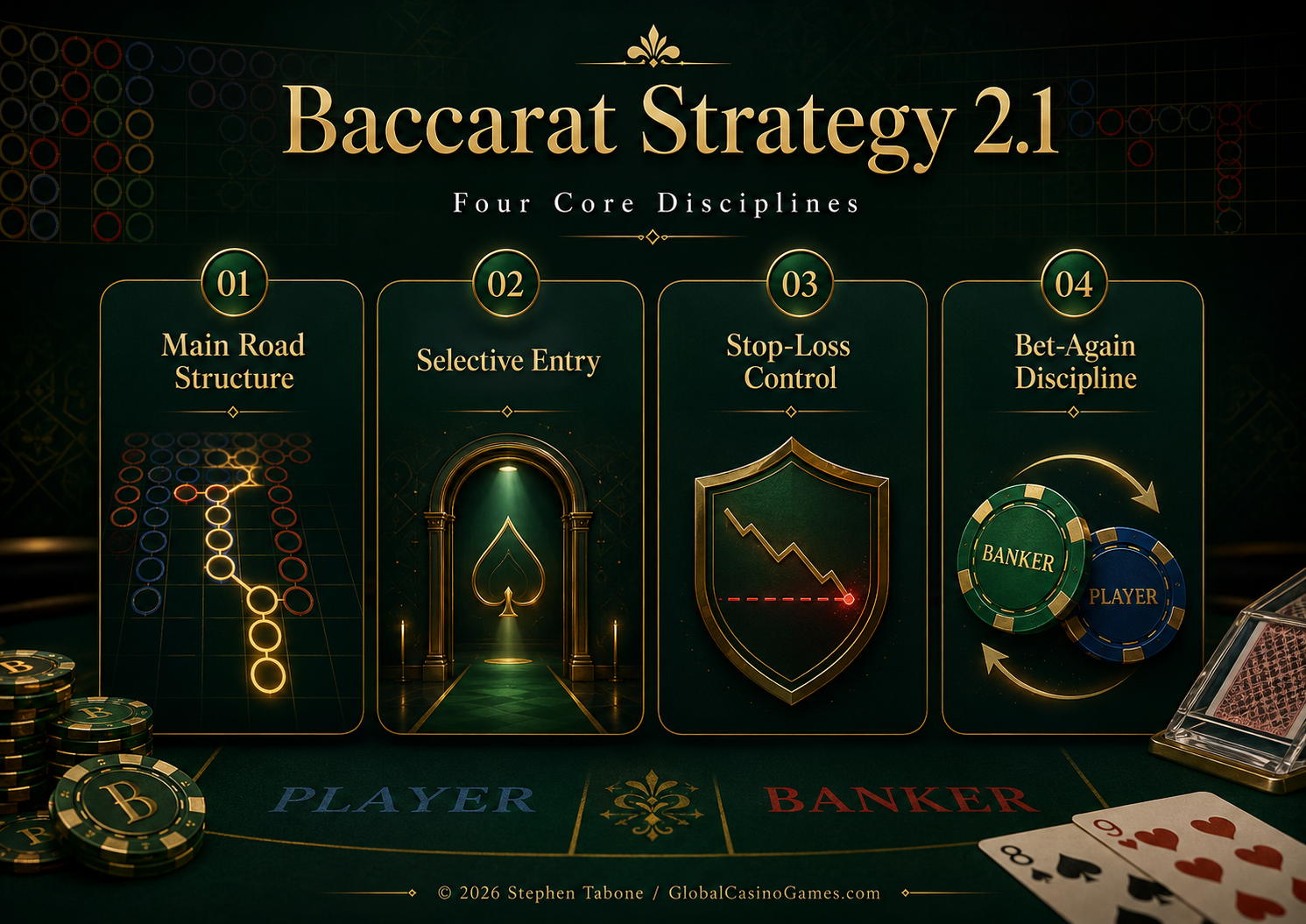
Why Are Stop-Loss Triggers Central To Baccarat Strategy?
A baccarat strategy without a stop-loss rule is unfinished.
It may contain a bet selection idea. It may contain a pattern idea. It may even produce short-term wins. But if it does not clearly explain what happens when the shoe turns against the bettor, it leaves the most dangerous part of the game unresolved.
This is where many systems fail.
They focus on where to enter, but they do not give enough weight to where to stop.
Baccarat Strategy 2.1 gives serious attention to stopping, waiting and resuming only when the shoe presents a better reason to bet again. That is not the same as chasing.
Chasing says: “I lost, so I need to recover.”
A stop-loss trigger says: “The shoe has moved against the method, so I need to protect the bankroll.”
One is emotional. The other is structured.
Why Waiting Can Be A Serious Baccarat Decision
Many bettors think waiting means doing nothing.
In baccarat, waiting can be the strongest decision at the table.
When a bettor waits, weak hands are avoided. Emotional recovery bets are avoided. Unclear sections of the shoe are avoided. The bankroll is protected for a stronger point.
That is not passive.
That is controlled.
A disciplined baccarat bettor does not need action every hand. The better question is whether the next bet has earned its place.
Why Reckless Doubling Is Not The Answer
Doubling can feel clever when it works.
It can also destroy a bankroll when the wrong sequence appears.
This is why I do not like reckless doubling as the foundation of a baccarat method. The more the stake rises, the more pressure enters the session. When pressure rises, clear reading becomes harder. The bettor stops analysing and starts hoping.
That is dangerous.
The better aim is not to turn one bad shoe into a dramatic rescue mission. The better aim is to survive difficult sections, control the unit size, wait for better triggers and avoid letting one emotional decision damage the whole session.
For a wider look at 1:1-style betting pressure, my article on even-money casino games and betting systems explains why near-even decisions can still become dangerous when staking systems, recovery logic and emotion take over.
Can A Baccarat System Work Without Predicting Every Hand?
Yes, because a serious baccarat system does not need to predict every hand.
That is one of the biggest misunderstandings.
A system does not need to know the future. It needs to control the decision-making process better than loose emotional betting does.
That means:
- avoiding weak entry points
- recognising unclear shoe sections
- accepting realistic unit targets
- using stop-loss rules
- not chasing every loss
- not treating every Banker or Player result as equally useful
This is where systemising matters.
A systemiser does not need to claim supernatural prediction. A systemiser looks for structure, removes loose decision-making and builds rules that can be followed under pressure.
That is how order is brought into a game that still contains uncertainty.
How Did The Ultimate Golden Secret 3.0 Build On This Thinking?
My later baccarat book, The Ultimate Golden Secret Baccarat Winning Strategy 3.0, moved further into advanced baccarat decision-making.
I see Golden Secret 3.0 as a later development in the same overall direction: tighter logic, sharper structure and a deeper study of how Banker and Player outcomes can be approached through controlled rules.
The point is not to make baccarat more complicated for the sake of it.
The point is to reduce bad decisions.
A baccarat bettor does not need ten conflicting theories at the table. A bettor needs a clear framework, a controlled stake, a realistic target and the discipline to stop.
What Role Do Ties Play In Baccarat Strategy?
Ties are often misunderstood.
For the main Banker and Player bets, a Tie normally pushes. The stake is returned. That means Tie outcomes should not be treated in the same way as a normal Banker or Player result when reading the main battle of the shoe.
That is important.
A Tie can interrupt the visual flow, but it does not need to distort the core reading of Banker and Player movement.
The Tie bet itself is a different subject. It may attract attention because of the higher payout, but it also carries much greater risk. A disciplined Banker/Player strategy should not be confused with side-bet chasing.
This is why Baccarat Strategy 2.1 keeps the central question focused:
Is the shoe giving a disciplined Banker or Player decision, or is the bettor being pulled into distraction?
Why Bankroll Management Matters More Than Excitement
Most baccarat bettors do not lose only because they choose the wrong side.
They lose because they do not stop.
They win a few units and want more. They lose a few units and chase. They hit a target and stay at the table. They think one more shoe will repair the last shoe.
That is not strategy.
That is pressure.
Before a session begins, a serious baccarat bettor should know:
- the unit size
- the profit target
- the maximum loss
- when to stop
- when to wait
- what happens after a bad shoe
These are not glamorous questions, but they are essential.
Without bankroll discipline, even a strong method can be ruined by the person using it.
Why Small Unit Targets Can Be Stronger Than Greed
Many baccarat bettors want too much from one shoe.
That is why profits get handed back.
A small unit target can look modest, but modest gains matter if they are protected. The psychological problem is that many people feel disappointed by a small win. They want the shoe to keep paying.
But baccarat does not owe the bettor another favourable section.
A disciplined person must be willing to leave with a controlled win instead of trying to turn every session into a dramatic result.
This is one of the most important lessons behind the 2.1 approach.
A method that wins but cannot protect winnings is not really winning.
Why Baccarat Is A Decision Game, Not A Guessing Game
Baccarat is often described as simple because the bettor normally chooses Banker, Player or Tie.
That simplicity is deceptive.
The cards are dealt according to fixed rules, but the bettor’s real work happens before the wager is placed. The real work is deciding whether there is a strong enough reason to enter.
Those automatic dealing decisions are set out in my baccarat third-card rules guide, which explains naturals, Player draws and the Banker response tableau.
That is why I do not treat baccarat as a guessing game.
I treat it as a decision game.
The bettor has to decide whether to enter, whether to wait, whether to stop, whether to accept a small win, whether to protect the bankroll and whether to ignore emotional pressure.
Those decisions are where baccarat is really won or lost.
Why Trend Spotting Still Matters In Baccarat
Trend spotting is not the same as fortune telling.
A trend is not a guarantee. It is a developing structure. It may continue, break or turn into something else. The value comes from learning how to recognise movement without becoming hypnotised by it.
That is why my later book, The Baccarat Trend Spotting and Betting System Book, is relevant to this subject.
Baccarat Strategy 2.1 and trend spotting are connected by the same wider idea: a bettor should not treat every hand as isolated noise, but neither should that bettor worship every short pattern as certainty.
The disciplined position is between those two extremes.
Read the shoe. Respect the risk. Wait for structure. Do not chase.
What Can Be Shared Without Revealing The Full 2.1 Rules?
I can share the philosophy without giving away the system.
The philosophy is that a baccarat bettor should not behave as though every hand is equally valuable. Some hands are worth watching. Some are worth ignoring. Some may represent a trigger. Some may represent danger.
The system rules define those differences.
This article does not give those rules away. It explains why they matter.
That is the right balance for Global Casino Games. Readers get the strategic thinking, the discipline and the reasoning behind the method, without turning the book itself into a free rule sheet.
How Should A Serious Baccarat Bettor Think About Strategy?
A serious baccarat bettor should start with rules before confidence.
Confidence at the table should not come from luck, mood or one good shoe. It should come from preparation.
If a person has no rules, confidence becomes fragile. When the shoe turns, that confidence disappears. The bettor starts chasing, switching sides, increasing stakes, blaming the dealer or hoping the next hand repairs the previous mistake.
That is not serious play.
Serious play begins before the session starts.
It begins with a system, a unit size, a stop-loss, a target and the discipline to wait.
Golden Secret 3.0 continued that wider thinking, but Baccarat Strategy 2.1 remains important because it deals with the foundation: how a baccarat bettor should think before the pressure arrives.
Baccarat Strategy 2.1 Strategic Lesson: Rules Before Hope
The main lesson of Baccarat Strategy 2.1 is that baccarat needs structure before confidence.
A bettor should not rely on blind Banker betting, emotional pattern chasing or reckless recovery staking. The better approach is to study the shoe, respect the Main Road, control the unit size, use stop-loss triggers and understand when not to bet.
On Global Casino Games, that is the kind of casino strategy I want to develop: serious, structured, risk-aware and clear enough for readers who want more than shallow gambling advice.
No strategy can remove the house edge or guarantee profit. But a bettor with rules is in a stronger position than a bettor who only has hope.
- Main Road Structure: Wait for clear patterns; do not bet every hand.
- Rules Before Hope: Rely on discipline, not luck or emotion.
- Stop-Loss Triggers: Stop and protect your bankroll when structure breaks.
Baccarat Strategy 2.1 Questions: Main Road, Stop-Loss Rules And Banker/Player Decisions
What is Baccarat Strategy 2.1?
Baccarat Strategy 2.1 is Stephen Tabone’s baccarat framework built around Main Road structure, controlled Banker/Player decisions, stop-loss discipline and bet-again triggers. This article explains the thinking behind the approach without giving away the full system rules.
Is betting Banker every hand enough to win at baccarat?
No. Banker is often treated as the mathematically stronger side, but blind Banker betting is not a complete strategy. Global Casino Games looks at baccarat as a decision game involving timing, bankroll control and discipline, not only side selection.
Why does the Main Road matter in baccarat strategy?
The Main Road helps baccarat bettors see Banker and Player movement, streaks, chops and breaks in a clear format. It does not guarantee the next result, but it helps structure the decision process and reduce emotional betting.
Does Stephen Tabone reveal the full Baccarat Strategy 2.1 rules in this article?
No. The article explains the principles behind the system, including stop-loss logic, waiting, triggers, Main Road discipline and Triangle Visualisation. The exact rules are not given away because they belong to the full book strategy.
What is the main Global Casino Games lesson from this baccarat article?
The main Global Casino Games lesson is that baccarat strategy should be judged by structure, not excitement. Banker/Player betting is a risk-management problem involving timing, discipline, unit targets and the ability to stop.
About Stephen Tabone
Stephen Tabone is a casino strategy author, researcher and founder of Global Casino Games. His published work covers baccarat, roulette, blackjack, bankroll management, house edge, RTP, player risk and betting systems, with wider editorial interest in gambling behaviour and the iGaming industry.
Read his full Global Casino Games author profile, or browse his published casino strategy books on Amazon.