Even-Money Bets in Casino Games: Roulette, Blackjack and Baccarat Explained
Stephen Tabone explains even-money bets in roulette, blackjack and baccarat, including 1:1 payouts, house edge, 50/50 myths, Banker and Player bets, blackjack even money and bankroll risk.

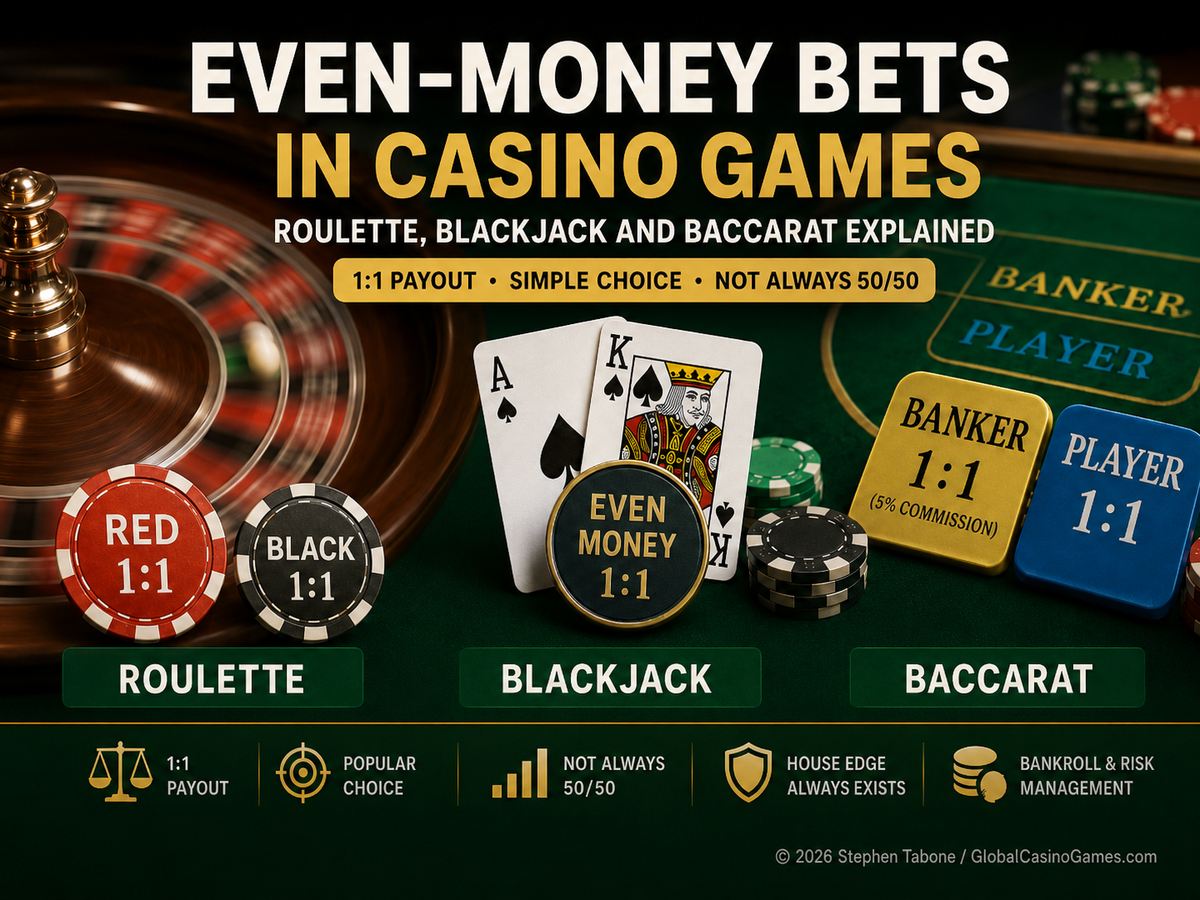
Written by Stephen Tabone for Global Casino Games. Last reviewed: 29 June 2026.
Even-money bets sound simple. The phrase suggests balance, fairness and a clean 1:1 payout. Bet £10, win £10 profit if the bet wins, or lose your £10 stake if it loses.
That is the attraction. The player feels close to a 50/50 chance.
But even money does not always mean a true 50/50 bet. That is the point many players miss.
I study even-money bets, probability and randomness because they sit at the centre of roulette, baccarat and blackjack thinking. They look calmer than higher-payout wagers because the frequency of wins can be higher. But they still carry house edge, rule pressure and bankroll risk. A player can choose the quieter side of the casino and still lose if the mathematics is misunderstood.
What Is an Even-Money Bet?
An even-money bet is a wager where the winning profit equals the stake. If you stake £20 and win, you make £20 profit and usually receive £40 back in total, including your original stake.
In plain English, the payout is 1:1.
That makes even-money bets easier to understand than bets paying 5:1, 17:1 or 35:1. The player is not looking for a high-payout result. The bet feels like one side against another: red or black, odd or even, Banker or Player, the player hand or the dealer hand.
The danger is that the payout can be even while the real odds are not truly even.
Why Even-Money Bets Are Not Always 50/50
This is what I think players need to understand first. A bet can pay 1:1 without giving the player a true 50% chance of winning.
Take European roulette. Red and black look like opposite halves of the wheel, but the green zero is also there. That zero means the player is not betting into a perfect 50/50 split. The same applies to odd or even and high or low.
The casino does not need to make the game look unfair. It only needs a small mathematical gap between the payout and the true probability.
That gap is the house edge.
For a deeper breakdown of how zero changes roulette, read my guide to roulette zero, green zero and house edge.
Even-Money Bets in Roulette
In roulette, the most familiar even-money bets are red or black, odd or even, and low or high. These bets pay 1:1 and are popular because they hit more often than single-number bets.
But that does not make them safe.
On European roulette, a red or black bet has 18 winning numbers and 19 losing numbers, because zero also loses. That gives a winning chance of about 48.65% and a house edge of about 2.70%.
On American roulette, zero and double zero make the position worse. Red or black still has 18 winning numbers, but there are now 20 losing numbers. That gives a winning chance of about 47.37% and a house edge of about 5.26%.
Roulette even-money bets are useful for understanding streaks, bankroll pressure and systems such as Martingale. They are not a way to remove the casino advantage. I explain that risk in more detail in my Martingale strategy guide.
Even Money in Blackjack
Blackjack uses the phrase “even money” in a more specific way.
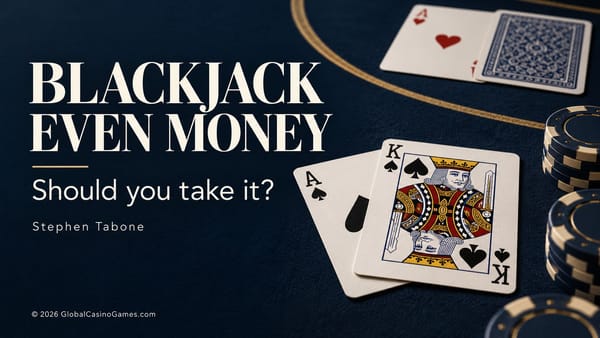
When a player has a natural blackjack and the dealer shows an Ace, the casino may offer even money. This means the player takes a guaranteed 1:1 win before the dealer checks or completes the blackjack outcome. If the player refuses and the dealer also has blackjack, the hand usually pushes and the player wins nothing. If the dealer does not have blackjack, the player normally receives the full blackjack payout, often 3:2 on better tables.
That is why even money can feel sensible. It removes uncertainty.
But mathematically it is closely connected to insurance. For ordinary players who are not counting cards, insurance-style decisions are usually poor value.
There is another important point I should make. Blackjack is not like roulette. The player’s decisions matter. Hit, stand, double, split and surrender can all change the house edge. A betting system cannot repair poor blackjack decisions.
🎰 Even-Money Simulator
Watch how the House Edge quietly impacts identical 1:1 table bets over time.
Betting Red (1:1 Payout) continuously on an American Wheel.
Taking "Even Money" (1:1) when the dealer shows an Ace.
Consistently backing the Banker Position.
Even-Money Thinking in Baccarat
Baccarat also attracts even-money thinking because the main choice appears simple: Banker or Player.
The Banker and Player bets are not identical in payout terms. Banker usually carries a small mathematical advantage, but a 5% commission is deducted from Banker wins in many traditional games. Player has no commission, but it does have a slightly higher house edge.
For the complete mathematical comparison, my Baccarat Banker bet guide explains the standard 5% commission, the Banker and Player house edges, and the payout changes used by no-commission tables.
The Tie bet may look tempting because of its larger payout, but it is much more expensive in house-edge terms. Tie is also one form of baccarat side bet, not the same type of main even-money decision as Banker or Player.
My baccarat side-bet guide compares Tie, Égalité and other optional wagers with the lower-edge Banker and Player bets, including their payouts, probabilities and house edges.
So baccarat is not just a guessing game between two equal sides. The bettor should understand Banker, Player, Tie, commission, other side bets and shoe behaviour.
Are Even-Money Bets Better Than Long-Shot Bets?
Sometimes they can be better for bankroll control because they can win more often and avoid the emotional swing of higher-payout bets.
But “better” does not mean profitable.
Even-money bets can still lose repeatedly. They can still create chasing behaviour. They can still tempt players into doubling after losses. The problem is not only the bet. The problem is how players react when bets lose three, five or ten times in a row.
That is why I treat even-money bets as a risk-management subject, not a shortcut to winning.
The Even-Money Illusion
A comparative look at 1:1 payouts versus actual mathematical win probabilities.
Can Betting Systems Work on Even-Money Bets?
Many betting systems are built around even-money bets because the structure appears simple. Martingale, Paroli, Fibonacci and 1-3-2-6 progressions often rely on the idea that a 1:1 payout can organise recovery or lead to profit-taking.
The trouble is that the house edge does not disappear. Table limits, losing streaks, commission, bankroll size and emotional pressure all remain.
A system can create rules around staking, stop random bet sizing and force the player to think before increasing risk. That can be useful as discipline. But it cannot turn a negative-expectation casino game into a guaranteed income stream.
Are Even-Money Bets Worth It?
Even-money bets are useful because they are simple, common and easy to compare across casino games. They appear in roulette, baccarat and blackjack, but each game treats them differently.
In my opinion, the key lesson is this: even money describes the payout, not the true fairness of the bet.
|
Game or bet type |
Typical payout |
Approximate winning chance |
Main issue |
|
European roulette red/black |
1:1 |
48.65% |
Single zero creates the house edge |
|
American roulette red/black |
1:1 |
47.37% |
Zero and double zero increase the house edge |
|
Baccarat Banker |
Usually 1:1 minus 5% commission |
Banker wins slightly more often than Player |
Commission reduces the payout |
|
Baccarat Player |
1:1 |
Player wins slightly less often than Banker |
Slightly higher house edge |
|
Blackjack even money |
1:1 guaranteed payout |
Depends on dealer Ace situation |
Closely linked to insurance |
This is why I do not treat even-money bets as automatically safe. The payout may look balanced, but the rules underneath the bet still matter.
At Global Casino Games, I look at even-money casino games through probability, rules, house edge, bankroll pressure and responsible gambling. My aim is not to pretend casino games can be made risk-free. Instead, my aim is to explain what the bet really means before money is placed.