Roulette 26 Strategy: Inside-Bet Hedging on the Betting Layout
The Roulette 26 Strategy builds an inside-bet hedge around number 26 using straight-ups, splits, corners, streets and six-lines. Stephen Tabone shows how the 14-chip layout works, why clustering matters, and why the 2.70% European roulette house edge still remains.

Written by Stephen Tabone for Global Casino Games. Last reviewed: 09 July 2026.
A focused look at straight-ups, splits, corners, streets and six-lines around number 26, using a real roulette wheel while remembering the 2.70% European house edge.
Roulette can be played randomly, or it can be played with structure.
That does not mean the player beats the wheel. It does not mean the house edge disappears. On a standard single-zero European roulette wheel, the casino edge is still 2.70%. Zero is still sitting there. Randomness is still randomness.
The difference is how the player approaches the betting layout.
In this article, I am looking at one inside-bet hedge built around number 26. I call it the Roulette 26 Strategy because 26 is the centre number in this example. The same type of structure can be built around other middle-column numbers, but 26 gives us a clean high-number case to study.
Stephen Tabone has studied roulette since the mid-1990s, and this is the kind of structure I prefer to analyse: not random chip chasing, not fantasy prediction, but a defined area of the table with clear payouts, clear risk and clear weaknesses.
How Does the Roulette 26 Strategy Work?
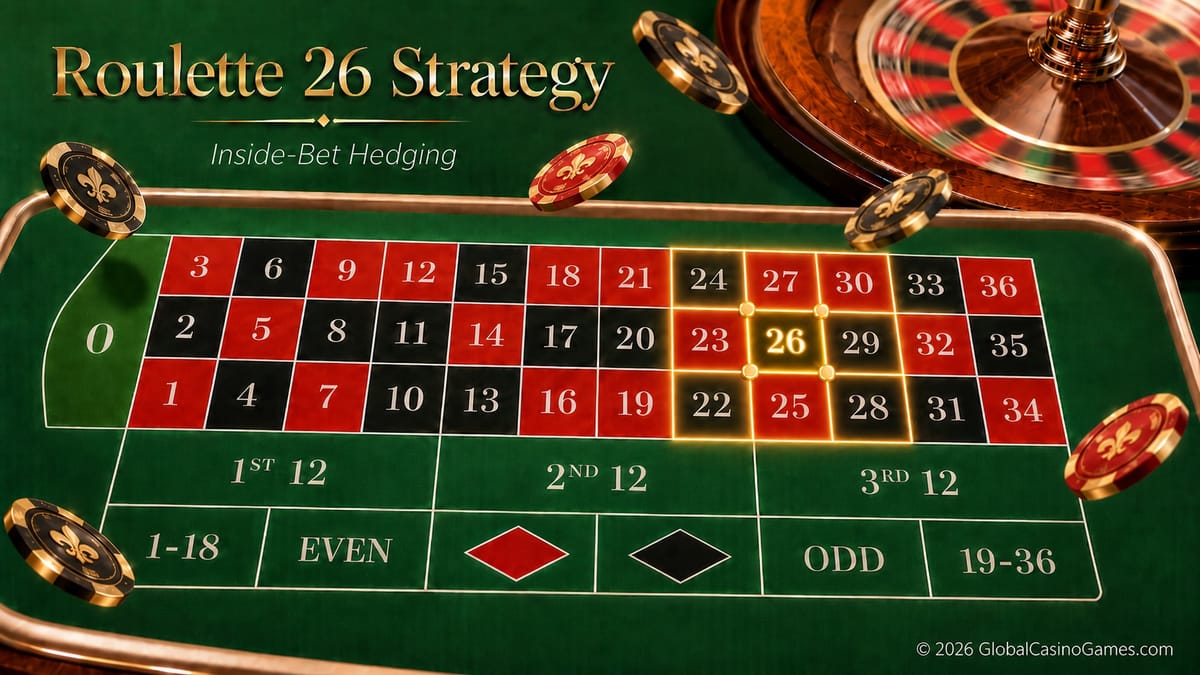
The Roulette 26 Strategy is an inside-bet hedge built around number 26 on the betting layout.
It is not a wheel-prediction method. It is not a claim that 26 is due. It is not a way to erase the roulette house edge.
It is a structured way of placing inside bets around one centre number.
Instead of picking new random numbers every spin, you choose a zone and build around it. In this case, the zone runs from 22 to 30, with 26 as the strongest point.
That gives the player a defined betting area rather than a scattered collection of chips.
Why Build the Hedge on the Inside Betting Layout?
The inside betting layout is where roulette becomes visual.
A straight-up bet covers one number. A split covers two connected numbers. A street covers three numbers. A corner covers four. A six-line covers six.
With those building blocks, you can shape risk around one number.
That is what I mean by hedging on the betting layout. I do not mean hedging in the strict financial sense. I mean placing chips around a selected number so different nearby results produce different returns.
You are still exposed to the house edge. You are still playing a negative-expectation game over the long run.
But the payout shape is different from flat even-money betting.
What Bets Build the 26-Centred Hedge?
The full 26-centred layout uses 14 chips if you place one chip on each part.
The structure is:
- one straight-up bet on 26;
- four splits: 26–27, 26–25, 26–23 and 26–29;
- four corners around 26;
- three streets: 22–23–24, 25–26–27 and 28–29–30;
- two six-lines: 22–27 and 25–30.
This covers nine numbers: 22, 23, 24, 25, 26, 27, 28, 29 and 30.
It does not cover them equally.
Number 26 is the strongest result. Numbers 25 and 27 are also strong. Numbers 23 and 29 sit in the next tier. Numbers 22, 24, 28 and 30 are lighter, but still profitable in this full version because the streets and six-lines are included.
For background on why the green pocket still controls the maths, read my roulette zero guide.
Where Do the 14 Equal-Value Chips Go?
| No. | Bet type | Place one equal-value chip here | Covers |
|---|---|---|---|
| 1 | Straight-up | Directly on 26 | 26 |
| 2 | Split | Between 25 and 26 | 25, 26 |
| 3 | Split | Between 26 and 27 | 26, 27 |
| 4 | Split | Between 23 and 26 | 23, 26 |
| 5 | Split | Between 26 and 29 | 26, 29 |
| 6 | Corner | Cross of 22, 23, 25, 26 | 22, 23, 25, 26 |
| 7 | Corner | Cross of 23, 24, 26, 27 | 23, 24, 26, 27 |
| 8 | Corner | Cross of 25, 26, 28, 29 | 25, 26, 28, 29 |
| 9 | Corner | Cross of 26, 27, 29, 30 | 26, 27, 29, 30 |
| 10 | Street | Outside edge of 22, 23, 24 | 22, 23, 24 |
| 11 | Street | Outside edge of 25, 26, 27 | 25, 26, 27 |
| 12 | Street | Outside edge of 28, 29, 30 | 28, 29, 30 |
| 13 | Six-line | Between the rows 22–24 and 25–27 | 22–27 |
| 14 | Six-line | Between the rows 25–27 and 28–30 | 25–30 |
What Does the 14-Chip Roulette Hedge Pay?
Here is the 26-centred layout using one chip on each bet.
|
Result |
Gross return |
Net result after 14-chip stake |
|
22 |
27 chips |
+13 chips |
|
23 |
54 chips |
+40 chips |
|
24 |
27 chips |
+13 chips |
|
25 |
60 chips |
+46 chips |
|
26 |
168 chips |
+154 chips |
|
27 |
60 chips |
+46 chips |
|
28 |
27 chips |
+13 chips |
|
29 |
54 chips |
+40 chips |
|
30 |
27 chips |
+13 chips |
|
Any uncovered number |
0 chips |
-14 chips |
In this table, “gross return” means the payout plus the stake back on the winning parts of the layout only. It does not mean all 14 chips come back on every covered result. The losing parts of the layout still lose on the same spin. For example, when 26 lands, the straight-up, four splits, four corners, the middle street and both six-lines win, but the two outside streets, 22–24 and 28–30, still lose.
This is the full flat-bet version. Every chip has the same value. If one chip is £1, the structure costs £14 per spin. If one chip is £5, the structure costs £70 per spin.
This is why the structure can feel powerful.
You are not just betting on 26. You are building a weighted zone around 26. If 26 lands, the return is very strong. If 25 or 27 lands, the return is still strong. If 22, 24, 28 or 30 lands, the layout still makes a profit.
The weakness is just as clear. The structure loses to zero, every low number from 1 to 18, and the high numbers outside the covered zone: 19, 20, 21 and 31 to 36.
What Are the Odds of the 26 Strategy Winning?
The structure covers nine numbers out of 37 possible European roulette results.
That means the layout covers 24.32% of the wheel.
On a pure average, that is roughly one covered hit every 4.11 spins.
But roulette does not land on schedule.
The covered zone may miss for 15 spins. It may hit twice in five spins. It may suddenly throw out 26, 29 and 25 close together.
That is why clustering matters.
The strategy is not trying to make every spin safe. It is trying to catch a short run where the covered zone starts producing results while you are actually playing.
What Happens Over a 37-Spin Model?
Now look at the clean mathematical model.
The full Roulette 26 layout uses 14 equal-value chips per spin. Over 37 spins, the total outlay is:
14 × 37 = 518 chips.
Now imagine every European roulette number lands once: zero, then 1 to 36.
The covered numbers are 22, 23, 24, 25, 26, 27, 28, 29 and 30. If each of those nine numbers lands once, the gross returns, including the winning stakes back, are:
- 22 returns 27 chips
- 23 returns 54 chips
- 24 returns 27 chips
- 25 returns 60 chips
- 26 returns 168 chips
- 27 returns 60 chips
- 28 returns 27 chips
- 29 returns 54 chips
- 30 returns 27 chips
Together, those nine covered results return 504 chips.
The other 28 results return nothing because they are outside the layout.
So the full 37-number model is:
518 chips staked
504 chips returned
= 14 chips lost overall
This includes the winning stakes returned. It still finishes 14 chips down because roulette payouts are built around 36 winning units, while the European wheel has 37 possible outcomes including zero.
Another way to see it is this: each separate inside bet loses one chip across a perfect 37-number cycle. A straight-up, split, corner, street or six-line all return 36 chips across their winning numbers after 37 chips have been staked. This layout has 14 separate bets, so the clean 37-number model loses 14 chips.
That 14-chip loss on 518 chips staked is 2.70%, which is the European roulette house edge showing through the structure.
Is the 26 Strategy Better Than Covering 35 Roulette Numbers?
Another way to understand the Roulette 26 Strategy is to compare it with a very different approach: covering 35 straight-up numbers and leaving two numbers out.
On a European roulette wheel, there are 37 outcomes: numbers 1 to 36 plus zero. If you placed one straight-up chip on 35 different numbers, the layout would cost 35 chips per spin.
If one of your covered numbers landed, the winning straight-up would return 36 chips including the stake back.
So the spin would make only 1 chip profit.
That sounds safe because you are covering most of the wheel. But the danger is heavy. If either of the two uncovered numbers lands, the whole 35-chip layout loses.
Over a clean 37-number cycle where every number lands once, the result would be:
35 covered wins × 1 chip profit = +35 chips
2 uncovered losses × 35 chips = -70 chips
Final result = -35 chips overall
That is still the 2.70% European roulette house edge.
The Roulette 26 Strategy works differently.
It covers only nine numbers, so it is not trying to survive nearly every spin. It will lose more often than a 35-number cover. But the loss per losing spin is 14 chips, not 35 chips. More importantly, the covered wins are not just tiny 1-chip profits.
If 22, 24, 28 or 30 land, the structure still makes a smaller profit. If 23 or 29 land, the return is stronger. If 25 or 27 land, it is stronger again. If 26 lands, the return is the best result in the whole layout.
That is why I prefer this kind of structure.
Covering 35 numbers gives you a high hit rate, but most wins are only 1 chip, and the two missed numbers are expensive. The 26 structure gives you fewer winning spins, but better payout potential when the right zone lands.
It does not beat the house edge.
But it gives the player a different risk shape: smaller total stake per spin, clearer zone focus, and stronger upside when the covered numbers cluster at the right time.
Why Does Clustering Matter in the Roulette 26 Strategy?
Real casino sessions do not usually unfold as neat 37-spin cycles.
You might play 10 spins, 15 spins or 20 spins. You might watch first and wait. You might stop early. You might leave after the zone hits. You might refuse to play every spin.
That is where timing becomes important.
If you bet £14 on red and red hits three times in a row, you are £42 up.
If you play this 26-centred structure at £1 per chip and 26 hits three times, those three winning spins would produce £462 net profit from those spins alone. That figure already deducts the full £14 layout cost on each of those winning spins.
That is not because the house edge vanished. It is because the payout structure is different.
Inside-bet hedging gives different payout potential. It can punish you when the zone goes cold, but it can also reward you sharply when the right part of the layout clusters.
That is the fine line: break-even, slightly down, badly down, slightly up or strongly up can depend on when you start, when you stop, and which covered numbers actually land.
Why Can Online Roulette Suit This Strategy?
This kind of structure is easier to play online, especially on live-dealer roulette with a real wheel.
In a land-based casino, placing the same 14-chip layout again and again can be tiring. Other players may be reaching across the table. Different chip colours can overlap. Someone may place a chip over yours. Hands move in quickly. You blink, and suddenly you are checking whether you covered every split, corner, street and six-line correctly.
It can become confusing.
Online roulette often solves that practical problem.
Many live roulette interfaces allow repeat bet, rebet or saved layouts. That means you can build the 26 structure once, repeat it when you choose, and skip spins when you do not want to play.
That matters because this article is not about betting every spin.
The point is not to sit there mechanically pressing repeat forever. The point is to have a structure ready for the moments when you decide the zone is worth playing.
This article is also focused on flat betting. I am not dealing here with increasing stakes, decreasing stakes or progression betting. For a separate test of staking systems, read my Martingale, Paroli and flat betting test.
Is the Roulette 26 Strategy Better Than Random Number Chasing?
In my opinion, yes, as a structure.
That does not mean it is mathematically positive. It means it is more organised than changing numbers every spin with no plan.
I once watched a player in a London casino placing around 10 chips on different straight-up numbers every spin. It looked random. Around 20 spins passed, and he did not catch one winning number. Not one chip. He looked across the table, shook his head, and I shrugged as if to say: what can you do?
That is roulette.
Randomness is invisible until the result lands. After the ball drops, everyone can see the answer. Before that, the player is trying to position risk.
A structured layout does not force the result. It gives you a defined area, a centre number and a payout map.
That is the difference.
Can the 26 Strategy Pivot Between Low and High?
Yes.
The 26 example sits fully in the high section because it covers 22 to 30.
Other centre numbers can cross the low/high boundary. For example, a structure around 20 can cover 16 to 24. That gives you some low numbers and some high numbers.
A structure around 17 can cover 13 to 21, again crossing the boundary.
That creates another form of hedge. You may mainly be looking at one side of the table, but still have three numbers covered on the other side.
Again, this does not beat the house edge. It simply changes the shape of the risk.
The 26 Strategy
System Architecture Blueprint
- Combines 1 straight-up, 4 splits, 4 corners, 3 streets, and 2 six-lines.
- Every single hit within the covered 22–30 spectrum returns a session profit.
- The standard European single-zero house edge remains exactly 2.70%.
- Relies on numbers clustering during short, disciplined dealer sessions.
Why This Roulette 26 Strategy Is Built for a Real Wheel
For this article, I am talking about a fair real wheel.
That includes a physical live-dealer wheel, including online live roulette where the ball and wheel are real. I am not talking about RNG roulette, electronic roulette, air wheels or computer-generated outcomes.
After studying roulette for many years, you do get a feel for the real wheel: the way results land, the way patterns form, the way outcomes cluster and disappear.
That does not mean the next result can be known. It means the experienced player begins to understand the rhythm of real-wheel randomness.
Stephen Tabone is not presenting this as a guaranteed system. Global Casino Games is presenting it as a structured inside-bet hedge with clear maths, clear payout potential and clear risk.
Roulette 26 Strategy: Common Questions About Inside-Bet Hedging
Is the Roulette 26 Strategy a guaranteed winning system?
No. The Roulette 26 Strategy does not guarantee profit. It is an inside-bet structure around number 26. It can produce strong returns when the covered zone clusters, but it does not remove the 2.70% European roulette house edge.
How many numbers does the 26-centred layout cover?
It covers nine numbers: 22, 23, 24, 25, 26, 27, 28, 29 and 30. The structure uses straight-up, split, corner, street and six-line bets to weight the layout around 26.
Why is 26 the strongest number in the layout?
Number 26 is the centre of the structure. If 26 lands, it catches the straight-up, four splits, four corners, the middle street and both six-lines. That creates the biggest return in the example.
Is online roulette better for this type of layout?
Online live-dealer roulette can be more convenient because many interfaces allow repeat bets or saved layouts. That reduces the practical difficulty of placing the same inside-bet structure repeatedly on a busy land-based table.
Does Global Casino Games recommend increasing stakes with this strategy?
No. This article focuses on flat betting and layout structure. Global Casino Games treats stake increases, Martingale-style systems and progression betting as separate risk topics because they can change bankroll pressure very quickly.
Is the Roulette 26 Strategy Really About Beating the Wheel?
The Roulette 26 Strategy is not about pretending the wheel can be controlled.
It is about structure, timing and risk placement.
Instead of chasing different numbers every spin, you choose a defined part of the betting layout. You know your strongest number. You know your weaker covered numbers. You know what happens if the ball lands outside the zone.
That makes the approach more disciplined than random chip spreading.
The opportunity comes from timing and clustering. If the 22 to 30 zone starts hitting while you are playing, especially if 26, 25, 27, 23 or 29 appear, the payout potential can be much stronger than flat even-money betting.
The danger is just as clear. If the zone goes cold, the 14-chip stake can disappear quickly.
That is why I see this as a risk map, not a magic formula. The layout helps you organise the bet. The real wheel still decides the result.
For more on roulette structure and why I prefer systems built around discipline rather than guesswork, read The Roulette Supernova System.